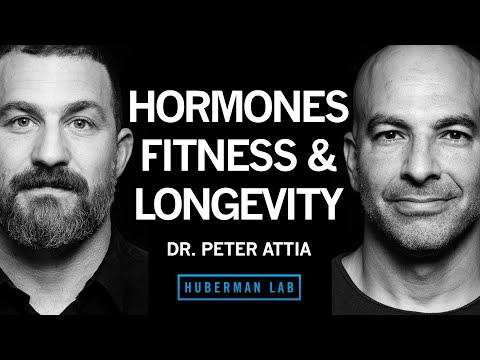
Exercise, Nutrition, Hormones for Vitality & Longevity | Dr. Peter Attia
Andrew Huberman (host), Peter Attia (guest)
In this episode of Huberman Lab, featuring Andrew Huberman and Peter Attia, Exercise, Nutrition, Hormones for Vitality & Longevity | Dr. Peter Attia explores attia And Huberman Redefine Longevity: Data-Driven Blueprint For Vitality Andrew Huberman and physician Peter Attia outline a comprehensive, data-driven framework for extending both lifespan and healthspan, with special emphasis on exercise, metabolic health, blood work, and hormones. Attia distinguishes between lifespan (avoiding early death from the "four horsemen": atherosclerosis, cancer, neurodegeneration, metabolic disease) and healthspan (cognitive, physical, emotional function).
Attia And Huberman Redefine Longevity: Data-Driven Blueprint For Vitality
Andrew Huberman and physician Peter Attia outline a comprehensive, data-driven framework for extending both lifespan and healthspan, with special emphasis on exercise, metabolic health, blood work, and hormones. Attia distinguishes between lifespan (avoiding early death from the "four horsemen": atherosclerosis, cancer, neurodegeneration, metabolic disease) and healthspan (cognitive, physical, emotional function).
They explain which lab markers truly matter (ApoB, LP(a), insulin-related markers, bone density, visceral fat) and how often to test them, arguing that most people should be screened earlier and more thoroughly than current norms. Attia presents concrete strength and aerobic benchmarks that dramatically reduce all-cause mortality risk and emphasizes backcasting from one’s “marginal decade” to decide what to train now.
The conversation also covers nuanced takes on HRT in women, testosterone therapy in men, cholesterol and ApoB management, and the promise and limits of emerging tools like GLP‑1 agonists, rapamycin, and metabolomics. Throughout, Attia insists that drugs and supplements are secondary to getting exercise, sleep, and emotional health in order.
Key Takeaways
Use Blood Work To Predict And Prevent The Big Killers, Not Just “Check Labs”
Attia frames blood work around two goals: reducing risk from atherosclerosis, cancer, neurodegeneration, and metabolic disease (lifespan), and supporting cognitive, physical, emotional function (healthspan). ...
Get the full analysis with uListen
DEXA Is Far More Valuable Than A Scale For Long-Term Health
Attia considers standard weight and BMI crude. ...
Get the full analysis with uListen
Strength And Cardiorespiratory Fitness Are Among The Strongest Predictors Of Survival
Low muscle mass and especially low strength are associated with roughly a 2–3. ...
Get the full analysis with uListen
Backcast From Your “Marginal Decade” To Decide How To Train Now
Attia has patients define their “marginal decade”—the last 10 years of life—and describe, in detail, what they want to be able to do (play on the floor with grandkids, travel, carry groceries, hike, toilet independently). ...
Get the full analysis with uListen
HRT In Women Was Mishandled; Modern Bioidentical Protocols Look Very Different
Attia calls the fallout from the Women’s Health Initiative (WHI) “the biggest screw-up” in recent medicine. ...
Get the full analysis with uListen
TRT Should Target Free Testosterone And Health Goals, Not Big Numbers
Attia emphasizes free testosterone (and estradiol in the 30–50 pg/mL range) over total T. ...
Get the full analysis with uListen
ApoB, Not LDL-C Alone, Should Drive Cardiovascular Prevention Strategy
LDL cholesterol is a concentration of cholesterol in LDL particles, but the atherogenic driver is ApoB—the number of ApoB-containing lipoproteins (LDL, VLDL, etc). ...
Get the full analysis with uListen
Notable Quotes
“You have to be able to articulate what it is you want in your marginal decade… until a person can tell you what it is that they want to be doing in that last decade, you can't design a program to get them there.”
— Peter Attia
“The gravity of aging is more vicious than people realize, and therefore the height of your glider needs to be much higher than you think it is when you're our age if you want to be able to do the things we probably want to be able to do when we're 90.”
— Peter Attia
“Cardiorespiratory fitness is probably the single strongest association I've seen for any modifiable behavior… comparing the bottom 25% to the top 2.5% you're talking about 5X, a 400% difference in all-cause mortality.”
— Peter Attia
“On the list of things that you can do to make your brain a little more focused, I would consider [low-dose nicotine] infinitely safer than what a lot of people are doing, which is using stimulants.”
— Peter Attia
“I don't think I will be able to think of a bigger act of incompetence than what happened with the Women's Health Initiative in the late '90s and early 2000s.”
— Peter Attia
Questions Answered in This Episode
You mentioned that reaching childhood ApoB levels (~20–30 mg/dL) could make atherosclerosis almost an orphan disease. For someone with currently “normal” ApoB, what specific diet and drug combination would you actually implement to try to get them into that range, and how would you sequence the interventions?
Andrew Huberman and physician Peter Attia outline a comprehensive, data-driven framework for extending both lifespan and healthspan, with special emphasis on exercise, metabolic health, blood work, and hormones. ...
Get the full analysis with uListen AI
In your marginal decade framework, what are the minimum realistic strength and VO2 max targets you’d accept for a 90-year-old who wants to live independently, and how would your training prescription differ for a 40-year-old who is currently far below those trajectories?
They explain which lab markers truly matter (ApoB, LP(a), insulin-related markers, bone density, visceral fat) and how often to test them, arguing that most people should be screened earlier and more thoroughly than current norms. ...
Get the full analysis with uListen AI
Given your strong critique of the Women’s Health Initiative, how would you advise a 52-year-old woman who is 8 years post-menopause, never took HRT because of WHI fears, and now presents with osteopenia and cognitive complaints—is there still a window where bioidentical HRT makes sense, or is it too late?
The conversation also covers nuanced takes on HRT in women, testosterone therapy in men, cholesterol and ApoB management, and the promise and limits of emerging tools like GLP‑1 agonists, rapamycin, and metabolomics. ...
Get the full analysis with uListen AI
For a 35-year-old man with normal total testosterone but low free T due to very high SHBG, who is also prediabetic, what would your stepwise plan look like—lifestyle, supplements if any, and pharmacology—before you even consider exogenous testosterone?
Get the full analysis with uListen AI
You were fairly skeptical of current stem cell and peptide practices but enthusiastic about rapamycin and GLP‑1 agonists. What specific study design (population, endpoints, duration) would convince you that a given peptide or stem cell protocol truly improves healthspan and not just short-term symptoms?
Get the full analysis with uListen AI
Transcript Preview
(uptempo music) Welcome to the Huberman Lab Podcast, where we discuss science and science-based tools for everyday life. I'm Andrew Huberman, and I'm a professor of neurobiology and ophthalmology at Stanford School of Medicine. Today, my guest is Dr. Peter Attia. Dr. Attia is a physician who's focused on nutritional, supplementation-based, behavioral, prescription drug, and other interventions that promote healthspan and lifespan. His expertise spans from exercise physiology to sleep physiology, emotional and mental health, and pharmacology. Today, we talk about all those areas of health, starting with the very basics, such as how to evaluate one's own health status and how to define one's health trajectory. We also talk about the various sorts of interventions that one can take in order to optimize vitality while also extending longevity, that is, lifespan. Dr. Attia is uniquely qualified to focus on the complete depth and breadth of topics that we cover, and indeed, these are the same topics that he works with his patients on in his clinic every day. Dr. Attia earned his Bachelor of Science in mechanical engineering and applied mathematics and his MD from Stanford University School of Medicine. He then went on to train at Johns Hopkins Hospital in general surgery, one of the premier hospitals in the world, where he was the recipient of several prestigious awards, including Resident of the Year. He's been an author on comprehensive reviews of general surgery. He spent two years at the National Institutes of Health as a surgical oncology fellow at the National Cancer Institute, where his work focused on immune-based therapies for melanoma. In the fields of science and medicine, it is well-understood that we are much the product of our mentors and the mentoring we receive. Dr. Attia has trained with some of the best and most innovative lipidologists, endocrinologists, gynecologists, sleep physiologists, and longevity scientists in the United States and Canada. So, the expertise that funnels through him and that he shares with us today is really harnessed from the best of the best and his extensive training and expertise. By the end of today's episode, you will have answers to important basic questions such as, should you have blood work? How often should you do blood work? What specific things should you be looking for on that blood work that are either counterintuitive or not often discussed and yet that immediately and in the long term influence your lifespan and healthspan? We talk about hormone health and hormone therapies for both men and women. We talk about drug therapies that can influence the mind as well as the body. And of course, we talk about supplementation, nutrition, exercise, and predictors of lifespan and healthspan. It is an episode rich with information. For some of you, you may want to get out a pen and paper in order to take notes. For others of you that learn better simply by listening, I just want to remind you that we have timestamped all this information so that you can go back to the specific topics most of interest to you. I'm pleased to announce that the Huberman Lab Podcast is now partnered with Momentous supplements. We partnered with Momentous for several important reasons. First of all, they ship internationally because e- we know that many of you are located outside of the United States. Second of all, and perhaps most important, the quality of their supplements is second to none, both in terms of purity and precision of the amounts of the ingredients. Third, we've really emphasized supplements that are single ingredient supplements and that are supplied in dosages that allow you to build a supplementation protocol that's optimized for cost, that's optimized for effectiveness, and that you can add things and remove things from your protocol in a way that's really systematic and scientific. If you'd like to see the supplements that we partner with Momentous on, you can go to livemomentous.com/huberman. There, you'll see those supplements and just keep in mind that we are constantly expanding the library of supplements available through Momentous on a regular basis. Again, that's livemomentous.com/huberman. Before we begin, I'd like to emphasize that this podcast is separate from my teaching and research roles at Stanford. It is, however, part of my desire and effort to bring zero cost to consumer information about science and science-related tools to the general public. In keeping with that theme, I'd like to thank the sponsors of today's podcast. Our first sponsor is Thesis. Thesis makes custom nootropics that are designed for your unique needs. And to be honest, I'm not a fan of the word nootropics because nootropics means smart drugs, and to be honest, there is no such thing as a smart drug because there's no neural circuit for being smart. There are neural circuits rather for being creative or for task switching or for focus. And as we all know, different sorts of demands, whether or not they are cognitive or physical, require different types of cognitive and physical abilities. Thesis understands this and has created a kit of custom nootropics that are tailored to your needs. To get your own personalized nootropic starter kit, you can go to takethesis.com/huberman, take their three-minute quiz, and Thesis will send you four different formulas to try in your first month. That's takethesis.com/huberman and use the code Huberman at checkout to get 10% off your first box of custom nootropics. Today's episode is also brought to us by InsideTracker. InsideTracker is a personalized nutrition platform that analyzes data from your blood and DNA to help you better understand your body and help you reach your health goals. I've long been a believer in getting regular blood work done for the simple reason that many of the factors that impact your immediate and long-term health can only be assessed from a quality blood test. And nowadays, with the advent of modern DNA tests, you can also analyze, for instance, what your biological age is and compare it to your chronological age, and obviously it's your biological age that really matters.The challenge with a lot of blood tests and DNA tests, however, is that you get information back about metabolic factors, hormones, and so forth, but you don't know what to do with that information. InsideTracker makes it very easy to know what to do with that information to optimize your health. They have a personalized platform, it's a dashboard that you go to. You can click on the level of any hormone, metabolic factor, lipid, et cetera, and it will tell you the various sorts of interventions based on nutrition, supplementation, et cetera, that you can use to bring those numbers into the ranges that are ideal for you. If you'd like to try InsideTracker, you can visit insidetracker.com/huberman to get 20% off any of InsideTracker's plans. That's insidetracker.com/huberman to get 20% off. Today's episode is also brought to us by Helix Sleep. Helix Sleep makes mattresses and pillows that are of the absolute highest quality. They also have some really unique features because they are customized to your unique sleep needs. I've talked over and over again on this podcast and on other podcasts about the fact that sleep is the foundation of mental health, physical health, and performance. There's just simply no other substitute for a quality night's sleep on a regular basis. I've been sleeping on a Helix mattress for well over a year now, and it's the best sleep that I've ever had, and that's in large part because the mattress was designed for me. What you need to know, however, is what's the ideal mattress for you? And you can do that by going to Helix site. You can take their brief quiz, which will ask you, "Do you sleep on your side, your back, your stomach, or maybe you don't know, or maybe all three. Do you tend to run hot or cold in the night? Maybe you know, maybe you don't." At the end of that short quiz they will match you to the ideal mattress for you. I matched to the Dusk, the D-U-S-K, mattress, but again, that's what I need, that's not necessarily what you need in order to get your best night's sleep. But if you're interested in upgrading your mattress, go to helixsleep.com/huberman, take their two-minute sleep quiz, and they'll match you to a customized mattress for you, and you'll get up to $200 off any mattress order and two free pillows. They have terrific pillows. And you get to try out that mattress for 100 nights risk-free. They'll even pick it up for you if you don't love it, but I'm certain you will. Again, if you're interested, you can go to helixsleep.com/huberman for up to $200 off your mattress order and two free pillows. And now for my discussion with Dr. Peter Attia. Peter, thanks for joining me today.
Install uListen to search the full transcript and get AI-powered insights
Get Full TranscriptGet more from every podcast
AI summaries, searchable transcripts, and fact-checking. Free forever.
Add to Chrome