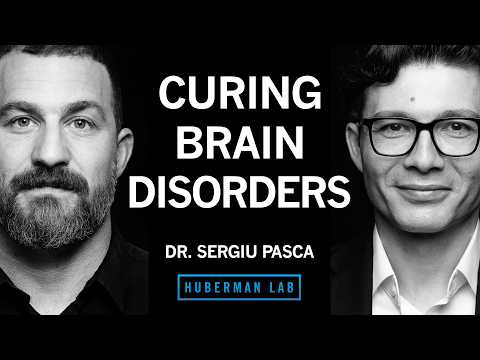
Curing Autism, Epilepsy & Schizophrenia with Stem Cells | Dr. Sergiu Pașca
Andrew Huberman (host), Dr. Sergiu Pașca (guest)
In this episode of Huberman Lab, featuring Andrew Huberman and Dr. Sergiu Pașca, Curing Autism, Epilepsy & Schizophrenia with Stem Cells | Dr. Sergiu Pașca explores building Miniature Human Brain Circuits To Treat Devastating Psychiatric Disease Neuroscientist and psychiatrist Dr. Sergiu Pașca explains how induced pluripotent stem cells, brain organoids, and assembloids are transforming our ability to study and potentially cure severe neurodevelopmental and psychiatric disorders such as profound autism, epilepsy, and schizophrenia.
Building Miniature Human Brain Circuits To Treat Devastating Psychiatric Disease
Neuroscientist and psychiatrist Dr. Sergiu Pașca explains how induced pluripotent stem cells, brain organoids, and assembloids are transforming our ability to study and potentially cure severe neurodevelopmental and psychiatric disorders such as profound autism, epilepsy, and schizophrenia.
He clarifies what autism is and is not, why its diagnosed prevalence is rising, and why genetics—not vaccines or single environmental factors—currently provide the strongest, most actionable insights.
Pașca describes how his lab can now recreate patient‑specific human brain circuits in dishes and in animals, track their development over years, and identify precise molecular defects that are invisible in traditional animal models.
These approaches have already yielded a first‑in‑kind, stem‑cell–based therapeutic candidate for a rare, severe autism‑epilepsy syndrome (Timothy syndrome), with a clinical trial in preparation, while raising new but tractable ethical questions about organoids, transplantation, and future gene and cell therapies.
Key Takeaways
Autism is a behaviorally defined, highly heterogeneous set of disorders with strong genetic underpinnings, not a single disease.
Autism currently affects close to 3% of the population and is diagnosed entirely on behavior—there is no biomarker. ...
Get the full analysis with uListen
The rise in autism diagnoses is real but cannot yet be fully explained; better diagnostics and shifting categories account for part, but not all, of the increase.
Changes in diagnostic criteria, greater awareness, and diagnostic migration (e. ...
Get the full analysis with uListen
iPSC‑derived brain organoids and assembloids allow direct study of living human brain cells and circuits from specific patients, overcoming major limits of animal models.
By reprogramming a patient’s skin cell into an induced pluripotent stem cell (via Yamanaka factors) and then into 2D neurons or 3D organoids, Pașca’s lab can watch human cortical development unfold over months to years in vitro. ...
Get the full analysis with uListen
Timothy syndrome illustrates how stem‑cell models can demystify a psychiatric disorder down to a single nucleotide change and guide a precise molecular therapy.
Timothy syndrome is caused by a single base mutation in a calcium channel gene expressed in heart and brain, leading to cardiac issues, epilepsy, and profound autism. ...
Get the full analysis with uListen
Many current “stem cell therapies” marketed abroad for autism and other brain conditions are scientifically unjustified and potentially dangerous.
Parents are flying children to clinics in South America and parts of Europe for intravenous, intrathecal, or even intracranial “stem cell” infusions of unclear provenance—sometimes their own cells, sometimes umbilical cells, sometimes unknown donor cells. ...
Get the full analysis with uListen
Gene therapy and CRISPR hold promise but face delivery, timing, and specificity constraints; targeting RNA or downstream pathways is often more practical for brain disorders today.
Classical gene therapy often uses viral vectors (AAV, lentivirus) to add a missing gene or enzyme, or CRISPR to edit DNA. ...
Get the full analysis with uListen
Ethical concerns around organoids and chimeras are serious but manageable, and precise language is central to responsible progress.
Neural organoids and assembloids are not “mini brains”; they are region‑limited, non‑sentient tissues lacking whole‑brain architecture, body, and the structures needed for consciousness as we understand it. ...
Get the full analysis with uListen
Notable Quotes
“Autism is not one disease. It’s more like fever in the 19th century: a behavioral syndrome that will eventually break down into many different biological conditions with different treatments.”
— Dr. Sergiu Pașca
“The unbearable inaccessibility of the human brain is one of the main reasons we’ve made such slow progress in understanding psychiatric disorders.”
— Dr. Sergiu Pașca
“What Yamanaka did was almost like biological alchemy: taking a skin cell and turning it back into something like embryonic stem cells.”
— Dr. Sergiu Pașca
“These cells in organoids keep time. After about nine months in a dish they switch to a postnatal molecular signature, even though there is no birth, no hormones, nothing changing in the medium.”
— Dr. Sergiu Pașca
“With Timothy syndrome we’ve gone from a point mutation to a detailed molecular mechanism to a candidate therapy that reverses every cellular defect we’ve measured—all using human stem cell models.”
— Dr. Sergiu Pașca
Questions Answered in This Episode
In your Timothy syndrome work, what specific in vitro or in vivo phenotype convinced you that the antisense‑like nucleic acid therapy was targeting the true causal mechanism rather than a downstream epiphenomenon?
Neuroscientist and psychiatrist Dr. ...
Get the full analysis with uListen AI
Given that organoids track human developmental timing so faithfully, have you seen any conditions where environmental manipulations (e.g., cytokines, hypoxia, hormones) can accelerate, delay, or desynchronize this intrinsic developmental ‘timer’?
He clarifies what autism is and is not, why its diagnosed prevalence is rising, and why genetics—not vaccines or single environmental factors—currently provide the strongest, most actionable insights.
Get the full analysis with uListen AI
For 22q11.2 deletion syndrome and other variably penetrant mutations, how are you using organoids and assembloids to dissect why some carriers develop schizophrenia or autism while others remain relatively unaffected?
Pașca describes how his lab can now recreate patient‑specific human brain circuits in dishes and in animals, track their development over years, and identify precise molecular defects that are invisible in traditional animal models.
Get the full analysis with uListen AI
When you transplant human organoids into neonatal rat cortex, what concrete criteria (beyond absence of pain behavior changes) would you use to decide that the level of human–rat integration has become ethically concerning—for example, in terms of learning capacity or altered rat behavior?
These approaches have already yielded a first‑in‑kind, stem‑cell–based therapeutic candidate for a rare, severe autism‑epilepsy syndrome (Timothy syndrome), with a clinical trial in preparation, while raising new but tractable ethical questions about organoids, transplantation, and future gene and cell therapies.
Get the full analysis with uListen AI
If we eventually can safely and precisely modulate neuronal developmental timing or rejuvenate specific brain circuits using insights from organoids, where do you personally draw the line between treating profound disease and enhancing normal traits such as memory or cognitive speed?
Get the full analysis with uListen AI
Transcript Preview
Welcome to the Huberman Lab podcast, where we discuss science and science-based tools for everyday life. I'm Andrew Huberman, and I'm a professor of neurobiology and ophthalmology at Stanford School of Medicine. My guest today is Dr. Sergiu-Pasca. Dr. Sergiu-Pasca is a professor of psychiatry and behavioral sciences, and the director of the Stanford Brain Organogenesis Program. During today's episode, we discuss autism, schizophrenia, and human brain development generally, both brain development during pregnancy, as well as during childhood, and leading all the way up to our third decade of life. During today's discussion, you will get the most up-to-date information about autism and its treatments. You'll learn why the prevalence of autism is rising, the role that genes play in autism, and the novel treatments that Dr. Pasca is developing to treat what is called profound autism, which are the most severe cases of autism. Dr. Pasca is one of a small handful of researchers that pioneered the discovery and development of what are called organoids and assembloids, which are essentially human brain circuits derived from stem cells that form in a dish so that one can study them directly. And while that might sound artificial, today he explains why those organoids and assembloids are immensely powerful for understanding exactly what is wrong in psychiatric illnesses like profound autism, schizophrenia, and other psychiatric challenges, and for developing cures. So today, you're going to learn a lot about human brain development and about stem cells, which is going to be important for anyone interested in how the brain wires up, how to treat various diseases of the brain, but also for anyone who is considering stem cell therapies. As you'll soon learn, Sergiu is an extraordinary scientist, but also an extraordinary teacher. By the end of today's episode, you'll have the latest information on stem cells, organoids, autism, and what is being done to cure autism and other psychiatric conditions. Before we begin, I'd like to emphasize that this podcast is separate from my teaching and research roles at Stanford. It is, however, part of my desire and effort to bring zero-cost-to-consumer information about science and science-related tools to the general public. In keeping with that theme, today's episode does include sponsors. And now for my discussion with Dr. Sergiu-Pasca. Dr. Sergiu-Pasca, welcome.
Thank you. It's great to be here.
We're old friends.
Mm-hmm.
Shared a laboratory space years ago. We'll get back to that a little later. In the meantime, these days, there's a ton of interest and I think misunderstanding about autism. As soon as the topic of autism comes up, immediately some people will say, "Why are we trying to cure this thing? I know autistic, uh, children and adults that are delightful people that lead functional lives."
Yeah.
"They might be a little bit different, or a lot different than other people, but why are we trying to, quote-unquote, 'cure' autism?" And then other people will say, "Well, there are people with autism who need constant care, who will never live independently." Tell us about autism, what this spectrum really is, and then we'll talk about what your laboratory is doing to try and literally find cures for the most debilitating forms of autism.
Install uListen to search the full transcript and get AI-powered insights
Get Full TranscriptGet more from every podcast
AI summaries, searchable transcripts, and fact-checking. Free forever.
Add to Chrome