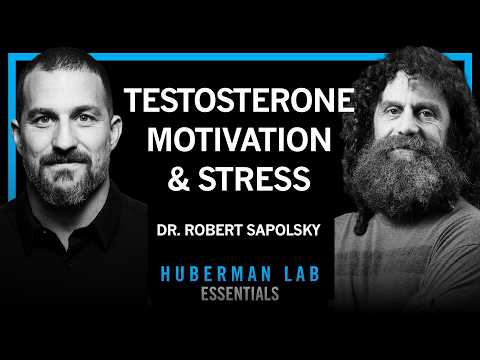
Essentials: Science of Stress, Testosterone, Aggression & Motivation | Dr. Robert Sapolsky
Andrew Huberman (host), Robert Sapolsky (guest)
In this episode of Huberman Lab, featuring Andrew Huberman and Robert Sapolsky, Essentials: Science of Stress, Testosterone, Aggression & Motivation | Dr. Robert Sapolsky explores decoding Stress, Hormones, and Status: Sapolsky Rewrites Human Motivation Andrew Huberman and Robert Sapolsky explore the biology of stress, hormones, and social hierarchies, emphasizing how perception and context radically shape physiological responses.
Decoding Stress, Hormones, and Status: Sapolsky Rewrites Human Motivation
Andrew Huberman and Robert Sapolsky explore the biology of stress, hormones, and social hierarchies, emphasizing how perception and context radically shape physiological responses.
They challenge common myths about testosterone, reframing it as an amplifier of existing tendencies and a status-protection hormone rather than a simple aggression or sex drive molecule.
Dopamine and testosterone are discussed as intertwined drivers of motivation and goal-directed behavior, while estrogen emerges as a powerful yet underappreciated protector of brain and cardiovascular health.
The conversation closes on how stress management, choice, prefrontal cortex framing, and the explosion of social media contexts influence health, self-esteem, and our sense of status.
Key Takeaways
Short-term stress can be beneficial, but chronic psychological stress is biologically damaging.
Acute stress in the right dose functions as stimulation—like rollercoasters or suspenseful movies—and can be physiologically similar to excitement. ...
Get the full analysis with uListen
Valence—whether something feels exciting or terrifying—depends heavily on amygdala involvement.
Physiologically, positive excitement and negative fear look very similar: elevated heart rate, fast breathing, muscle activation, overlapping brain circuits. ...
Get the full analysis with uListen
Testosterone does not cause aggression; it amplifies existing tendencies and status-related behaviors.
Sapolsky emphasizes that testosterone lowers the threshold for aggression when aggression is already primed; it turns up the volume on aggressive circuits rather than creating them. ...
Get the full analysis with uListen
Testosterone primarily responds to status challenges and boosts whatever your culture uses to grant status.
The “challenge hypothesis” suggests testosterone surges when status is threatened and promotes behaviors that defend or gain status. ...
Get the full analysis with uListen
Testosterone increases confidence and motivation—but can also impair cooperation and risk assessment.
Elevated testosterone improves energy, presence, and motivation, which can be beneficial in aging or low-energy contexts. ...
Get the full analysis with uListen
Dopamine and testosterone jointly drive anticipation, motivation, and outward goal focus—more than pure pleasure.
Dopamine is now understood as the neurochemical of anticipation and goal-directed effort, not simple reward. ...
Get the full analysis with uListen
Estrogen is a major neuroprotective hormone, especially for cognition and cardiovascular health.
High physiological estrogen supports cognition, hippocampal neurogenesis, glucose and oxygen delivery to the brain, and protection against dementia and vascular damage. ...
Get the full analysis with uListen
Perception, control, and choice fundamentally shape whether stress harms or helps.
In the yoked rat wheel experiment, the voluntary runner gained all the benefits of exercise, while the forced runner experienced severe stress, despite identical physical activity. ...
Get the full analysis with uListen
Stress-mitigation techniques only work if they fit you and are prioritized consistently.
Meditation, exercise, breathing practices, prayer, gratitude, and similar tools reduce physiological stress on average, but only when they’re personally tolerable and done regularly (20–30 minutes most days), not just “on weekends” or during brief annoyances. ...
Get the full analysis with uListen
The prefrontal cortex can reframe status and threat—both protecting and sabotaging us.
Humans can belong to multiple hierarchies simultaneously and use cognition to downgrade the importance of one (e. ...
Get the full analysis with uListen
Notable Quotes
“Testosterone does no such thing. It doesn't cause aggression... It makes systems that are already turned on turn on louder.”
— Robert Sapolsky
“What testosterone does is make you more of whatever you already are in that domain.”
— Robert Sapolsky
“If you got a choice in the matter between having a lot of estrogen in your bloodstream or not, go for having a lot of estrogen.”
— Robert Sapolsky
“It's the interpretation in your head.”
— Robert Sapolsky
“You can feel miserable about yourself in ways that no other organism can.”
— Robert Sapolsky
Questions Answered in This Episode
In real-world settings, how could we systematically redesign status systems—schools, workplaces, online platforms—so that testosterone amplifies pro-social behaviors like generosity and cooperation rather than aggression?
Andrew Huberman and Robert Sapolsky explore the biology of stress, hormones, and social hierarchies, emphasizing how perception and context radically shape physiological responses.
Get the full analysis with uListen AI
Given your caveats about hormone timing and continuity, what specific clinical or research criteria would you prioritize in deciding when estrogen or testosterone replacement is likely to be net beneficial versus harmful?
They challenge common myths about testosterone, reframing it as an amplifier of existing tendencies and a status-protection hormone rather than a simple aggression or sex drive molecule.
Get the full analysis with uListen AI
If displacement aggression reliably reduces stress for the aggressor, what realistic, large-scale alternatives could society offer that provide similar stress relief without harming more vulnerable people?
Dopamine and testosterone are discussed as intertwined drivers of motivation and goal-directed behavior, while estrogen emerges as a powerful yet underappreciated protector of brain and cardiovascular health.
Get the full analysis with uListen AI
How might individuals practically reframe their participation in multiple hierarchies (job, family, hobbies, online communities) to protect health when they feel chronically low status in one dominant domain?
The conversation closes on how stress management, choice, prefrontal cortex framing, and the explosion of social media contexts influence health, self-esteem, and our sense of status.
Get the full analysis with uListen AI
With social media massively expanding our comparison set, are there concrete cognitive or behavioral strategies you’d recommend to stop abstract, distant comparisons from chronically activating our status and stress circuitry?
Get the full analysis with uListen AI
Transcript Preview
Welcome to the Huberman Lab Podcast, where we discuss science and science-based tools for everyday life. I'm Andrew Huberman, and I'm a professor of neurobiology and ophthalmology at Stanford School of Medicine. Today, I have the pleasure of introducing Dr. Robert Sapolsky. Thank you so much, Robert, for joining us today.
Oh, yes, glad to be here.
I wanna return to a topic that is near and dear to your heart, which is stress. What is the difference between short and long-term stress in terms of their benefits and their drawback? How should we conceptualize stress?
Basically, sorta two graphs that one would draw. The first one is just all sorts of beneficial effects of stress, short term, and then once we get into chronicity, it's just downhill from there. The sorts of chronic stressors that most people deal with are just undeniably in the chronic range, like having spent the last 20 years, daily traffic jams, or abusive boss, or some such thing. Um, the other curve that's sort of perpendicular to this is dealing with the fact that sometimes stress is a great thing. Um, like our goal is not to cure people of stress, um, because if it's the right kind, we love it. We, we pay good money to be stressed that way by a scary movie or rollercoaster ride. Um, what you wind up seeing is when it's the right amount of stress, it's what we call stimulation.
One thing that's really striking to me is how the, physiologically, the stress response looks so much like the excitement response to a positive event. But is there anything else that we know about the biology that reveals to us, you know, what, what really creates this thing we call valence, that an experience can be terrible or feel awful, or it can feel wonderful depending on this somewhat subjective feature we call valence?
On a really mechanical level, um, if you're in a circumstance that is requiring that your heart races and your, your breathing is fast and you're using your muscles and some such thing, um, you're gonna be having roughly the same brain activation profile, whether this is for something wonderful or something terrible, with the one exception being that if the amygdala is part of the activation, this is something that's gonna be counting as adverse. The amygdala, in some ways, is kind of the checkpoint as to whether we're talking about excitement or terror.
Let's use the amygdala as a transition point to another topic that you've spent, uh, many years working on and thinking about, which is testosterone and other sex steroid hormones. How should we think about the role of testosterone in the amygdala, given that the engagement of the amygdala is fundamental in this transition point between a exhilarating positive response and a, uh, and a negative stressful response? Or maybe just broadly, how should we think about testosterone and its effects on the brain?
Install uListen to search the full transcript and get AI-powered insights
Get Full TranscriptGet more from every podcast
AI summaries, searchable transcripts, and fact-checking. Free forever.
Add to Chrome