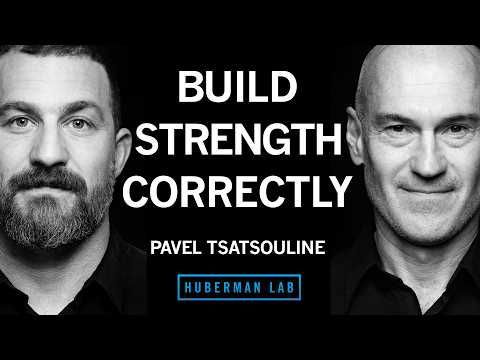
How to Build Strength, Endurance & Flexibility at Any Age | Pavel Tsatsouline
Andrew Huberman (host), Pavel Tsatsouline (guest), Narrator, Narrator, Narrator, Narrator
In this episode of Huberman Lab, featuring Andrew Huberman and Pavel Tsatsouline, How to Build Strength, Endurance & Flexibility at Any Age | Pavel Tsatsouline explores strength As Skill: Pavel Tsatsouline’s Blueprint For Lifelong Performance Andrew Huberman and Pavel Tsatsouline detail a science‑driven framework for building strength, endurance and flexibility as trainable skills at any age. Strength is positioned as the “mother quality” that underpins all other physical abilities, and they contrast high‑skill, low‑fatigue practice with the common “smoke yourself” gym culture.
Strength As Skill: Pavel Tsatsouline’s Blueprint For Lifelong Performance
Andrew Huberman and Pavel Tsatsouline detail a science‑driven framework for building strength, endurance and flexibility as trainable skills at any age. Strength is positioned as the “mother quality” that underpins all other physical abilities, and they contrast high‑skill, low‑fatigue practice with the common “smoke yourself” gym culture.
They outline how to select a minimal set of high‑carryover movements, how to program them for neural strength versus hypertrophy, and how to sequence strength and endurance so they support rather than cancel each other. Concepts like “grease the groove,” anti‑glycolytic training, disinhibition and targeted breathing are unpacked into practical templates.
The discussion ranges from barbell, kettlebell, and bodyweight methods to grip training, core bracing, isometrics, and endurance protocols that build capacity without wrecking recovery. Real‑world examples—from world champions to Pavel’s 80‑plus parents—illustrate that intelligent, consistent practice can yield exceptional performance deep into older age.
Key Takeaways
Treat Strength As a Skill, Not a Suffering Contest
Pavel emphasizes that strength gains are largely neural for a long time: you’re upgrading coordination, motor unit recruitment, and disinhibition, not just muscle size. ...
Get the full analysis with uListen
Use a Small, High‑Carryover Exercise Menu
You do not need dozens of movements. ...
Get the full analysis with uListen
Apply ‘Grease the Groove’ for Fast, Low‑Stress Strength Gains
Grease the Groove means practicing a lift or skill frequently with submaximal effort: select a weight around 75–85% of 1RM, do sets of roughly half your possible reps (e. ...
Get the full analysis with uListen
Train Endurance by Targeting Muscles, Not Just Lungs
Endurance is both central (heart, lungs) and peripheral (muscle mitochondria, capillaries). ...
Get the full analysis with uListen
Program Hard and Easy Phases: You Can’t Max Out All the Time
Both Soviet and classic American powerlifting systems agree that you can only truly train maximally a small fraction of the time (roughly 2 weeks out of 4). ...
Get the full analysis with uListen
Use Breathing and Bracing as Force Multipliers
Intra‑abdominal pressure (IAP) and breathing patterns can instantly increase or decrease strength via spinal stiffness and the pneumo‑motor reflex (pressure receptors boosting alpha motor neuron output). ...
Get the full analysis with uListen
Avoid Training to Failure; Prioritize Long‑Term Practice Quality
Repeatedly grinding to failure strengthens inhibitory pathways (long‑term depression) and degrades technique, which undermines both strength and safety. ...
Get the full analysis with uListen
Notable Quotes
“Strength is the mother quality of all the other qualities.”
— Pavel Tsatsouline (quoting Prof. Matveev)
“Find a limited battery of exercises you can do well, pain‑free, and enjoy them for years.”
— Pavel Tsatsouline
“Grease the Groove means train moderately heavy as often as possible while staying as fresh as possible.”
— Pavel Tsatsouline
“Success begets success, failure begets failure. Train to success, not to failure.”
— Pavel Tsatsouline (citing Fred Hatfield)
“If you have to drink some stupid energy drink just to get yourself up to training, there’s something wrong in your life.”
— Pavel Tsatsouline
Questions Answered in This Episode
For someone who currently trains in a typical ‘bodypart split’ bodybuilding style, what would be a realistic 8‑week transition plan into a minimal, strength‑skill program based on your principles?
Andrew Huberman and Pavel Tsatsouline detail a science‑driven framework for building strength, endurance and flexibility as trainable skills at any age. ...
Get the full analysis with uListen AI
You mentioned anti‑glycolytic strength circuits dramatically improved MMA fighters’ heart‑rate recovery; what specific weekly template (exercises, sets, and days) would you recommend for a jiujitsu athlete who trains on the mat 4 times per week?
They outline how to select a minimal set of high‑carryover movements, how to program them for neural strength versus hypertrophy, and how to sequence strength and endurance so they support rather than cancel each other. ...
Get the full analysis with uListen AI
Given the neural interference between endurance and hypertrophy signals, how would you program for a person who wants to gain 5–8 kg of muscle but must also keep a 5K time within a competitive range for their sport or profession?
The discussion ranges from barbell, kettlebell, and bodyweight methods to grip training, core bracing, isometrics, and endurance protocols that build capacity without wrecking recovery. ...
Get the full analysis with uListen AI
You highlighted that training to failure can induce long‑term depression of strength pathways; how should powerlifters and CrossFit athletes who are used to frequent max attempts and grinders rethink their testing and competition prep to preserve long‑term progress?
Get the full analysis with uListen AI
For older adults starting in their 60s or 70s with no prior lifting background, what initial assessments and progression milestones (e.g., specific squat, hinge, push, and pull standards) would you use to define ‘enough strength’ for health and independence?
Get the full analysis with uListen AI
Transcript Preview
Welcome to the Huberman Lab podcast, where we discuss science and science-based tools for everyday life. I'm Andrew Huberman, and I'm a professor of neurobiology and ophthalmology at Stanford School of Medicine. My guest today is Pavel Tsatsouline. Pavel Tsatsouline is considered one of the premier strength training and fitness coaches in the world. He has pioneered the development of various programs to improve strength, which he calls the mother of all fitness. Indeed, today you will learn about strength as a practice, as a skill that can be applied to sports, that can be applied to general fitness, to getting leaner, to getting faster, and to improving your endurance. As Pavel Tsatsouline explains, by building one's strength through body weight exercises, free weight exercises, and occasionally machines, one can develop incredible levels of fitness at any age. We discuss some of the spectacular examples of people in their 70s and 80s performing strength feats like 100 pull-ups per week, and we emphasize that one does not have to be seeking hypertrophy, one does not have to be seeking getting larger muscles in order to get exceptionally strong. I myself these days am focusing primarily on trying to get stronger and build endurance for sake of health and for general life reasons, and because getting really strong turns out to be very beneficial in every aspect of life. Today you're going to learn how to get extremely strong. You can add muscle if you want in parallel with that, or as Pavel Tsatsouline explains, you can pursue strength and flexibility for their own sake. And there's tremendous value for doing so. So today's discussion pertains to women, to men, and frankly, to people of all ages. I do think that pursuing strength as its own thing independent of muscle growth, right, which we hear so much about these days, everyone wants hypertrophy, grow muscle, this and that, pursuing strength as its own thing is a tremendously valuable endeavor. Today you're going to learn how from the world's premier expert in this topic. You're in for a very special episode with Pavel Tsatsouline. He is truly in a class all his own when it comes to fitness and strength training. Before we begin, I'd like to emphasize that this podcast is separate from my teaching and research roles at Stanford. It is, however, part of my desire and effort to bring zero cost to consumer information about science and science-related tools to the general public. In keeping with that theme, this episode does include sponsors. And now for my discussion with Pavel Tsatsouline. Pavel Tsatsouline, welcome.
Andrew, uh, pleasure to be on your podcast. I respect your work a lot.
Thank you. Likewise.
Thank you.
I will say that you and perhaps one other person have truly changed the way that I think about fitness, the way that I train, and I'm super excited to talk to you today.
Oh, thank you.
So I'm withholding excitement. There are a bunch of different ways to think about this thing that we call fitness, strength, endurance, hypertrophy, and there's so much information out there now. How do you conceptualize fitness? Meaning do you look at things through the lens of, are we focused on nervous system, bone, connective tissue, or muscle? Do you look at things through the lens of anterior chain, posterior chain, hypertrophy, strength? I would just like to get your sort of high-level conceptualization of this thing that we call fitness, with the idea in mind that most people would like to have some level of endurance, some level of strength and feel healthy, and presumably look however they want to look. But let's set aesthetics aside for the moment. How do you think about this thing we call fitness?
Install uListen to search the full transcript and get AI-powered insights
Get Full TranscriptGet more from every podcast
AI summaries, searchable transcripts, and fact-checking. Free forever.
Add to Chrome