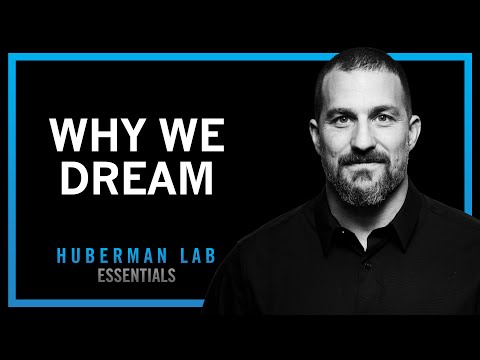
Understand and Use Dreams to Learn and Forget | Huberman Lab Essentials
Andrew Huberman (host)
In this episode of Huberman Lab, featuring Andrew Huberman, Understand and Use Dreams to Learn and Forget | Huberman Lab Essentials explores harness Dream States: Use Sleep To Learn, Heal, And Forget Andrew Huberman explains how different phases of sleep—slow wave (non-REM) and REM—support distinct forms of learning and emotional processing. Slow wave sleep early in the night consolidates motor skills and detailed factual information, while REM sleep later in the night helps detach excessive emotional charge from experiences and builds meaningful associations. He connects REM sleep’s neurochemistry to trauma therapies like EMDR and ketamine, arguing that REM functions as nightly, self-induced therapy. Huberman also offers practical guidance on stabilizing sleep patterns and modulating behaviors (exercise, substances, fluids) to better support learning and emotional health.
Harness Dream States: Use Sleep To Learn, Heal, And Forget
Andrew Huberman explains how different phases of sleep—slow wave (non-REM) and REM—support distinct forms of learning and emotional processing. Slow wave sleep early in the night consolidates motor skills and detailed factual information, while REM sleep later in the night helps detach excessive emotional charge from experiences and builds meaningful associations. He connects REM sleep’s neurochemistry to trauma therapies like EMDR and ketamine, arguing that REM functions as nightly, self-induced therapy. Huberman also offers practical guidance on stabilizing sleep patterns and modulating behaviors (exercise, substances, fluids) to better support learning and emotional health.
Key Takeaways
Slow wave (non-REM) sleep is critical for motor skill and detail learning.
Early-night slow wave sleep consolidates both fine and gross motor skills (e. ...
Get the full analysis with uListen
REM sleep helps uncouple intense emotions from memories, acting as nightly therapy.
During REM sleep, the brain is highly active and dreams are vivid, but stress-related neuromodulators like norepinephrine/epinephrine are essentially absent. ...
Get the full analysis with uListen
REM deprivation increases emotional volatility and catastrophic thinking.
When people are selectively deprived of REM sleep, they become more irritable and prone to interpreting minor issues as major problems. ...
Get the full analysis with uListen
REM sleep builds ‘meaning’ by solidifying and pruning associations and spatial maps.
REM involves replay of spatial experiences with precise neural firing patterns, helping solidify how places, people, and events relate. ...
Get the full analysis with uListen
EMDR and ketamine therapies mimic core aspects of REM sleep to treat trauma.
EMDR uses side-to-side eye movements—which naturally occur during self-generated movement—to suppress amygdala activity while patients recount trauma, gradually removing its emotional load. ...
Get the full analysis with uListen
Consistency of sleep duration may matter more than chasing a higher average.
Huberman emphasizes that getting a reasonably constant amount of sleep (e. ...
Get the full analysis with uListen
Daily behaviors can shift your sleep architecture, enhancing specific types of learning.
Resistance training increases slow wave sleep and associated growth hormone release, bolstering motor and detail learning. ...
Get the full analysis with uListen
Notable Quotes
“REM sleep is really where we establish the emotional load, but where we also start discarding all the meanings that are irrelevant.”
— Andrew Huberman
“A certain component of our sleeping life is acting like therapy, and that's really what REM sleep is about.”
— Andrew Huberman
“Sleep deprivation isn't just deprivation of energy. It is deprivation of self-induced therapy every time we go to sleep.”
— Andrew Huberman
“You never forget the traumatic experience. What you do is you remove the emotional load.”
— Andrew Huberman
“Consistency of sleep, meaning getting six hours every night, is better than getting ten one night, eight the next, five the next, four the next.”
— Andrew Huberman
Questions Answered in This Episode
If someone frequently wakes at 3–4 AM and can’t fall back asleep, what specific steps beyond NSDR would you recommend to preserve enough REM for emotional unlearning?
Andrew Huberman explains how different phases of sleep—slow wave (non-REM) and REM—support distinct forms of learning and emotional processing. ...
Get the full analysis with uListen AI
How might resistance training timing (morning vs. evening) differentially affect slow wave sleep and subsequent motor learning consolidation?
Get the full analysis with uListen AI
Given the ethical concerns, in what narrowly defined circumstances do you think ketamine should or should not be used acutely after trauma to block emotional plasticity?
Get the full analysis with uListen AI
For people with long, diffuse traumas (e.g., an entire difficult childhood) rather than single-event traumas, how could the principles of REM-like emotional uncoupling be adapted beyond classic EMDR protocols?
Get the full analysis with uListen AI
If chronic use of alcohol or THC has distorted someone’s sleep architecture for years, is there evidence that normal slow wave–REM balance can be fully restored, and what would a realistic recovery protocol look like?
Get the full analysis with uListen AI
Transcript Preview
(music) Welcome to Huberman Lab Essentials, where we revisit past episodes for the most potent and actionable science-based tools for mental health, physical health, and performance. I'm Andrew Huberman, and I'm a professor of neurobiology and ophthalmology at Stanford School of Medicine. Today, we're going to talk about dreaming, learning during dreaming, as well as unlearning during dreaming, in particular unlearning of challenging emotional events. Now, numerous people throughout history have tried to make sense of dreams in, in some sort of organized way, the most famous of which, of course, is, uh, Sigmund Freud, who talked about symbolic representations in dreams. A lot of that has been kind of debunked. Although, I think that, um, there's some interest in what the symbols of dreaming are. And this is something that we'll talk about in more depth today, although not Freudian, uh, uh, theory, uh, in particular. So I think w- in order to really think about dreams and what to do with them and how to maximize the dream experience for sake of learning and unlearning, the best way to address this is to look at the physiology of sleep, to really address, what do we know concretely about sleep? So, first of all, as we get sleepy, we tend to shut our eyes, and that's 'cause there are some autonomic centers in the brain, some neurons that control closing of the eyelids when we get sleepy. And then we transition into sleep. And sleep, regardless of how long we sleep, is generally broken up into a series of 90-minute cycles, these ultradian cycles. So early in the night, these 90-minute cycles tend to be comprised more of shallow sleep and slow wave sleep. And we tend to have less so-called REM sleep, R-E-M sleep, which stands for rapid eye movement sleep. For every 90-minute cycle that we have during a night of sleep, we tend to start having more and more REM sleep. So more of that 90-minute cycle is comprised of REM sleep and less of slow wave sleep. Now, this is true regardless of whether or not you wake up in the middle of the night to use the restroom or your sleep is broken. The more sleep you're getting across the night, the more REM sleep you're going to have. And REM sleep and non-REM, as I'll refer to it, have distinctly different roles in learning and unlearning, and they are responsible for learning and unlearning of distinctly different types of information. And this has enormous implications for learning of motor skills, for unlearning of traumatic events, or for processing emotionally challenging, as well as emotionally pleasing events. And as we'll see, one can actually leverage their daytime activities in order to access more slow wave sleep, or non-REM sleep as we'll call it, or more REM sleep depending on your particular emotional and physical needs. So it's really a remarkable stage of life that we have a lot more control and power over than you might believe. So let's start by talking about slow wave sleep, or non-REM sleep. So slow wave sleep is characterized by a particular pattern of brain activity in which the brain is metabolically active, but that there's these big sweeping waves of activity that include a lot of the brain. Now, the interesting thing about slow wave sleep are the neuromodulators that tend to be associated with it that are most active and least active during slow wave sleep. And here's why. To remind you, neuromodulators are these chemicals that act rather slowly, but their main role is to bias particular brain circuits to be active and other brain circuits to not be active. And they are associated, as a consequence, with certain brain functions. So we know, for instance, and just to review, acetylcholine in waking states is a neuromodulator that tends to amplify the activity of brain circuits associated with focus and attention. Norepinephrine is a neuromodulator that tends to amplify the brain circuits associated with alertness and the desire to move. Serotonin is the neuromodulator that's released and tends to amplify the circuits in the brain and body that are associated with bliss and the desire to remain still. And dopamine is the neuromodulator that's released and is associated with amplification of the neural circuits in the brain and body associated with pursuing goals and pleasure and reward. So in slow wave sleep, something really interesting happens. There is essentially no acetylcholine. And acetylcholine, as I just mentioned, is associated with focus. So you can s- think of slow wave sleep as these big sweeping waves of activity through the brain and a kind of distortion of space and time so that we're not really focusing on any one thing. Now, the other molecules that are very active at that time are norepinephrine, which is a little bit surprising, 'cause normally in waking states norepinephrine is going to be associated with a lot of alertness and the desire to move. But there's not a ton of norepinephrine around in slow wave sleep, but it is around. So there's something associated with the movement circuitry going on in slow wave sleep. And remember, this is happening mostly at the beginning of the night. Your sleep is dominated by slow wave sleep. So very, no acetylcholine, very little norepinephrine, although there is some, and a lot of serotonin. And serotonin, again, is associated with this desire, uh, the sensation of kind of bliss or well-being, but not a lot of movement. And during sleep, you tend not to move. Now, in slow wave sleep, you can move. You're not paralyzed. So you can roll over. If people are going to sleepwalk, typically it's going to be during slow wave sleep. And what studies have shown through some, um, kind of sadistic experiments where people are deprived specifically of slow wave sleep, and that can be done by waking them up in the, as soon as the electrode recording show that they're in slow wave sleep, or by, uh, chemically altering their sleep so that it biases them away from slow wave sleep, what studies have shown is that motor learning...... is generally occurring in slow wave sleep. So let's say the day before you go to sleep, you were learning some new dance move, or you were learning some specific motor skill, either a fine motor skill or a coarse motor skill. Learning of those skills is happening primarily during slow wave sleep in the early part of the night. In addition, slow wave sleep has been shown to be important for the learning of detailed information. So we can think of slow wave sleep as important for motor learning, motor skill learning, and for the learning of specific details about specific events. And this turns out to be fundamentally important, because now we know that slow wave sleep is primarily in the early part of the night and motor learning is occurring primarily early in the night, and detail learning is occurring early in the night. I want to talk about REM sleep, or rapid eye movement sleep. REM sleep and rapid eye movement sleep, as I mentioned before, occurs throughout the night, but you're going to have more of it, a larger percentage of these 90-minute sleep cycles is going to be comprised of REM sleep as you get toward morning. REM sleep is fascinating. It was discovered in the '50s when a sleep laboratory in Chicago, um, the researchers observed that people's eyes were moving under their eyelids. Now, something very important that we're going to address when we talk about trauma later is that the eye movements are not just side to side, they're very erratic and all different directions. One thing that I don't think anyone, uh, I've never heard anyone really talk about publicly is why eye movements during sleep. Right? Eyes are closed, and sometimes people's eyelids will be a little bit open and their eyes are darting around, especially in little kids. I don't suggest you do this. I'm not even sure it's ethical. But it has been done where you, you know, pull back the eyelids of a kid while they're sleeping and their eyes are kind of darting all over the place. Rapid eye movement sleep is fascinating and occurs be- because there are connections between the brainstem, an area called the pons, and areas of the thalamus and the top of the brainstem that are involved in generating movements in different directions, sometimes called saccades, although sometimes during rapid eye movement sleep, it's not just rapid, it's kind of a jittery side to side thing, and then the eyeballs kind of roll. It's really pretty creepy to look at if you see. So, what's happening there is the circuitry that's involved in conscious eye movements is kind of going haywire, but it's not haywire. It's these waves of activity from the brainstem up to the so-called thalamus, which is an area that filters sensory information, then up to the cortex. And the cortex, of course, is involved in conscious perceptions. In REM sleep, serotonin is essentially absent, okay? So this molecule, this neuromodulator that tends to create the feeling of bliss and well-being and just calm, placidity, is absent. In addition to that, norepinephrine, this molecule that's involved in movement and alertness, is absolutely absent. It's probably one of the few times in our life that epinephrine is essentially at, at zero activity within our system. And that has a number of very important implications for the sorts of dreaming that occur during REM sleep, and the sorts of learning that can occur in REM sleep, and unlearning. First of all, in REM sleep, we are paralyzed. We are, we are experiencing what's called atonia, which just means that we're completely laid out and paralyzed. We also tend to experience whatever it is that we're dreaming about as a kind of hallucination or a hallucinatory activity. So in REM, our eyes are moving, but the rest of our body is paralyzed and we are hallucinating. There's no epinephrine around. Epinephrine doesn't just create a desire to move and alertness, it is also the chemical signature of fear and anxiety. It's what's released from our adrenal glands when we experience something that's fearful or alerting. So if a car suddenly screeches in front of us, or we get a troubling text message, adrenaline is deployed into our system. Adrenaline is epinephrine. Those are equivalent molecules. And epinephrine isn't just released from our adrenals, it's also released within our brain. So there's this weird stage of our life that happens more toward morning that we call REM sleep, where we're hallucinating and having these outrageous experiences in our mind, but the chemical that's associated with fear and panic and anxiety is not available to us. And that turns out to be very important, and you can imagine why that's important. It's important because it allow us- allows us to experience things, both replay of things that did occur, as well as elaborate contortions of things that didn't occur, and it allows us to experience those in the absence of fear and anxiety. So we have this incredible period of sleep in which our experience of emotionally laden events is dissociated, it's chemically blocked from us having the actual emotion. So, to just recap where we've gone so far, slow wave sleep early in the night, h- it's been shown to be important for motor learning and for detail learning. REM sleep has a certain dream component when which there's no epinephrine, therefore we can't experience anxiety. We are paralyzed. Those dreams tend to be really vivid and have a lot of detail to them, and yet in REM sleep, what's very clear is that the sorts of learning that happen in REM sleep are not motor events, it's more about unlearning of emotional events. And now we know why, because the chemicals available for e- really feeling those emotions are not present.Now, that has very important implications. So let's address those implications from two sides. First of all, we should ask, what happens if we don't get enough REM sleep? And a scenario that happens a lot where people don't get enough REM sleep is the following. I'll just explain the one that, uh, I'm familiar with 'cause it happens to me a lot, although I've figured out ways to adjust. I go to sleep around 10:30, 11:00. I fall asleep very easily, and then I wake up around 3:00 or 4:00 AM. I now know to use a NSDR, a non-sleep deep rest protocol, and that allows me to fall back asleep. Even though it's called non-sleep deep rest, it's really allows me to relax my body and brain, and I tend to fall back asleep and sleep till about 7:00 AM. During which time I get a lot of REM sleep. And I know this because I've measured it, and I know this because my dreams tend to be very intense, um, of the sort that we know is typical of REM sleep. In this scenario, I've gotten my slow wave sleep early in the night, and I've got my REM sleep toward morning. However, there are times when I don't go back to sleep. Maybe I have a flight to catch. That's happened. Sometimes I've got a lot on my mind and I don't go back to sleep. I can tell you, and you've probably experienced, that the lack of REM sleep tends to make people emotionally irritable. It tends to make us feel as if the little things are the big things. So it's very clear from laboratory studies where people have been deprived selectively of REM sleep that our emotionality tends to get a little bit unhinged, and we tend to catastrophize small things. We tend to feel like the world is really daunting, we're never going to move forward in the ways that we want. We can't unlearn the emotional components of whatever it is that's been happening, even if it's not traumatic. The other thing that happens in REM sleep is a replay of certain types of spatial information about where we were and why we were in those places. And this maps to some beautiful data and studies that were initiated by a guy named Matt Wilson at MIT years ago, showing that in rodents, and it turns out in other, in non-human primates and in humans, there's a replay of spatial information during REM sleep that almost precisely maps to the activity that we experience during the day as we move from one place to another. So here's a common world scenario. You go to a new place, you navigate through that city or that environment. This place doesn't have to be, y- you know, at the scale of a city. It can be a new building, it could be, uh, finding particular rooms, new social interaction. You experience that, and if it's important enough, that becomes solidified a few days later, and you won't forget it. If it's unimportant, you'll probably forget it. During REM sleep, there's an, it is a literal replay of the exact firing of the neurons that occurred while you were navigating that same city or building earlier. So REM sleep seems to be involved in the generation of this detailed spatial information. But what is it that's actually happening in REM sleep? So there's this uncoupling of emotion, but most of all what's happening in REM sleep is that we're forming a relationship with particular rules or algorithms. We're starting to figure out based on all the experience that we had during the day whether or not it's important that we avoid certain people or that we approach certain people, whether or not it's im- portant that, um, you know, when we enter a building that we go into the elevator and, um, turn left where the bathroom is, for instance. These general themes of things and locations and how they fit together. And that has a word. It's called meaning. During our day we're experiencing all sorts of things. Meaning is how we each individually piece together the relevance of one thing to the next, right? So if I suddenly, uh, told you that, um, you know, this pen was downloading all the information to my brain that was important to deliver this information, you'd probably think I was a pretty strange character, because typically we don't think of pens as downloading information into brains. But if I told you that I was getting information from my computer that was allowing me to, um say things, uh, to you, you'd say, "Well, that's perfectly reasonable." And that's because we have a clear and agreed upon association with computers and information and memory, um, and we don't have that same association with pens. You might say, "Well, duh." But something in our brain needs to solidify those relationships and make sure that the re- certain relationships don't exist. And it appears that REM sleep is important for that, because when you deprive yourself or people o- of REM, they start seeing odd associations. And we know that if people are deprived of REM sleep for very long periods of time, they start hallucinating. They literally start seeing relationships and movement of objects that isn't happening. And so REM sleep is really where we establish the emotional load, but where we also start discarding of all the meanings that are irrelevant. And if you think about emotionality, a lot of, of over-emotionality or catastrophizing is about seeing problems everywhere. It's very important in order to have healthy emotional and cognitive functioning that we have fairly narrow channels between individual things. If we see something on the news that's very troubling, well, then it makes sense to be very troubled. But if we're troubled by everything and we start just saying, "You know, everything is bothering me and I'm feeling highly irritable, and everything is dis- distorting and troubling me," chances are we are not actively removing the meaning, the connectivity between life experiences as well as we could. And that almost always maps back to a deficit in REM sleep. So REM sleep seems to be where we uncouple the potential for emotionality between various experiences. And that brings us to the absolutely fundamental relationship and similarity of REM sleep...... to some of the clinical practices that have been designed to eliminate emotionality and help people move through trauma and other troubling experiences. Many of you perhaps have heard of trauma treatment such as EMDR, Eye Movement Desensitization Reprocessing, or ketamine treatment for trauma, something that recently became legal and is in fairly widespread clinical use. Interestingly enough, EMDR and ketamine at kind of a core level bear very similar features to REM sleep. So let's talk about EMDR first. Uh, EMDR, Eye Movement Desensitization Reprocessing, is something that was developed by a psychologist, Francine Shapiro. She actually was in Palo Alto. Um, and the story goes that she was walking, not so incidentally, in the trees and forest behind Stanford, and she was recalling a troubling event in her own mind. So this would be from her own life, and she realized that as she was walking, the emotional load of that experience was not as intense or severe. She extrapolated from that experience of walking and not feeling as stressed about the stressful event to a practice that she put into work in, with her clients, with her patients, and that now has become fairly widespread. It's actually one of the few behaviorally, the behavior treatments that are approved by the American Psychological Association for the treatment of trauma. What she had her clients and patients do was move their eyes from side to side while recounting some traumatic or troubling event. Why eye movements? Well, she never really said why eye movements, but, um, soon I'll tell you why the decision to select these lateralized eye movements for the work in the clinic was the right one. So these eye movements, they look silly, but they basically involve sitting in a chair and moving one's eyes from side to side for 30, 60 seconds, then describing this challenging procedure. Now, as a vision scientist who also works on stress, when I first heard this, I thought it was crazy, frankly. Um, people would ask me about EMDR, and I just thought, "That's crazy." I went and looked up some of the theories about why EMDR might work, and there were a bunch of theories. Oh, it mimics the eye movements during REM sleep. That was one. Turns out that's not true, and I'll explain why. The other one was, oh, it synchronizes the, the activity on the two sides of the brain. Well, sort of, I mean, when you look i- into both sides of the binocular visual field, you activate the visual cortex, but n- this whole idea of synchrony between the two sides of the brain is something that I think modern neuroscience is starting to, um, m- let's just say, uh, gently or not so gently, uh, move away from, this whole right brain, re-, uh, left brain business. Turns out, however, that eye movements of the sort that I just did and that Francine Shapiro took from this walk experience and brought to the, her clients in, in the, uh, clinic are the sorts of eye movements that you generate whenever you're moving through space when you are self-generating that movement. So not so much when you're driving a car, but certainly if you were riding a bicycle or you were walking or you were running. You don't realize it, but you have these reflexive subconscious eye movements that go from side to side, and they are associated with the motor system, so when you move forward, your eyes go like this. There have been a number of studies showing that these lateralized eye movements helped people move through or dissociate the emotional experience of particular traumas with those experiences such that they could re- recall those experiences after the treatment and not feel stressed about them or they didn't report them as traumatic any longer. Now, the success rate wasn't 100%, but they were statistically significant in a number of studies. In the last five years, there have been no fewer than five journals and, and papers showing that lateralized eye movements of the sort that I just did, and if you're just listening to this, it's just sweep, th- moving the eyes from side to side with eyes open, that those eye movements, but not vertical eye movements, suppress the activity of the amygdala, which is this brain region that is involved in threat detection, stress, anxiety, and fear. There are some forms of fear that are not amygdala-dependent, but the amygdala, it's not a fear center, but it is critical for the fear response and for the experience of anxiety. So that's interesting. We've got a clinical tool now that indeed shows a lot of success in a good number of people where eye movements from side to side are suppressing the amygdala and the general theme is to use those eye movements to suppress the fear response and then to recount or repeat the experience, and over time, uncouple the heavy emotional load, the sadness, the depression, the anxiety, the fear from whatever it was that happened that was traumatic. This is important to understand because, you know, I'd love to be able to tell somebody who had a traumatic experience that they would forget that experience, but the truth is, you never forget the traumatic experience. What you do is you remove the emotional load. Eventually, it really does lose its potency. The emotional potency is alleviated. Now, EMDR, I should just mention, tends to be most successful for single event or very specific kinds of trauma that happen over and over as opposed to, say, an entire childhood or an entire divorce. Uh, they tend to be, um, it tends to be most effective for single event kinds of things, car crashes, et cetera, where people can really recall the events in quite a lot of detail.It's not for everybody and it should be done, uh, if it's going to be done for trauma, it should be done in a clinical setting with somebody who's, um, certified to do this. But that bears a lot of resemblance to REM sleep, right? This experience in our sleep where our eyes are movement, moving, excuse me, although, in a different way, but we don't have the chemical, eh, epinephrine, in order to generate the fear response, and yet we're remembering the event from the previous day or days. And then now there's this chemical treatment with the drug ketamine, which also bears a lot of resemblance to the sorts of things that happen in REM sleep. Ketamine is a dissociative anesthetic. It is remarkably similar to the drug called PCP, which is certainly a hazardous drug for people to use. Ketamine and PCP both function to disrupt the activity of a particular receptor in the brain called the NMDA receptor, N-methyl-D-aspartate receptor. This is a receptor that's in the surface of neurons or on the surface of neurons for which most of the time it's not active, but when something very extreme happens and there's a lot of activity in the neural pathway that impinges on that receptor, it opens and it allows the entry of molecules, ions that trigger a cellular process that we call long-term potentiation. And long-term potentiation translates to a change in connectivity so that later you don't need that intense event for the sa- for the neuron to become active again. Ketamine blocks this NMDA receptor. So how is ketamine being used? Ketamine is being used to prevent learning of emotions very soon after trauma. Ketamine is being stocked in a number of different emergency rooms where if people are brought in quickly, and, you know, these are hard to describe even, but, you know, a horrible experience of, you know, somebody seeing a loved one next to them killed in a car accident and they were driving that car, this isn't for everybody, uh, certainly and you need to talk to f- your physician, but ketamine is being used so they might infuse somebody with ketamine so that their emotion is... it can still occur, but that the, that the plasticity, the change in the wiring of their brain won't allow that intense emotion to be attached to the experience. Now, immediately you can imagine the sort of ethical implications of this, right? (laughs) Because certain emotions need to be coupled to experiences. But in the clinical setting, the basis of ketamine-assisted therapies is really to remove emotion. Ketamine is about becoming dissociative or removed from the emotional component of an experience. So now we have ketamine, which chemically blocks plasticity and prevents the, the connection between an emotion and an experience. That's a pharmacologic intervention. We have EMDR, which is this eye movement thing that is designed to suppress the amygdala and is designed to remove emotionality while somebody recounts an experience. And we have REM sleep where the chemical epinephrine that allows for signaling of intense emotion to end the experience of intense emotion in the brain and body is not allowed. And so we're starting to see a organizational logic, which is that a certain component of our sleeping life is acting like therapy, and that's really what REM sleep is about. So we should really think about REM sleep and slow wave sleep as both critical, slow wave sleep for motor learning and detailed learning, REM sleep for attaching of emotions to particular experiences, and then for making sure that the emotions are not attached to the wrong experiences and for unlearning emotional responses if they're too intense or severe. And this all speaks to the great importance of mastering one's sleep, something that we talked about in episode two of the podcast, and making sure that if life has disruptive events, either due to travel or stress or, um, changes in school or s- or food schedule, something that we talked about in episodes three and four, that one can still grab ahold and manage one's sleep life. Because fundamentally, the unlearning of emotions that are troubling to us is what allows us to move forward in life. And indeed, the REM deprivation study show that people become hyper-emotional. They start to catastrophize. And it's no surprise, therefore, that sleep disturbances correlate with so many emotional and psychological disturbances. By now, it should just be obvious why that would be the case. I was in a discussion with a colleague of mine, um, who's down in Australia, Dr. Sarah Mackay. I've known her, uh, for two decades now from the time, uh, she was at Oxford, and Sarah studies m- um, among other things menopause and the brain, and she was saying that a lot of the emotional so- um, effects of menopause actually are not directly related to the hormones. There have been some really nice studies showing that the disruptions in temperature regulation in menopause map to changes in sleep regulation that then impact emotionality and an inability to correctly adjust the circuits related to emotionality. So sleep deprivation isn't just deprivation of, of energy. It's not just deprivation of immune function. It is deprivation of self-induced therapy every time we go to sleep. So these things like EMDR and ketamine therapies are in-clinic therapies, but REM sleep is the one that you're giving yourself every night when you go to sleep. Which raises, I think, the other important question, which is how to get and how to know if you're getting the appropriate amount of REM sleep and slow wave sleep. It turns out that for sake of learning new information, limiting the variation in the amount of your sleep...... is at least a- as important and perhaps more important than just getting more sleep overall. I find great relief personally in the fact that consistently getting, for me, about six hours or six and a half hours is going to be more beneficial than constantly striving for eight or nine, and finding that some nights I'm getting five and sometimes I'm getting nine, and varying around the mean. Now, ideally you're getting the f- the full complement of slow wave sleep early in night and sleep toward morning, which is REM sleep, which brings us to how to get more REM sleep. Well, there are c- (laughs) couple of different ways, but, um, here's how to not get more REM sleep. All right? First of all, drink a lot of fluid right before going to sleep. One of the reasons why we wake up in the middle of the night to use the bathroom is because when our bladder is full there is a neural connection, literally an- a set of neurons and a nerve circuit that goes to the brain stem that wakes us up. So having a full bladder is one way to disrupt your sleep. The other one is tryptophan or anything that contains 5-HTP, which is, um, serotonin or a precursor to s- serotonin. Serotonin is made from tryptophan. For some people those supplements might work, but beware serotonin supplements at, um, could disrupt the timing of REM sleep and slow wave sleep. Now, if you want to increase your slow wave sleep, that's interesting. Uh, there are ways to do that. One of the most powerful ways to increase slow wave sleep, the percentage of slow wave sleep, apparently without any disruption to the other components of, of sleep and learning, is to engage in resistance exercise. It's pretty clear that resistance exercise triggers a number of metabolic and endocrine pathways that lend themselves to release of growth hormone, which happens early in the night. And resistance exercise therefore can induce a greater percentage of slow wave sleep. It doesn't have to be done very close to going to bedtime. In fact, for some people that, the exercise could be disruptive for reasons I've talked about in previous episodes. But resistance exercise, unlike aerobic exercise, does seem to increase the amount of slow wave sleep, which as we know is involved in motor learning and the acquisition of fine detailed information, not general rules or the emotional components of experiences. Alcohol. Alcohol and marijuana are well-known to induce states that are pseudo-sleep-like, especially when people fall asleep, um, w- after having consumed alcohol or, um, THC, the active component, one of the active components of marijuana. Alcohol, THC, and most things like them, meaning things that increase serotonin, um, or GABA, are going to disrupt the pattern of sleep. They're going to disrupt the depth, they're going to disrupt the overall sequencing of more slow wave sleep early in the night and more REM sleep later in the night. That's just the r- the reality. Now, of course, if that's what you need in order to sleep and that's within your protocols, I've said here before I'm not suggesting people take anything, I'm not a medical doctor, I'm not a cop, so I'm not trying to regulate anyone's behavior, (laughs) I'm just telling you what the literature says. Today we've been in a deep dive of sleep and dreaming, learning and unlearning, and I just want to recap a few of the highlights and important points. A lot more slow wave sleep and less REM early in the night. More REM and less slow wave sleep later in the night. REM sleep is associated with i- intense experiences without this chemical epinephrine that allows us the anxiety or fear, and almost certainly has an important role in uncoupling of emotion from experiences, kind of self-induced therapy that we go into each night. That bears striking resemblance to things like EMDR and ketamine therapies and so forth. Slow wave sleep is critical, however. It's critical mostly for motor learning and the learning of specific details. So REM is kind of emotions and general themes and meaning, and slow wave sleep, motor learning and details. I personally find it fascinating that consistency of sleep, meaning getting six hours every night, is better than getting 10 one night, eight the next, five the next, four the next. I find that fascinating and bec- and I think I also like it because it's something I can control better (laughs) than just trying to sleep more, which I think I'm not alone in agreeing that that's just hard for a lot of people to do. Thank you for joining me in this journey of the nervous system and biology, and trying to understand the mechanisms that make us who we are and how we function in sleep and in wakefulness. It's really an incredible landscape to consider, and I hope that you're getting a lot out of the information. (instrumental music plays) As always, thank you for your interest in science.
Install uListen to search the full transcript and get AI-powered insights
Get Full TranscriptGet more from every podcast
AI summaries, searchable transcripts, and fact-checking. Free forever.
Add to Chrome