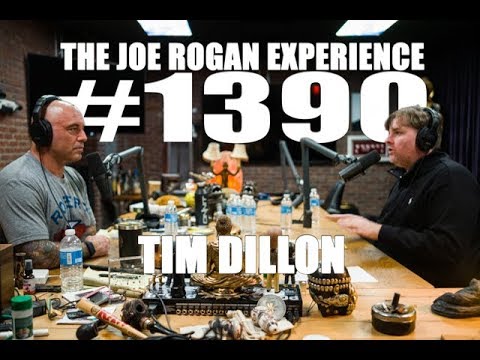
Joe Rogan Experience #1390 - Tim Dillon
Joe Rogan (host), Tim Dillon (guest), Narrator, Narrator, Narrator, Narrator, Tim Dillon (character bit) (guest), Narrator, Narrator
In this episode of The Joe Rogan Experience, featuring Joe Rogan and Tim Dillon, Joe Rogan Experience #1390 - Tim Dillon explores tim Dillon Joins Rogan: Outrage Culture, Conspiracies, Comedy, And Chaos Joe Rogan and Tim Dillon riff for hours on outrage culture, political media figures, online mobs, and how internet platforms are reshaping comedy careers. They skewer TV pundits (Meghan McCain, Candace Owens, Fox “fembots”), late‑night news culture, and the incentives behind being permanently combative online. The conversation repeatedly veers into conspiracy territory—Epstein, 9/11, CIA/Mossad, sex‑blackmail operations—while Rogan pushes for where skepticism is warranted versus where people go off the rails. They also dig into stand‑up craft, internet fame, YouTube demonetization fears, and the psychological toll of social media hate, all wrapped in relentless dark comedy and satire.
Tim Dillon Joins Rogan: Outrage Culture, Conspiracies, Comedy, And Chaos
Joe Rogan and Tim Dillon riff for hours on outrage culture, political media figures, online mobs, and how internet platforms are reshaping comedy careers. They skewer TV pundits (Meghan McCain, Candace Owens, Fox “fembots”), late‑night news culture, and the incentives behind being permanently combative online. The conversation repeatedly veers into conspiracy territory—Epstein, 9/11, CIA/Mossad, sex‑blackmail operations—while Rogan pushes for where skepticism is warranted versus where people go off the rails. They also dig into stand‑up craft, internet fame, YouTube demonetization fears, and the psychological toll of social media hate, all wrapped in relentless dark comedy and satire.
Key Takeaways
Controversy is now a monetizable business model.
Rogan and Dillon note that figures like Candace Owens, Ann Coulter, and even Dillon’s Meghan McCain impressions thrive because combative, polarizing content reliably drives attention, bookings, and brand value.
Legacy media and social platforms shape what’s ‘acceptable’ speech through access and monetization.
They argue TV networks protect access to power (politicians, royals, CEOs), while YouTube and Instagram quietly control careers via demonetization and vague ‘commercial viability’ standards, pushing creators to self‑censor.
Online mobs often care more about dopamine than principles.
Rogan describes how haters and cancel campaigns frequently just want interaction or catharsis; Dillon admits he sometimes fires back, then sees people instantly switch to ‘just kidding, love the show,’ revealing how performative much of it is.
Conspiracy thinking fills the vacuum left by obvious cover‑ups.
The Epstein case—broken cameras, dead witnesses, non‑answers—is used as a prime example of an event so blatantly mishandled that it convinces ordinary people other conspiracies (like JFK) might also be true, feeding broader institutional distrust.
Stand‑up success still comes down to repetition and ruthless self‑review.
Rogan emphasizes listening back to sets, doing multiple spots a night, and treating club sets like ‘mini‑specials’ if you want to build strong material, contrasting that with comics who rely mostly on crowd work or social media heat.
Fame without structure can warp judgment and behavior.
They talk about TV hosts, reality stars, and YouTubers who get fast money and attention (e. ...
Technology is outpacing human psychological and ethical capacity.
Rogan worries AI, algorithms, and ubiquitous social media are evolving far faster than humans, who haven’t changed much since ‘arrowhead’ days; our lizard‑brain responses to outrage and tribalism are being exploited at scale.
Notable Quotes
“People don’t realize this business doesn’t have a soul; it has money.”
— Tim Dillon
“YouTube seems like they’re done with small creators… your career is at the mercy of an algorithm.”
— Tim Dillon
“When people see you limping, they start kicking you. That’s just part of being a person.”
— Joe Rogan
“The Epstein thing was so blatant and so outrageous that people go, ‘Hey, maybe they did kill Kennedy.’”
— Joe Rogan
“We’re the last human era. Technology’s innovating faster than we can evolve. We can’t keep up with the thing we made.”
— Joe Rogan
Questions Answered in This Episode
How much responsibility should platforms like YouTube and Instagram have in deciding what political or comedic content is ‘commercially viable’?
Joe Rogan and Tim Dillon riff for hours on outrage culture, political media figures, online mobs, and how internet platforms are reshaping comedy careers. ...
Where is the line between legitimate skepticism about events like Epstein’s death and going so deep into conspiracy thinking that you lose touch with reality?
How can comedians balance the career benefits of controversy with the risk of deplatforming or becoming defined solely by outrage?
What does the Epstein case reveal about the relationship between intelligence agencies, billionaires, and elected officials—and will we ever get a full accounting?
As AI and algorithms increasingly optimize for engagement, what concrete steps—if any—can individuals or governments take to protect public discourse from becoming permanently toxic?
EVERY SPOKEN WORD
Install uListen for AI-powered chat & search across the full episode — Get Full Transcript
Get more out of YouTube videos.
High quality summaries for YouTube videos. Accurate transcripts to search & find moments. Powered by ChatGPT & Claude AI.
Add to Chrome