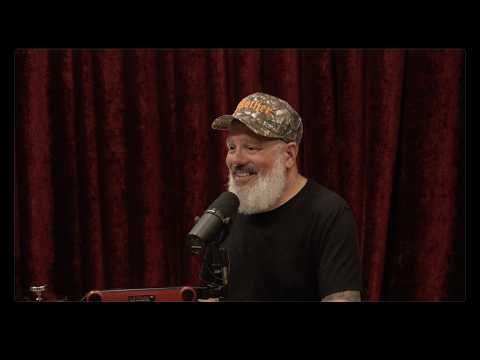
Joe Rogan Experience #2484 - David Cross
Joe Rogan (host), David Cross (guest), David Cross (guest), David Cross (guest), David Cross (guest)
In this episode of The Joe Rogan Experience, featuring Joe Rogan and David Cross, Joe Rogan Experience #2484 - David Cross explores david Cross and Joe Rogan riff on comedy, tech, culture, fear Rogan and Cross trade stories about late-night radio icons (Art Bell, Phil Hendrie) and how respectful, improvisational formats shaped comedic sensibilities.
David Cross and Joe Rogan riff on comedy, tech, culture, fear
Rogan and Cross trade stories about late-night radio icons (Art Bell, Phil Hendrie) and how respectful, improvisational formats shaped comedic sensibilities.
They revisit the Boston comedy boom and its darker underside—mob-adjacent clubs, cash-and-cocaine culture, provincial gatekeeping, and comics trapped by local fame.
The pair discuss the TV/streaming business from inside the system, emphasizing how executives, analytics, and risk-avoidant decision-making often derail genuinely funny projects.
The conversation shifts into unease about AI and deepfakes, arguing that rapid advances will destroy trust in media and potentially end privacy through broken encryption.
They end on creative process and meaning: stand-up as a necessary practice, the value of walking for ideas, and Cross promoting his YouTube special and new-material workflow.
Key Takeaways
Respectful hosting can make even ‘crazy’ ideas compelling.
Cross praises Art Bell’s ability to treat every caller with deference, which kept the show entertaining regardless of credibility and modeled a powerful interview posture for long-form talk.
Get the full analysis with uListen
High-skill improvisation is partly a memory and breath-control discipline.
Cross describes watching Phil Hendrie juggle multiple characters live and explains how strategic breathing and detail recall make the illusion work—similar to elite improv teams like TJ & Dave.
Get the full analysis with uListen
Local success can become a ‘velvet prison’ for comedians.
They argue Boston’s scene created traps: comics who never left, relied on hyper-local references, repeated the same act for decades, and still made good cash—at the cost of growth and broader audiences.
Get the full analysis with uListen
Entertainment development is increasingly constrained by marketing and analytics.
Cross recounts selling a limited-series pitch that was later killed because ‘marketing and analytics couldn’t figure it out,’ illustrating how non-creative gatekeepers can override strong writing and casting plans.
Get the full analysis with uListen
Creative work needs recovery time or output degrades.
Cross notes long writer-room stretches produced diminishing returns, and he learned to force breaks (walks/coffee) to restore clarity—echoing how Rogan got ideas while driving limos.
Get the full analysis with uListen
AI is rapidly eroding trust in what we see and hear.
They cite deepfakes, AI-generated actors, and even institutions sharing game footage as real, concluding that verification will get harder as realism improves and distribution accelerates.
Get the full analysis with uListen
Digital safety for kids now depends on defaults and education, not just supervision.
Cross describes disabling chat after a suspicious Roblox interaction, while Rogan warns about Snapchat’s location features—highlighting practical risk points (chat, maps, impersonation) parents must actively manage.
Get the full analysis with uListen
Notable Quotes
“Having a hair transplant is like taking people that are healthy and moving them into a neighborhood where everyone's dying.”
— Joe Rogan
“He would always treat the guest with deference, you know, and respect.”
— David Cross
“Marketing and analytics couldn't figure it out, what to do with the show.”
— David Cross
“We’re about to give birth to a digital god.”
— Joe Rogan
“If you told me I can’t do stand-up, I’d go crazy.”
— David Cross
Questions Answered in This Episode
Cross argues Art Bell’s deference made the show work—what specific interview habits from Bell does he try to emulate (or avoid) in his own work?
Rogan and Cross trade stories about late-night radio icons (Art Bell, Phil Hendrie) and how respectful, improvisational formats shaped comedic sensibilities.
Get the full analysis with uListen AI
Rogan calls certain comedy career paths a ‘velvet prison’—what concrete steps help a comic avoid getting trapped by local fame or a steady writers-room paycheck?
They revisit the Boston comedy boom and its darker underside—mob-adjacent clubs, cash-and-cocaine culture, provincial gatekeeping, and comics trapped by local fame.
Get the full analysis with uListen AI
Cross says he can’t ‘sit down and write jokes’ and only writes onstage—what’s his exact process for turning rough stage ideas into a final, tour-ready 75 minutes?
The pair discuss the TV/streaming business from inside the system, emphasizing how executives, analytics, and risk-avoidant decision-making often derail genuinely funny projects.
Get the full analysis with uListen AI
They describe Boston clubs as mob-adjacent and cash-heavy—how did that environment shape what kinds of comedy got rewarded, and what did it do to younger comics’ risk-taking?
The conversation shifts into unease about AI and deepfakes, arguing that rapid advances will destroy trust in media and potentially end privacy through broken encryption.
Get the full analysis with uListen AI
Cross recounts a project killed because analytics ‘couldn’t figure it out’—what would a healthier greenlight process look like that still respects business realities?
They end on creative process and meaning: stand-up as a necessary practice, the value of walking for ideas, and Cross promoting his YouTube special and new-material workflow.
Get the full analysis with uListen AI
Transcript Preview
Joe Rogan Podcast, check it out.
The Joe Rogan Experience.
Train by day, Joe Rogan Podcast by night. All day. [upbeat music] David.
Joseph.
Good to see you.
Good to see you.
Dude, I haven't seen you in a long fucking time. When was the last time we were actually in a room together?
I, well, I was trying to think of that. I don't know... I would imagine post Newsradio, we hung out at some point, at some show somewhere.
Somewhere.
But I don't know. But I do remember, uh, 'cause I did Newsradio a couple times, and we, we hung out, and I remember, I think we both... No, just you had more hair then. [laughs]
[laughs]
Uh, I was probably already at this point, um-
I was fighting-
Yeah
... to keep it. I was hanging on.
Do you, are you, do you shave or is that it? Is that bald-
Oh, it's, I mean, I'm bald.
Yeah.
If I didn't shave, I'd be bald all the way up here.
Yeah.
But I got a hair transplant, and it was useless.
It's, yeah.
I jo- I did a joke about it. I go, "Having a hair transplant is like taking people that are healthy and moving them into a neighborhood where everyone's dying."
[laughs]
This is just like, "Where did Bob go?" He just fucking flew off the face of the earth.
So, uh, yeah, you'd say you just, uh, accepted it-
Yes
... and said, "Fuck it," yeah.
I should've done it a long time ago.
Yeah.
It's so much better, and I don't have to talk to a barber.
Mm-hmm.
I don't have to listen to boring fucking stories while they hold you hostage with a pair of scissors.
That's what, that's what this is. Uh, this gets me... I d- I don't like shaving. I don't, it's kind of a pain in the ass, and I, also, I look like a, a, kind of a tur- I l- I look like a turtle, you know-
[laughs]
... when I shave, and I don't like it. Um, and it's not attractive to me-
[laughs]
... and I jerk off to me all the time-
[laughs]
... so I wanna keep things fresh. Uh, but, uh, I, this... I probably don't have to. I could probably get clippers and stuff, but I go to m- you know, one of my guys around the corner where I live, and, uh, and I, [laughs] I have this experience where I'm, I, I want that... I wanna get in and out, right? 'Cause of what you were saying.
Yeah.
There's a lot of chitchat, and there are a couple guys, very quiet, "Hi, how you doing?" "Good." Fist bump, whatever. You get, you know what I want. Dooh, get, get out of there. There's one guy-
[laughs]
... who just talks all the... And, and then they have that, um, the blade, you know?
Uh-huh.
The, the, what do you call that? The, you know, the-
Install uListen to search the full transcript and get AI-powered insights
Get Full TranscriptGet more out of YouTube videos.
High quality summaries for YouTube videos. Accurate transcripts to search & find moments. Powered by ChatGPT & Claude AI.
Add to Chrome