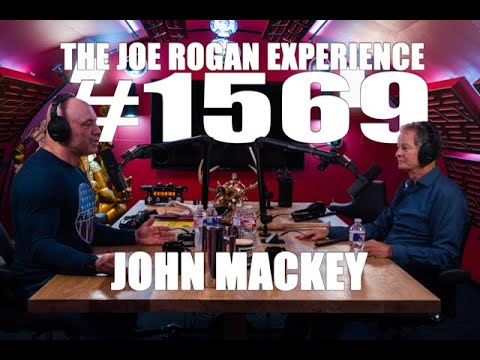
Joe Rogan Experience #1569 - John Mackey
Narrator, Joe Rogan (host), John Mackey (guest), Narrator
In this episode of The Joe Rogan Experience, featuring Narrator and Joe Rogan, Joe Rogan Experience #1569 - John Mackey explores whole Foods CEO Defends Conscious Capitalism, Clashes Over Diet Science Joe Rogan and Whole Foods CEO John Mackey discuss capitalism, socialism, and Mackey’s concept of “conscious capitalism,” arguing that business can create broad social good when it focuses on value creation, not just profit.
Whole Foods CEO Defends Conscious Capitalism, Clashes Over Diet Science
Joe Rogan and Whole Foods CEO John Mackey discuss capitalism, socialism, and Mackey’s concept of “conscious capitalism,” arguing that business can create broad social good when it focuses on value creation, not just profit.
They debate COVID policy, government overreach, and how lockdowns, fear, and media incentives have shaped public behavior and economic damage.
A large portion of the conversation centers on nutrition: whole‑foods plant-based diets, meat, epidemiology, Blue Zones, and whether plant-based diets uniquely reverse heart disease, leading to a prolonged, technical disagreement.
They close by exploring leadership, corporate culture at Whole Foods, personal discipline, and the importance of purpose, love, and authenticity in both business and life.
Key Takeaways
Reframe capitalism as innovation and value creation, not greed.
Mackey argues that what we call capitalism is better understood as “innovationism”: businesses commercialize scientific advances to create value, lifting billions out of poverty and extending lifespan when they’re oriented around solving real problems.
Recognize that socialism historically fails due to flawed incentives.
Both note that dozens of socialist experiments have collapsed or reversed course; without profit incentives and personal stakes, productivity and innovation stall, and governments tend to resort to coercion and mismanagement, including environmental damage.
Balance public health measures with economic and mental health realities.
They criticize heavy-handed COVID lockdowns for ignoring the health costs of economic destruction, isolation, and delayed care, suggesting a strategy focused on protecting the vulnerable, strengthening immune health, and keeping people working safely.
Be wary of diet claims that ignore confounding lifestyle factors.
Their long debate on plant-based diets vs. ...
Use business as a platform for purpose and love, not just profit.
Mackey’s ‘conscious leadership’ model says companies should seek win‑win‑win outcomes for customers, employees, suppliers, investors, and society, emphasizing purpose and genuine care as core strategic advantages that drive loyalty and long-term success.
Tie employee incentives directly to health and culture.
Whole Foods gives baseline discounts to all staff and larger discounts to those who hit biometric targets (BMI/waist, cholesterol, blood pressure, non‑smoker), and trains “cultural champions” to spread the company’s purpose and values throughout the workforce.
Detach identity from beliefs to reduce polarization and learn faster.
Both stress treating beliefs like clothes you can change—if new evidence comes, you swap outfits—rather than as your core self; that mindset allows open debate, course correction, and less emotional reactivity when strongly held ideas are challenged.
Notable Quotes
“Business is primarily about creating value for other people, and through creating value, you make a profit.”
— John Mackey
“Greed is found in human nature, Joe. It’s not just found in business people.”
— John Mackey
“It’s like sucking a thousand dicks in front of your mother. That’s how bombing feels.”
— Joe Rogan
“Ideas are like clothes. They’re not who I am. When they don’t fit any longer, I set them aside.”
— John Mackey
“We agree on 90% of it. It’s the question of how much animal foods are good for us.”
— John Mackey
Questions Answered in This Episode
How persuasive is John Mackey’s “conscious capitalism” vision in addressing criticisms that capitalism inherently drives inequality and environmental harm?
Joe Rogan and Whole Foods CEO John Mackey discuss capitalism, socialism, and Mackey’s concept of “conscious capitalism,” arguing that business can create broad social good when it focuses on value creation, not just profit.
In the COVID discussion, where do you personally draw the line between necessary public health intervention and damaging government overreach?
They debate COVID policy, government overreach, and how lockdowns, fear, and media incentives have shaped public behavior and economic damage.
After hearing both sides of the diet debate, what specific changes—if any—would you make to your own eating habits and why?
A large portion of the conversation centers on nutrition: whole‑foods plant-based diets, meat, epidemiology, Blue Zones, and whether plant-based diets uniquely reverse heart disease, leading to a prolonged, technical disagreement.
Could Mackey’s model of tying employee perks to health metrics be scaled ethically across other industries without becoming intrusive or discriminatory?
They close by exploring leadership, corporate culture at Whole Foods, personal discipline, and the importance of purpose, love, and authenticity in both business and life.
If future medicine could reliably extend healthy life by decades, how might that change your career, family, and risk-taking decisions today?
EVERY SPOKEN WORD
Install uListen for AI-powered chat & search across the full episode — Get Full Transcript
Get more out of YouTube videos.
High quality summaries for YouTube videos. Accurate transcripts to search & find moments. Powered by ChatGPT & Claude AI.
Add to Chrome