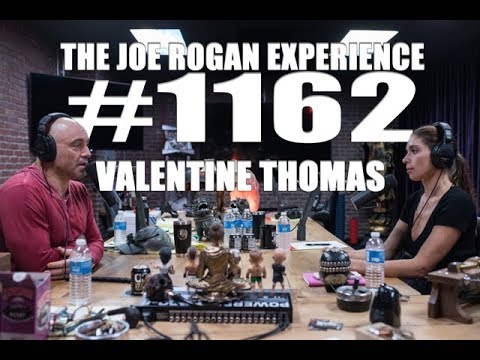
Joe Rogan Experience #1162 - Valentine Thomas
Joe Rogan (host), Valentine Thomas (guest), Guest (unidentified male friend/producer) (guest), Guest (brief interjection) (guest)
In this episode of The Joe Rogan Experience, featuring Joe Rogan and Valentine Thomas, Joe Rogan Experience #1162 - Valentine Thomas explores from Corporate Law To Deep Blue: Valentine Thomas Redefines Hunting Joe Rogan interviews Valentine Thomas, a former lawyer and finance professional who left her conventional career to become a full‑time spearfisher and freediving instructor.
From Corporate Law To Deep Blue: Valentine Thomas Redefines Hunting
Joe Rogan interviews Valentine Thomas, a former lawyer and finance professional who left her conventional career to become a full‑time spearfisher and freediving instructor.
She explains how facing her fear of the ocean led to a profound life change, a deeper connection to food sourcing, and a more community‑oriented way of living.
Together they critique industrial fishing, media hypocrisy, and public outrage culture, contrasting small‑scale, selective hunting with destructive commercial practices and supermarket detachment.
They also dive into freediving physiology, shark encounters, near‑death experiences, and the personal costs and rewards of rejecting the traditional career path in favor of passion and purpose.
Key Takeaways
Selective hunting is often more ethical than blind consumption.
Thomas argues that personally harvesting a few fish with a spear—selectively and with full awareness—is far less damaging than buying anonymous, mass‑caught seafood from industrial fleets.
Freediving capacity is largely trainable, not innate.
She went from barely holding her breath 15–20 seconds to over five minutes by using controlled breathing, relaxation, and leveraging the mammalian dive reflex, showing most people can significantly improve with training.
Industrial fishing is a primary driver of ocean depletion.
They highlight bottom trawlers, mile‑long nets, and foreign factory ships that destroy seafloor habitat and indiscriminately catch everything, contrasting this with tightly regulated recreational and spearfishing quotas.
Public outrage is driven by optics, not substance.
Examples like The Wall Street Journal dropping her from an event, or sponsors panicking over shark photos, show companies reacting to how things look online rather than to actual environmental impact.
Modern comfort can numb people to community and reality.
After living simply in places like Cape Verde and the Bahamas, Thomas realized how city life and consumerism had distanced her from neighbors, nature, and the true cost of food.
Stepping out of the comfort zone reveals who you really are.
Living out of her car, facing sharks, and nearly drowning forced Thomas to confront fear, ego, and hypocrisy—and ultimately clarified what she values more than money or status.
Conservation works when incentives and rules are aligned.
Rogan cites U. ...
Notable Quotes
“I cannot spend my entire life just seeking to buy things to impress people I don’t like.”
— Valentine Thomas
“If you eat fish, you cannot be against spearfishing. If you eat meat, you cannot be against hunting.”
— Valentine Thomas
“People are killing things left and right with their pocketbook. They’re paying a supermarket hitman to go out and do the work for them.”
— Joe Rogan
“You’re never gonna discover the person you are by staying in your comfort zone.”
— Valentine Thomas
“What you’re doing is admirable. I wish more people would chase their dreams instead of just jumping into the rat race.”
— Joe Rogan
Questions Answered in This Episode
How should we realistically balance the needs of small‑scale fishers with the push to curb industrial overfishing worldwide?
Joe Rogan interviews Valentine Thomas, a former lawyer and finance professional who left her conventional career to become a full‑time spearfisher and freediving instructor.
If more people hunted or spearfished their own food, would that meaningfully change environmental outcomes—or just our personal ethics and awareness?
She explains how facing her fear of the ocean led to a profound life change, a deeper connection to food sourcing, and a more community‑oriented way of living.
Where do we draw the line between necessary public sensitivity to animals and counterproductive outrage that silences honest discussions about food sourcing?
Together they critique industrial fishing, media hypocrisy, and public outrage culture, contrasting small‑scale, selective hunting with destructive commercial practices and supermarket detachment.
Could a global version of the North American conservation funding model (taxing gear to restore habitat) work for the oceans, and who would enforce it?
They also dive into freediving physiology, shark encounters, near‑death experiences, and the personal costs and rewards of rejecting the traditional career path in favor of passion and purpose.
What personal sacrifices—comfort, stability, income—are we actually willing to make to live a life that aligns with our values the way Thomas has?
EVERY SPOKEN WORD
Install uListen for AI-powered chat & search across the full episode — Get Full Transcript
Get more out of YouTube videos.
High quality summaries for YouTube videos. Accurate transcripts to search & find moments. Powered by ChatGPT & Claude AI.
Add to Chrome