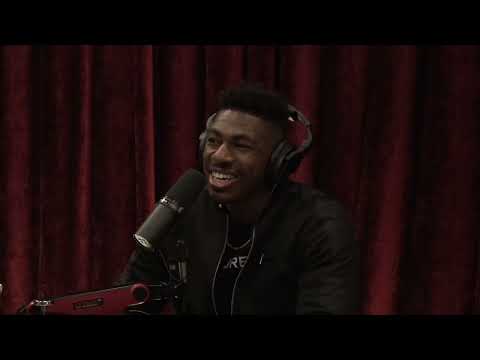
JRE MMA Show #132 with Joaquin Buckley
Joe Rogan (host), Narrator, Joaquin Buckley (guest), Narrator, Narrator, Narrator
In this episode of The Joe Rogan Experience, featuring Joe Rogan and Narrator, JRE MMA Show #132 with Joaquin Buckley explores self-taught knockout artist Joaquin Buckley reshapes path to UFC glory Joaquin Buckley joins Joe Rogan to unpack his unlikely rise from YouTube-taught martial artist and small “mom-and-pop” gyms to owning one of MMA’s most viral knockouts. He details how movies, online tutorials, and limited early coaching shaped his unconventional striking, then contrasts that with the structured, tight-knit team he now relies on. Buckley explains why he’s moving from middleweight to welterweight, how big gyms can fail developing fighters, and why personal hardship—losing both parents and caring for his grandmother with ALS—fuels his fighting spirit. The conversation ranges across technical striking influences, gym culture, weight cutting, title fights, and the mental side of both combat sports and life.
Self-taught knockout artist Joaquin Buckley reshapes path to UFC glory
Joaquin Buckley joins Joe Rogan to unpack his unlikely rise from YouTube-taught martial artist and small “mom-and-pop” gyms to owning one of MMA’s most viral knockouts. He details how movies, online tutorials, and limited early coaching shaped his unconventional striking, then contrasts that with the structured, tight-knit team he now relies on. Buckley explains why he’s moving from middleweight to welterweight, how big gyms can fail developing fighters, and why personal hardship—losing both parents and caring for his grandmother with ALS—fuels his fighting spirit. The conversation ranges across technical striking influences, gym culture, weight cutting, title fights, and the mental side of both combat sports and life.
Key Takeaways
Unconventional learning can still produce elite skills if paired with obsession and repetition.
Buckley never had formal traditional striking instructors; he built his famous kicks by obsessively studying YouTube tutorials and martial arts movies, then drilling techniques on heavy bags until they became powerful and instinctive.
A small, focused team can outperform big-name gyms for many developing fighters.
He argues big gyms often leave unknown fighters to ‘sink or swim’ in hard sparring, while smaller camps offer structure, targeted partner selection, and constant attention—key for long-term skill development and safety.
Repetition of basics under strict coaching matters more than endlessly chasing new techniques.
Buckley’s current coach makes him and his teammates drill the same core patterns over and over until they become reflexive, resisting the temptation to constantly add new flashy moves from the internet.
Choosing excitement over optimal strategy has real career and financial trade-offs.
Early in his UFC run, Buckley consciously chased knockouts and bonuses, prioritizing fan-friendly striking over safer paths to victory; now he’s pivoting toward a ‘championship’ mindset focused on winning first, excitement second.
Fighting at a non-ideal weight class magnifies physical disadvantages at the elite level.
He reveals he sometimes walked into middleweight fights at only 181–185 lbs against opponents cutting from 220–240, and believes moving to welterweight is necessary to remove unnecessary size and strength gaps.
Personal hardship can forge resilience and perspective that transfers directly into fighting.
Losing both parents young and putting his career on hold to care for his grandmother with ALS gave Buckley a deep sense that most problems—including fear of fighting—are small by comparison, strengthening his resolve in the cage.
Modern fighters must be both specialists and generalists, but development needs sequencing.
They discuss how pure wrestling or striking isn’t enough in today’s MMA; wrestlers like Khabib or Bo Nickal still need years of focused adaptation, and rushing blue-chip prospects (e. ...
Notable Quotes
““Nobody taught me that kick… I was just fascinated with martial arts and learned it off YouTube and movies.””
— Joaquin Buckley
““Big gyms got all the pretty stuff, but a lot of ’em don’t have structure… they’re not gonna develop you.””
— Joaquin Buckley
““At first I was fighting to be exciting and get that third check. Now I’m fighting to be a champion.””
— Joaquin Buckley
““I was willing to give up everything to take care of my grandmother. I wouldn’t be here if she wasn’t there for me.””
— Joaquin Buckley
““You die twice: when you take your last breath, and when they say your name for the last time. I just want my name to be remembered somehow.””
— Joaquin Buckley
Questions Answered in This Episode
How much can a fighter realistically build their game from YouTube and film study before they *must* find high-level in-person coaching?
Joaquin Buckley joins Joe Rogan to unpack his unlikely rise from YouTube-taught martial artist and small “mom-and-pop” gyms to owning one of MMA’s most viral knockouts. ...
What would an ideal development path look like for a young talent to avoid being ‘lost in the crowd’ at big super-gyms?
Where is the right balance between fighting intelligently to win and taking risks to entertain and build a brand like Buckley did early on?
How differently might Buckley’s career have unfolded if he’d been placed at his optimal weight class and in a structured camp from the start?
In what ways do experiences like losing parents young or caring for a sick relative tangibly change a fighter’s approach to training, fear, and adversity?
EVERY SPOKEN WORD
Install uListen for AI-powered chat & search across the full episode — Get Full Transcript
Get more out of YouTube videos.
High quality summaries for YouTube videos. Accurate transcripts to search & find moments. Powered by ChatGPT & Claude AI.
Add to Chrome