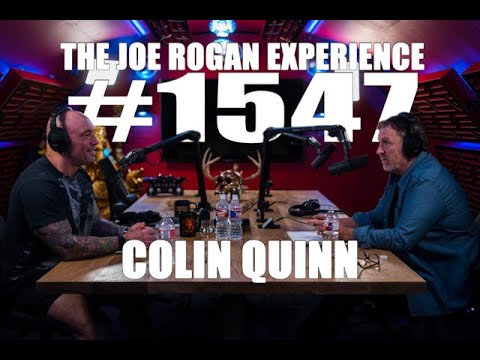
Joe Rogan Experience #1547 - Colin Quinn
Narrator, Joe Rogan (host), Colin Quinn (guest), Guest (same conversation, brief additional segment) (guest), Narrator
In this episode of The Joe Rogan Experience, featuring Narrator and Joe Rogan, Joe Rogan Experience #1547 - Colin Quinn explores colin Quinn and Joe Rogan Dissect Comedy, New York, and Power Joe Rogan and Colin Quinn spend a long, free‑wheeling conversation bouncing between the state of New York under COVID, political leadership, policing, and the way social media distorts public perception.
Colin Quinn and Joe Rogan Dissect Comedy, New York, and Power
Joe Rogan and Colin Quinn spend a long, free‑wheeling conversation bouncing between the state of New York under COVID, political leadership, policing, and the way social media distorts public perception.
They dive deep into stand‑up comedy: gritty club histories in New York, Boston, Houston, and LA; how comics actually develop material; and war stories about hecklers, mob‑run rooms, and cocaine‑fueled 1980s scenes.
The pair reflect on influential comics like Sam Kinison, Bill Hicks, Bill Cosby, and Norm Macdonald, exploring how fame, drugs, and even brain injuries shaped their acts and legacies.
Throughout, Quinn half‑jokingly flirts with the idea of moving to Texas and reviving his old panel show Tough Crowd as a modern, uncensored comedy podcast based around Rogan’s planned Austin comedy club.
Key Takeaways
COVID exposed how much local leadership matters.
Quinn argues that mayors like de Blasio and Garcetti were largely ignored until COVID, but their decisions on lockdowns, policing, and business closures suddenly became life‑defining, revealing who was and wasn’t a real crisis leader.
Get the full analysis with uListen
Social media skews public perception of policing.
Rogan notes that only the worst police encounters go viral, creating an impression that all cops behave horribly, even though millions of mundane, respectful interactions are never seen, feeding a broad, simplistic ‘all cops are bad’ narrative.
Get the full analysis with uListen
Great stand-up needs both big rooms and brutal small rooms.
They emphasize that comics must test material in tiny, indifferent late‑night crowds to strip out ‘fat’ and hype, then in large, adoring rooms to see what’s truly special‑worthy, treating career development like cross‑training.
Get the full analysis with uListen
Crowd work and ‘local’ jokes can be seductive crutches.
Boston’s hyper‑local style and heavy crowd work made killers locally but often collapsed on the road, showing that sustainable greatness comes from material that works with strangers, not just hometown references or fake improvisation.
Get the full analysis with uListen
Comedy is a meritocracy—but not everyone accepts that.
Quinn and Rogan insist that in the long run comics get the respect they actually earn: real killers are universally acknowledged, while weaker comics often externalize blame, claiming they’re underrated instead of improving.
Get the full analysis with uListen
Audience discomfort kills jokes faster than being offensive.
Quinn argues a comic can be edgy, cruel, or political, but cannot appear ashamed or uncomfortable; once the audience feels sorry for you, the hypnotic ‘follow the leader’ bond is broken and the act collapses.
Get the full analysis with uListen
There’s a genuine opportunity to rebuild comedy outside Hollywood.
With LA shrinking, Rogan pitches Austin as a new hub—rapid COVID testing, a purpose‑built club, and a Tough Crowd‑style podcast—suggesting a future where comics bypass TV gatekeepers and build careers around clubs and digital platforms.
Get the full analysis with uListen
Notable Quotes
“You can argue either side of ‘New York is dead’ and be right.”
— Colin Quinn
“The audience can hate you, but they can never feel sorry for you.”
— Colin Quinn
“Here’s the thing about comedy: everybody gets the respect they deserve.”
— Joe Rogan
“First be funny. Like doctors—first do no harm.”
— Colin Quinn
“Somewhere out there there’s someone who hasn’t seen Joe DiMaggio play, and I don’t want to let them down.”
— Colin Quinn (paraphrasing Joe DiMaggio as a model for how comics should treat every show)
Questions Answered in This Episode
How realistic is Quinn and Rogan’s vision of Austin becoming the new epicenter of American stand‑up, and what would that mean for legacy scenes like New York and LA?
Joe Rogan and Colin Quinn spend a long, free‑wheeling conversation bouncing between the state of New York under COVID, political leadership, policing, and the way social media distorts public perception.
Get the full analysis with uListen AI
To what extent does the viral nature of social media justify or distort contemporary anti‑police sentiment, and how could platforms present a more balanced picture?
They dive deep into stand‑up comedy: gritty club histories in New York, Boston, Houston, and LA; how comics actually develop material; and war stories about hecklers, mob‑run rooms, and cocaine‑fueled 1980s scenes.
Get the full analysis with uListen AI
Is comedy truly a meritocracy, or do factors like gender, race, industry politics, and algorithm‑driven visibility skew who gets recognized as ‘great’?
The pair reflect on influential comics like Sam Kinison, Bill Hicks, Bill Cosby, and Norm Macdonald, exploring how fame, drugs, and even brain injuries shaped their acts and legacies.
Get the full analysis with uListen AI
What responsibilities—if any—do comics have when they tackle topics like conspiracy theories, police violence, and political extremism in an already polarized culture?
Throughout, Quinn half‑jokingly flirts with the idea of moving to Texas and reviving his old panel show Tough Crowd as a modern, uncensored comedy podcast based around Rogan’s planned Austin comedy club.
Get the full analysis with uListen AI
Would a revived Tough Crowd‑style show actually be possible in today’s climate without career‑ending backlash, and if so, what guardrails (if any) should it have?
Get the full analysis with uListen AI
Transcript Preview
(drum music) Joe Rogan podcast, check it out. The Joe Rogan Experience.
Train by day, Joe Rogan podcast by night, all day. (rock music) Colin Quinn, I had to move to Texas to get you on this podcast. I tried forever to get you in LA. You said, "No chance."
Not true.
Oh, okay. I- every time we see each other, we just- yeah. (laughs)
I was always like, "Ah, I'll get out there one of these days," but I- I'm glad I waited this long. It's kind of- I can savor. I can appreciate it.
Ah, I'm savoring it right now.
If I was on one of the first podcasts, I'd be like, "Yeah, I was on Joe's and I was on this one." This is like, you know, you're getting, you're getting the respect you deserve now.
I see. Um, what- what is it like in the lockdown for you? You still living in New York?
Yeah, I live in New York.
Is it weird?
Yeah, I mean, it's- I was telling everybody, it's, uh, you know, it's- it's very... It's not like- people are like, "Oh, it's like New York in the '70s." No, the '70s was a whole different vibe and- but now, it's all boarded up stores. The store on my corner, like the corner bodega, basically, just closed and it was, uh, you know, it was around for a long time and, you know, it's- it's depressing. Like you're on the subway, there's only a few people on and it still smells. It smells as bad. They've been cleaning it every day and it still stinks. It doesn't even smell better. That's how ingrained it is. And, um... You know, the- the pigeons are homeless 'cause ANTIFA took down all the statues, so they have no place to live.
(laughs)
And, um... Yeah, it's- it's a very, it's a very, uh, weird place.
You can't say, like people that say it's like the '70s, like no, the '70s it was like, it was the '50s and the '60s and the '70s, like, it didn't change much. It was seedy and weird.
Yeah.
But it was always like that. This is a-
Yeah.
... drastic change from six months ago. You can't say it's like the '70s, because it's not. It's like, uh, something has deteriorated. There's a collapse.
Right.
And then there's all this weirdness that comes along with that.
Well, the '70s was kind of a collapse, but it was a different type. So like in the '70s, all the stores at night would be locked up, but they were open during the day.
Mm.
So at night, if anybody was out after 9:00 at night, that was on them. But I mean, but it was not like now where it's just 20- you're walking down deserted streets, there's nobody out, you know what I mean? It's just-
Install uListen to search the full transcript and get AI-powered insights
Get Full TranscriptGet more out of YouTube videos.
High quality summaries for YouTube videos. Accurate transcripts to search & find moments. Powered by ChatGPT & Claude AI.
Add to Chrome