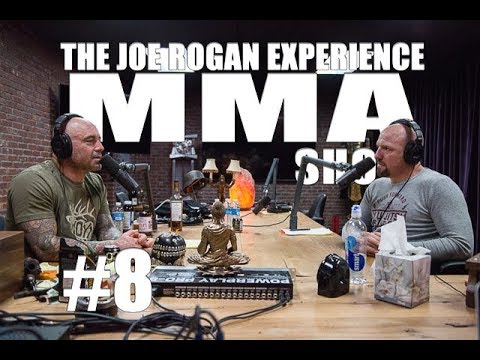
JRE MMA Show #8 with Jimmy Smith
Joe Rogan (host), Jimmy Smith (guest), Narrator, Narrator, Narrator, Narrator, Narrator
In this episode of The Joe Rogan Experience, featuring Joe Rogan and Jimmy Smith, JRE MMA Show #8 with Jimmy Smith explores inside MMA Commentary, Weight-Cutting Dangers, And Khabib’s Dominance Explained Joe Rogan and Jimmy Smith dive deep into the craft of MMA commentary, Jimmy’s exit from Bellator, and the evolution of high‑level mixed martial arts. They unpack why good commentators are rare, how storytelling and technical insight shape the viewer’s experience, and why some great fighters make poor analysts or coaches. A large portion focuses on weight cutting, new hydration rules, and examples from fighters like Douglas Lima, Khabib Nurmagomedov, and Rafael dos Anjos to show how divisions and styles are changing. They close by speculating about Conor McGregor’s future, Khabib vs. Tony Ferguson, the business of promotions, and how careers like Jimmy’s fit into a rapidly shifting MMA landscape.
Inside MMA Commentary, Weight-Cutting Dangers, And Khabib’s Dominance Explained
Joe Rogan and Jimmy Smith dive deep into the craft of MMA commentary, Jimmy’s exit from Bellator, and the evolution of high‑level mixed martial arts. They unpack why good commentators are rare, how storytelling and technical insight shape the viewer’s experience, and why some great fighters make poor analysts or coaches. A large portion focuses on weight cutting, new hydration rules, and examples from fighters like Douglas Lima, Khabib Nurmagomedov, and Rafael dos Anjos to show how divisions and styles are changing. They close by speculating about Conor McGregor’s future, Khabib vs. Tony Ferguson, the business of promotions, and how careers like Jimmy’s fit into a rapidly shifting MMA landscape.
Key Takeaways
Elite MMA commentary is a specialized skill, not a plug‑and‑play role for ex‑fighters.
Rogan and Smith stress that being a great fighter doesn’t automatically translate to being a good coach or broadcaster; you need timing, teaching ability, genuine enthusiasm, and the ability to tell compelling stories in real time.
Get the full analysis with uListen
Effective commentary has three jobs: educate, transmit enthusiasm, and tell the fight’s story.
They explain that most viewers don’t understand grappling or nuanced transitions, so analysts must explain positions, stay excited without faking it, and frame each bout like a narrative (e. ...
Get the full analysis with uListen
Modern weight cutting is more extreme and more dangerous than in early MMA.
Examples like Douglas Lima cutting from ~210 to 170 highlight how far fighters push their bodies; they discuss IV bans, hydration testing (ONE FC, high school wrestling), and argue that rule tweaks alone won’t override fighters’ risk‑taking mentality.
Get the full analysis with uListen
Khabib’s dominance over Barboza showcased a new level of pressure‑wrestling in MMA.
They frame Khabib’s performance as making an elite striker look lost, emphasizing his inevitability, top control time, and 10‑8 rounds even under old scoring criteria—raising the bar for what ‘dominant’ looks like at lightweight.
Get the full analysis with uListen
Weight class changes require style adjustments, not just moving the scale number.
Rogan and Smith praise Rafael dos Anjos for changing his approach at 170—focusing on volume, leg kicks, and attrition rather than pure power, recognizing that what knocked guys out at 155 won’t work on bigger welterweights.
Get the full analysis with uListen
MMA’s scoring and officiating remain highly subjective, making strong referees and judges crucial.
They recount odd scorecards, inconsistent 10‑8s, and quirky ref decisions (like partial time for low blows), noting that concepts like ‘intelligently defending’ or ‘effective striking’ still depend heavily on individual interpretation.
Get the full analysis with uListen
Promotional ecosystems and timing can make or hide great fighters and broadcasters.
Stories about Eddie Alvarez, Yves Edwards, Mayhem Miller, Jacare, and even Jimmy Smith’s own career show how contracts, defunct divisions, and rival promotions can keep world‑class talent off the mainstream radar for years.
Get the full analysis with uListen
Notable Quotes
““You can’t fake enthusiasm.””
— Jimmy Smith
““Don’t say anything my mom knows.””
— Jimmy Smith, on good color commentary
““If you don’t play chess, eventually there’ll come a time where no one will ask you to play chess.””
— Jimmy Smith, quoting Bobby Fischer’s friend about Conor’s inactivity
““You’re asking people who already take a huge risk…to not take another huge risk.””
— Jimmy Smith, on fighters and extreme weight cuts
““When everybody talks, everybody loses.””
— Jimmy Smith, on broadcast teams stepping on each other’s commentary
Questions Answered in This Episode
What specific habits or training could aspiring commentators adopt to reach the level Rogan and Smith describe?
Joe Rogan and Jimmy Smith dive deep into the craft of MMA commentary, Jimmy’s exit from Bellator, and the evolution of high‑level mixed martial arts. ...
Get the full analysis with uListen AI
How realistic is it that global MMA ever truly solves the weight‑cutting problem without completely reshaping the sport’s business model?
Get the full analysis with uListen AI
In a Khabib vs. prime Rafael dos Anjos rematch, with both at their current best, how might the fight look different from their first meeting?
Get the full analysis with uListen AI
How much should promotions prioritize cross‑promotion or neutral ‘world titles’ to recognize talent outside the UFC brand?
Get the full analysis with uListen AI
What are the ethical limits of letting incredibly one‑sided fights (like Khabib–Barboza) continue in the hope of a miraculous comeback?
Get the full analysis with uListen AI
Transcript Preview
... waiting on ja-? We good?
Just waiting on you guys.
Oh, okay. Oh, yeah. Oh, sorry. (laughs)
(laughs)
We're chatting about kombucha. I just wanna say before this podcast starts, you fucked up, Bellator.
(laughs)
You fucked up. You fucked up. I've been telling everybody that Jimmy Smith's the best out there forever, and you let him go. That's, that's, that's a, that's a huge error on their part.
It's just... We can't talk about anything.
It is what it is.
That might be, like, uh, some future news. We can't talk about that. We can't, uh- But the past is, the past is up for-
Yeah.
... for discussion, that's for sure.
The past is up for discussion. I would be-
The present's good.
... thrilled if somehow or another they were able to work it out where Jimmy Smith was at the UFC.
We shall see.
That would be what I would like to see.
We shall see how that goes.
I would like to see that.
We will.
That, they've... That's a big fuck up.
Yeah, man. It was, um... What do you want me to say? Like, uh, just a little background because a lot of people have been asking me. I haven't made any real public statements other than that-
I'm not a Bellator hater. I just want to say.
Yeah, no. Bellator is-
Across the board, never been a Bellator hater.
Yeah, yeah.
Respect. You know?
Yeah.
I enjoy watching it. I like the fighters.
Yeah.
And I've always told everybody that you were the best out there.
Thank you so much.
You, you do an amazing job.
I really appreciate that. Um, number one, yeah, it's, it's not a, it's not a Bellator thing. I mean, they, they were great to work with. They were great about the, the whole breakup thing. Um-
They fucked up!
(laughs)
Just say it! Someone say it!
Yeah, so what happened was I was... I had a, I had a, a, a deal with a, with an option year, and 2018 was my option year. And when I was in, uh, Verona, New York, doing the Verona show, my boss sat me down, and he said, "We're not gonna renew 2018. We want a diff- we want a different deal." And when they come to you and say, "We want a different deal," what, they're not-
They want to downgrade.
It's never-
Yeah.
... it's never... You know, when your girlfriend comes to you and says, "I want to talk," it's never, "I don't give enough blow jobs." That's never-
(blow job sounds)
That's never what they... They never say that. It's always-
I'm gonna be a better girlfriend.
Exactly. Yeah, it's never-
Install uListen to search the full transcript and get AI-powered insights
Get Full TranscriptGet more out of YouTube videos.
High quality summaries for YouTube videos. Accurate transcripts to search & find moments. Powered by ChatGPT & Claude AI.
Add to Chrome