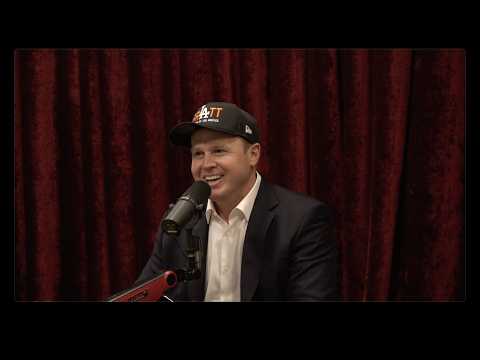
Joe Rogan Experience #2483 - Spencer Pratt
Joe Rogan (host), Spencer Pratt (guest)
In this episode of The Joe Rogan Experience, featuring Joe Rogan and Spencer Pratt, Joe Rogan Experience #2483 - Spencer Pratt explores spencer Pratt’s LA mayor bid targets fire negligence and NGO fraud Pratt says the Pacific Palisades fire disaster stemmed from foreseeable risk, inadequate preparation, and institutional negligence, not simply climate change or “hurricane winds.”
Spencer Pratt’s LA mayor bid targets fire negligence and NGO fraud
Pratt says the Pacific Palisades fire disaster stemmed from foreseeable risk, inadequate preparation, and institutional negligence, not simply climate change or “hurricane winds.”
Both Rogan and Pratt argue that homelessness funding in LA has become an “industrial complex” where billions flow to NGOs, contractors, and overhead with weak accountability and worsening street conditions.
Pratt proposes mandatory treatment for severe addiction and mental illness, paired with strict enforcement of existing laws against open drug use and encampments, framing this as “compassion” through intervention rather than tolerance.
He claims city governance is distorted by ideological capture and self-dealing, citing council politics, prosecution policy, and alleged cover-ups that block audits and obscure public records.
Pratt outlines a “day one” strategy: recruit experienced operators, cooperate with federal agencies (IRS CI, DEA/ATF, CDC), publish transparent spending dashboards, and apply political pressure to city council members via their districts.
Key Takeaways
They frame the wildfire failure as preventable mismanagement, not an unforeseeable climate event.
Pratt argues agencies had clear red-flag forecasts, yet lacked fuel management/fire breaks, removed resources too early, and faced water-supply failures—undercutting claims that wind/climate made losses inevitable.
Get the full analysis with uListen
Money flows are portrayed as the core lever: follow the incentives, not the slogans.
Both contend that “homeless services” and disaster relief are attractive for graft because outcomes are hard to measure, unlike line-item services such as fire operations where assets and staffing are easier to audit.
Get the full analysis with uListen
Their policy north star is enforcement plus treatment, not more programs.
Pratt repeatedly says LA’s street crisis is primarily addiction and severe mental illness, so the city should stop tolerating open drug use/encampments and instead route people into compulsory care pathways (he cites SB 43-style holds and conservatorship escalation).
Get the full analysis with uListen
Transparency is positioned as an operational tool, not just messaging.
Pratt proposes public-facing accounting (“live dashboard”) and immediate document production to enable federal investigations, arguing that bureaucracy survives by obscuring where funds go and what they accomplish.
Get the full analysis with uListen
They describe governance as constrained by prosecution policy and political retaliation.
Pratt claims LAPD/LAFD are “hands tied” without mayor/city attorney support, and says whistleblowing is discouraged by leadership’s ability to fire chiefs or manage narratives through PR and media access.
Get the full analysis with uListen
Federal partnerships are central to the plan, especially ahead of the Olympics.
Pratt argues LA can enlist IRS Criminal Investigation for NGO fraud, DEA/ATF for drug markets, and CDC for public-health surveillance in encampments—using national security/event readiness as justification for surge enforcement.
Get the full analysis with uListen
The campaign pitch is outsider governance with an ‘operators over ideologues’ staffing model.
He claims competent talent avoids LA due to “cartel” politics, so he would recruit experienced leaders (fire, studio/permit management, finance) and confront city council members publicly in their districts to reduce obstruction.
Get the full analysis with uListen
Notable Quotes
“I got so sick of just being a… ‘yapper.’”
— Spencer Pratt
“The idea that climate change is the get out of jail, burn everything down excuse, it doesn’t even add up.”
— Spencer Pratt
“They stole the money.”
— Joe Rogan
“It’s not a housing problem… It’s a drug abuse and mental health problem. That’s all it is.”
— Joe Rogan
“If you wanted to destroy a city… you would do it exactly the way they’re doing it.”
— Joe Rogan
Questions Answered in This Episode
On the fire timeline: what evidence most strongly supports the claim that Jan 7 was a rekindle of a New Year’s Eve fire, and what agency decisions would that directly implicate?
Pratt says the Pacific Palisades fire disaster stemmed from foreseeable risk, inadequate preparation, and institutional negligence, not simply climate change or “hurricane winds.”
Get the full analysis with uListen AI
Reservoir issue: who had operational authority to drain/keep Santa Ynez and the adjacent firefighting reservoir offline, and what would your procurement/maintenance reform be to prevent year-long outages?
Both Rogan and Pratt argue that homelessness funding in LA has become an “industrial complex” where billions flow to NGOs, contractors, and overhead with weak accountability and worsening street conditions.
Get the full analysis with uListen AI
FireAid/NGO claims: which specific NGOs received the largest shares, and what documentation would you subpoena first to prove whether funds reached victims versus overhead?
Pratt proposes mandatory treatment for severe addiction and mental illness, paired with strict enforcement of existing laws against open drug use and encampments, framing this as “compassion” through intervention rather than tolerance.
Get the full analysis with uListen AI
You repeatedly cite IRS Criminal Investigation: what exact “one document” do they need from each NGO/grant, and what legal mechanism would the city use to compel rapid production?
He claims city governance is distorted by ideological capture and self-dealing, citing council politics, prosecution policy, and alleged cover-ups that block audits and obscure public records.
Get the full analysis with uListen AI
Mandatory treatment plan: what facilities, staffing, and funding sources would handle a surge in 72-hour holds and longer conservatorships without simply shifting people into ERs and jails?
Pratt outlines a “day one” strategy: recruit experienced operators, cooperate with federal agencies (IRS CI, DEA/ATF, CDC), publish transparent spending dashboards, and apply political pressure to city council members via their districts.
Get the full analysis with uListen AI
Transcript Preview
Joe Rogan Podcast, check it out. The Joe Rogan Experience. Train by day, Joe Rogan Podcast by night. All day. [upbeat rock music]
What's going on, Mr. Mayor? [laughs]
[laughs] I'm so thankful to be here.
My pleasure. Um, so first of all, how did this idea even get into your head of running for mayor in LA?
To be clear, I never wanted to run for any political office or have anything to do with politicians. What happened was, after spending a year uncovering how my house and my parents' house burned down, and my neighbors burned alive, and, and 7,000 houses burned, and then I realized there's a, a cover-up going on, all the negligence, and I keep posting about it, and I have all the facts, I have all the whistleblowers, I have all the evidence, and business as usual. And I see that nobody is stepping up to run against the mayor who's responsible for this disaster and so many other disasters. So it became to the point where I got so sick of just being a, as the younger people say in the comments section, a yapper. Like, I felt like I was just yapping. I'm like making these videos, I'm telling the, the truth, I'm do-
Right
... I got a congressional investigation. I went to Washington, I met with everyone possible that I could do as just a citizen, and I, I was like, "Okay, well, game on now. I'm gonna go into your, into your headquarters and just take your job, and then remove all these toxic entities that are destroying our way of life in Los Angeles."
So let's start from the fire. Um, so the narrative was, my God, there was a lot of terrible, stupid, fake narratives, and one of them was climate change. That was the craziest one, that climate change is causing the fire. Look, I lived in LA for 29, 30 years, whatever it was, and I guess it was, yeah, somewhere around there. Eh, maybe even more. Whatever it was. Uh, when I lived in LA, fire season happened every year. It, this is not climate change. This is not some new thing over the last couple of decades. I was evacuated three different times. Uh, I used to live in Bell Canyon, and my neighbors, three of the homes right across the, right across the street from my house burned to the ground in 2018. There, there's always been fires in Los Angeles. But the lack of preparation for the Palisades fires was astonishing. The fact that the reservoir was empty was criminal mismanagement. I mean, it was just insanity that everybody knew that we had fires, like massive fires, that it was a dry place, and when the Santa Ana winds would blow, if something caught fire, it was a real problem. We had known that forever. And when you see all these people that are passing the buck and moving the blame, and then the fund, when they had that big charity thing for the fire, and you found out that hundreds of millions of dollars was raised. You know, if you're, you're looking at it in, it, it, like a, an, a rational person, a rational person would say, "Oh, this is great. All these people who lost their homes will have some funds from this, and they'll be able to rebuild." And then you find out that the money was given to, what was it? Like 108 different NGOs?
Install uListen to search the full transcript and get AI-powered insights
Get Full TranscriptGet more out of YouTube videos.
High quality summaries for YouTube videos. Accurate transcripts to search & find moments. Powered by ChatGPT & Claude AI.
Add to Chrome