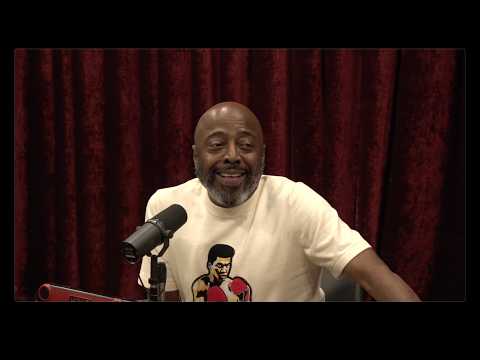
Joe Rogan Experience #2455 - Donnell Rawlings
Joe Rogan (host), Donnell Rawlings (guest), Joe Rogan (host), Joe Rogan (host), Joe Rogan (host), Joe Rogan (host), Joe Rogan (host), Donnell Rawlings (guest), Joe Rogan (host)
In this episode of The Joe Rogan Experience, featuring Joe Rogan and Donnell Rawlings, Joe Rogan Experience #2455 - Donnell Rawlings explores rawlings and Rogan riff on health, comedy beef, fame, purpose Donnell Rawlings opens by joking about digestive issues, drinking Tito’s with steak, aging, and needing a “handler,” prompting Rogan to push practical fixes like medical testing, exercise, and cutting back on alcohol/cigarettes.
Rawlings and Rogan riff on health, comedy beef, fame, purpose
Donnell Rawlings opens by joking about digestive issues, drinking Tito’s with steak, aging, and needing a “handler,” prompting Rogan to push practical fixes like medical testing, exercise, and cutting back on alcohol/cigarettes.
They pivot into nicotine, menthol cigarettes, and targeted marketing, then into diet myths: salt vs sugar, processed foods, and why sugary drinks drive metabolic disease—especially in communities heavily marketed to.
The episode’s core becomes comedy and culture: the economics of attention, why “beef” sells online, why some comics attack more successful peers, and Rawlings’ ongoing frustration with how Kill Tony clips and comment culture shaped narratives about him.
They close with reflections on success as happiness and craft, lessons from Chappelle-era touring and pandemic shows, and advice to stay off comments, focus on community, and be “undeniable.”
Key Takeaways
Rawlings’ ‘red meat problem’ likely reflects a broader lifestyle stack, not just age.
Rogan challenges the idea that steak alone is the culprit, pointing to alcohol pairing, smoking, and exercise habits; the practical next step is medical testing (allergies/intolerances, GI workup) and changing the surrounding behaviors.
Get the full analysis with uListen
Nicotine can enhance cognition, but delivery method drives harm and dependence.
Rogan frames nicotine as a cognitive enhancer used by “academics/writers,” while emphasizing smoking’s immediate hit comes with major health costs—compounded by additive strategies like ammonia to increase freebase nicotine.
Get the full analysis with uListen
Menthol’s ‘smoothness’ can increase inhalation depth and addiction risk.
Using an AI summary mid-show, they outline menthol’s cooling/numbing effects that suppress cough and mask irritation, potentially encouraging deeper, more frequent smoking without making it safer.
Get the full analysis with uListen
Diet misinformation often scapegoats the wrong villain—added sugar is central.
Rogan argues salt is essential and widely misblamed, while added sugar (especially liquid sugar) is metabolically disruptive; they underscore soda’s extreme sugar load and the lack of fiber buffering found in whole fruit.
Get the full analysis with uListen
Institutions can monetize desperation—megachurches and lotteries exploit hope.
They describe televangelists urging broke people to borrow to donate and the lottery’s structural house advantage (revenue split, lump-sum haircut, taxes), calling both ‘legal’ but predatory systems.
Get the full analysis with uListen
Online ‘beef’ is often a proxy for envy and career frustration.
Rogan’s model: people who aren’t ‘bigger’ than their targets attack upward to drag others down; Rawlings agrees many critics secretly want the status/position they’re mocking.
Get the full analysis with uListen
Comment addiction and clip narratives can distort reality and mental health.
Rawlings’ Kill Tony story centers on editing, context loss, and how audiences fixate on controversy; Rogan’s repeated prescription is to stop feeding the cycle—focus on craft, relationships, and what you can control.
Get the full analysis with uListen
Notable Quotes
“I eat a steak, and I wash it down with Titos and tonic.”
— Donnell Rawlings
“Cigarettes are a cognitive enhancer. Nicotine is a cognitive enhancer.”
— Joe Rogan
“They associate saturated fat with heart disease to get the blame off sugar.”
— Joe Rogan
“I think [megachurches are] a scam that’s legal.”
— Joe Rogan
“Everybody does not have to be Batman. I don’t have a problem with being Robin.”
— Donnell Rawlings
Questions Answered in This Episode
On the digestion issue: what specific symptoms does Rawlings get with steak (reflux, nausea, insomnia, constipation), and how often—and does it change with alcohol or late-night eating?
Donnell Rawlings opens by joking about digestive issues, drinking Tito’s with steak, aging, and needing a “handler,” prompting Rogan to push practical fixes like medical testing, exercise, and cutting back on alcohol/cigarettes.
Get the full analysis with uListen AI
Rogan claims salt ‘isn’t bad for you’—under what conditions does sodium restriction actually matter (kidney disease, hypertension subtypes), and what evidence is he relying on?
They pivot into nicotine, menthol cigarettes, and targeted marketing, then into diet myths: salt vs sugar, processed foods, and why sugary drinks drive metabolic disease—especially in communities heavily marketed to.
Get the full analysis with uListen AI
They mention ammonia and ‘freebase nicotine’ in cigarettes—how much does this vary by brand, and what does the research say about addiction intensity and delivery?
The episode’s core becomes comedy and culture: the economics of attention, why “beef” sells online, why some comics attack more successful peers, and Rawlings’ ongoing frustration with how Kill Tony clips and comment culture shaped narratives about him.
Get the full analysis with uListen AI
Rawlings argues targeted marketing shaped menthol brand loyalty in Black communities—what historical ad evidence and policy decisions (e.g., menthol exemptions) support or refute that?
They close with reflections on success as happiness and craft, lessons from Chappelle-era touring and pandemic shows, and advice to stay off comments, focus on community, and be “undeniable.”
Get the full analysis with uListen AI
Rogan calls megachurch fundraising ‘predatory’—what would a fair regulatory framework look like without violating religious freedom protections?
Get the full analysis with uListen AI
Transcript Preview
Joe Rogan Podcast, check it out!
The Joe Rogan Experience.
Trainer by day, Joe Rogan Podcast by night. All day. [upbeat music] Really? Red meat.
It's unfortunate. That's just-
In any form?
You know, like, I've... I know it's weird. If I eat a burger, it's different if I eat a steak.
Steak is a problem?
Yeah, I don't know if my digestive system just, like, you too old to fucking, uh-
How old are you?
bust this down. I'm 58.
I- I'm 58, too. I eat mostly meat. I don't think it's age.
What is it, then?
Well, what are you eating it with?
Uh, Titos. We rolling?
Uh-huh.
Titos. Titos and tonic.
Titos Vodka?
Well, it can't be that, right? [laughing]
[laughing]
No, T- [laughing] Titos, I'm eating a steak, and I wash it down-
You just eat, [laughing] you eat steak with Titos?
I eat a steak, and I wa- and I wash it down with Titos and tonic 'cause it's r- it resembles H2O so much, sometime I get thrown off until I do it.
What? [laughing]
Yeah, I think I'm gonna-
Titos and tonic resembles water?
The look of it.
The look of it.
It's clear.
That's all it matters to you?
Yeah.
[laughing]
I know at some point I need to change, I need to change my life.
Oh!
I'm at the age now that it's like, I look at certain food, and I'm like: "Oh, my God, it looks good, but you know you can't handle that." I think this is when I really, really need to be in love, because I need to be with somebody that understands when I go places and when I wanna pig out, they gotta be like, "He can't eat that. He's gonna be sick-"
Oh, right.
"He's gonna sit up-
You need a handler.
"He's gonna be throwing up." But I think it's-
You need a female handler.
A, a female handler. They, they call it geriatric, uh, like, they... This is what I hear.
[laughing]
That this is what the streets is saying.
The streets. [laughing]
Most men get to an age, it's the geriatric shit, when you just smash all the women you wanna do and everything. Now you're gonna have to worry about somebody helping you with your pill diet, helping you with your dietary needs and sort of thing, and they say that's a lot of times when men fall in love, when they need somebody to take them to the golden years, or when it's... When you're about to be out of here, you need somebody to say, "Don't do that. You gotta mash this food up, you gotta chop it up." But I'm having digestive issues sometimes.
With steak, huh?
With, it's red meat, I wanna say, and I've... I'm a fan of it.
So you eat... If you eat, like, a bowl of pasta with the Titos, no problem?
That's not a problem.
Interesting. Huh.
But it's definitely red meat. Red meat, I'm not sleeping.
Install uListen to search the full transcript and get AI-powered insights
Get Full TranscriptGet more from every podcast
AI summaries, searchable transcripts, and fact-checking. Free forever.
Add to Chrome