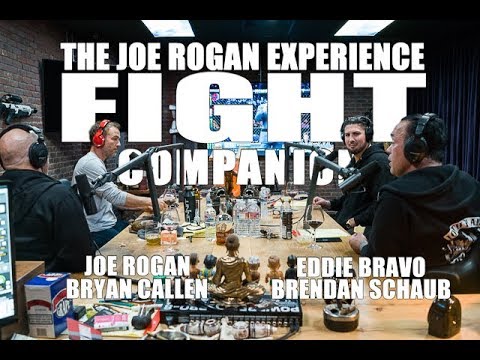
Joe Rogan Experience - Fight Companion - February 17, 2019
Joe Rogan (host), Brendan Schaub (guest), Bryan Callen (guest), Eddie Bravo (guest), Brendan Schaub (guest), Bryan Callen (guest), Eddie Bravo (guest), Bryan Callen (guest), Brendan Schaub (guest), Bryan Callen (guest), Brendan Schaub (guest), Brendan Schaub (guest), Eddie Bravo (guest), Eddie Bravo (guest), Bryan Callen (guest), Bryan Callen (guest), Bryan Callen (guest), Brendan Schaub (guest), Brendan Schaub (guest), Brendan Schaub (guest), Narrator, Bryan Callen (guest), Narrator, Bryan Callen (guest), Brendan Schaub (guest), Eddie Bravo (guest)
In this episode of The Joe Rogan Experience, featuring Joe Rogan and Brendan Schaub, Joe Rogan Experience - Fight Companion - February 17, 2019 explores rogan, Schaub, Bravo riff on UFC, fighting, and flat Earth This Fight Companion episode is a long, loose, four‑hour hang where Joe Rogan, Brendan Schaub, Eddie Bravo, and Brian Callen watch Cain Velasquez vs. Francis Ngannou and the rest of the UFC Phoenix card while constantly veering into side tangents.
Rogan, Schaub, Bravo riff on UFC, fighting, and flat Earth
This Fight Companion episode is a long, loose, four‑hour hang where Joe Rogan, Brendan Schaub, Eddie Bravo, and Brian Callen watch Cain Velasquez vs. Francis Ngannou and the rest of the UFC Phoenix card while constantly veering into side tangents.
They break down several fights in detail (Velasquez–Ngannou, Kron Gracie’s debut, Paul Felder vs. James Vick), debate who the greatest heavyweights are, and talk about training, conditioning, and coaching philosophies in MMA and jiu‑jitsu.
Between rounds they drift into comedy, parenting, cars, conspiracies (including Eddie’s flat‑Earth and “fake space” views), and memories from the comedy and fight worlds, frequently roasting each other.
The tone is very informal and chaotic—more like listening to four friends on a couch than a structured analysis show—so the value is in personality, chemistry, and insider anecdotes rather than clean fight commentary.
Key Takeaways
Francis Ngannou’s power and development make him uniquely dangerous at heavyweight.
They frame Ngannou as arguably the scariest puncher ever, highlighting how quickly he dismantled Cain Velasquez and previously Alistair Overeem and Curtis Blaydes, especially considering his relatively short time training MMA.
Get the full analysis with uListen
Kron Gracie’s back‑take and rear‑naked choke show that pure elite jiu‑jitsu still wins fights.
Rogan and Bravo emphasize how Kron calmly clinched, took the back, and finished Alex Caceres in round one, using classic Gracie fundamentals rather than complex modern setups, proving that world‑class grappling is still a fight‑ending weapon.
Get the full analysis with uListen
Late‑career heavyweights are limited more by their bodies than by their skills or will.
Rogan describes Cain as a ‘spaceship missing tiles’—the mind and heart are championship level, but accumulated injuries (knees, back) eventually fail under stress, as seen in the awkward finish against Ngannou.
Get the full analysis with uListen
Open scoring and more judges could improve combat sports judging transparency.
They praise Glory kickboxing’s use of five judges and open scoring (showing scores after every round), arguing it pressures judges to be accountable and lets fighters adjust strategy instead of guessing where they stand.
Get the full analysis with uListen
Wrestling remains the most important base for MMA success.
All four repeatedly come back to wrestling as the best starting discipline because it lets you dictate where the fight happens, with examples ranging from Khabib and Cormier to Tyron Woodley and their control-heavy styles.
Get the full analysis with uListen
High‑level training is becoming increasingly scientific and individualized.
They talk about TJ Dillashaw’s work with his performance team (Kalavita), moving away from altitude gimmicks toward volume, periodization, and data‑driven nutrition—suggesting future champions will combine talent with precise, science‑based prep.
Get the full analysis with uListen
Career pivots in fighting require honest self‑assessment and outside feedback.
Rogan and Schaub revisit Rogan’s on‑air plea for Schaub to retire; Schaub admits he initially resisted but ultimately realized his passion and upside were greater in comedy and podcasting, illustrating how hard but necessary those decisions are.
Get the full analysis with uListen
Notable Quotes
“Francis Ngannou is the scariest motherfucker in the history of the sport.”
— Joe Rogan
“People don’t understand the level of jiu‑jitsu—Kron is a different animal on your back.”
— Eddie Bravo
“I was thinking I was better than people because I knew so much about space… then I realized it’s all cartoons.”
— Eddie Bravo
“I knew you didn’t want to be doing this [fighting] anymore. This was a hill I was willing to die on.”
— Joe Rogan (to Brendan Schaub about urging him to retire)
“A huge part of success is knowing when you suck and when you’re good.”
— Brian Callen
Questions Answered in This Episode
How differently would we view Francis Ngannou if he had started wrestling in his teens instead of working in a sand mine and finding MMA late?
This Fight Companion episode is a long, loose, four‑hour hang where Joe Rogan, Brendan Schaub, Eddie Bravo, and Brian Callen watch Cain Velasquez vs. ...
Get the full analysis with uListen AI
Does Kron Gracie’s success suggest that pure, old‑school Gracie jiu‑jitsu can still carry a fighter to a UFC title, or will striking and takedown defense eventually cap his ceiling?
They break down several fights in detail (Velasquez–Ngannou, Kron Gracie’s debut, Paul Felder vs. ...
Get the full analysis with uListen AI
Would open scoring in the UFC meaningfully change fighter behavior and fan satisfaction, or would it just create new controversies?
Between rounds they drift into comedy, parenting, cars, conspiracies (including Eddie’s flat‑Earth and “fake space” views), and memories from the comedy and fight worlds, frequently roasting each other.
Get the full analysis with uListen AI
How much responsibility should commentators, promotions, and coaches bear for encouraging aging fighters like Cain Velasquez to continue—or to walk away?
The tone is very informal and chaotic—more like listening to four friends on a couch than a structured analysis show—so the value is in personality, chemistry, and insider anecdotes rather than clean fight commentary.
Get the full analysis with uListen AI
What does Eddie Bravo’s flat‑Earth and ‘space is fake’ stance reveal about how people form and protect fringe beliefs even when they embrace science and technology in other parts of their lives?
Get the full analysis with uListen AI
Transcript Preview
... you dare. (instrumental music plays)
I'll, I'll send you a link.
For, here we go, shh, shh, shh.
Just do it.
Three, dos, uno. (door closes) Yes! And we're live, ladies and gents. (laughs)
(laughs)
Brendon Schaub with the official Comedy Store jersey on. That's a real Comedy Store hoodie. That's the real shit.
It's the real deal, man.
You look like a doorman.
I look like a doorman.
Yeah, I wear those shits all the time.
I love them.
Yeah, me too.
I know, I finally got one.
<< It's your motherfucking bravo. >>
Dude, you'd be head of security if you were working the door. You know what I mean?
Too handsome?
Like, right away.
Dude, I'd-
Right away.
... I would do, uh, I'd work the, I'd be a doorman at the Comedy Store. Especially if they gave me spots in the OR, I'd 100% do that.
Shit.
Yeah, you'd get those 1:00 AM spots. You don't want them spots. Those spots are confidence crushers.
Ugh.
Yeah.
They make you wanna quit. (laughs)
(laughs)
(laughs)
Those spots-
Like, "Why am I doing this?" (laughs)
Those spots are good if you're Dave Chappelle.
Yeah.
They're good if you've been doing standup forever.
Fuck yeah, they're good if you're Dave Chappelle.
And then he-
He can walk into anything.
Well, the thing about that is, like, it's also good for you to be in front of a tired, small crowd. Like, a tired, small crowd is good.
Yeah.
To test out shit.
Yeah.
You know, those are, those are good.
Scary.
I did a, I did a spot, uh, an unannounced spot the other night at the Comedy Store in the OR, and it was, like, half packed.
At what time?
No, it was-
But dude, everybody loves you.
... it was fairly late. It was fairly late. But it was, uh, people were beaten down. It's a different animal.
Their energy is gone.
Yeah, yeah, yeah. It's different.
It's late.
It's interesting.
They're coming after dinner, drinks.
Half, half full, different... You know, you can get fucking real used to it. Like, Louis C.K. used to say that, like, he likes to just show up. And even though he was really famous and everything like that when he was doing this, still is, right? But e- when he would show up, what he liked is that they weren't h- there to see him.
Mm-hmm.
So then he would get a more honest response to his material. You know what I'm saying?
I like that fake shit. (laughs)
(laughs)
(laughs)
Like that, like when you go on, um...
(gasps) (laughs)
Install uListen to search the full transcript and get AI-powered insights
Get Full TranscriptGet more out of YouTube videos.
High quality summaries for YouTube videos. Accurate transcripts to search & find moments. Powered by ChatGPT & Claude AI.
Add to Chrome