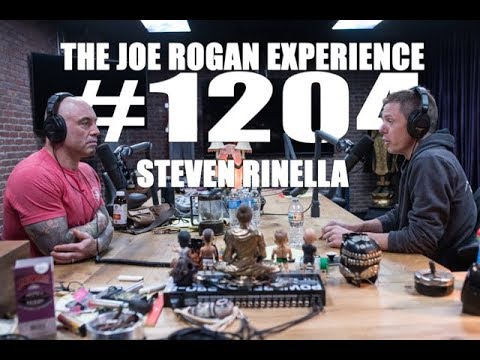
Joe Rogan Experience #1204 - Steven Rinella
Steven Rinella (guest), Joe Rogan (host), Narrator, Narrator
In this episode of The Joe Rogan Experience, featuring Steven Rinella and Joe Rogan, Joe Rogan Experience #1204 - Steven Rinella explores joe Rogan and Steven Rinella Dive Deep Into Hunting, History, Ethics Joe Rogan and Steven Rinella range from genetics and Neanderthals to modern hunting, cooking wild game, and predator management. Rinella explains the cultural, historical, and ecological context of hunting, emphasizing food, tradition, and conservation funding. They discuss controversial topics like bear and wolf hunting, trophy images, invasive species eradication, and the disconnect between urban perceptions and rural realities. The conversation also highlights Rinella’s new fish and game cookbook and how he uses media to articulate a thoughtful defense of hunting.
Joe Rogan and Steven Rinella Dive Deep Into Hunting, History, Ethics
Joe Rogan and Steven Rinella range from genetics and Neanderthals to modern hunting, cooking wild game, and predator management. Rinella explains the cultural, historical, and ecological context of hunting, emphasizing food, tradition, and conservation funding. They discuss controversial topics like bear and wolf hunting, trophy images, invasive species eradication, and the disconnect between urban perceptions and rural realities. The conversation also highlights Rinella’s new fish and game cookbook and how he uses media to articulate a thoughtful defense of hunting.
Key Takeaways
Food-centered hunting narratives resonate far more than abstract justifications.
Rinella cites research showing non-hunters care less about population control or heritage and respond most positively to hunting framed around honest, direct acquisition of food.
Get the full analysis with uListen
Modern hunters should learn whole-animal use and diverse preparations.
Rinella’s cookbook emphasizes processing everything from frogs and pigeons to deer and bear, showing how to turn often-discarded parts (shanks, hearts, tails) into valued dishes instead of focusing only on backstraps and ground meat.
Get the full analysis with uListen
Media images of hunting heavily shape public ethics and emotion.
Grip‑and‑grin photos, spear-hunting videos, or glamorized ‘huntress’ Instagram accounts can overshadow nuanced realities, making celebrations after a kill appear cruel to outsiders and fueling backlash irrespective of legality or use of the meat.
Get the full analysis with uListen
Predator debates are really about broader values and power, not just animals.
Fights over wolves, grizzlies, and mountain lions double as proxy battles over rural vs. ...
Get the full analysis with uListen
Invasive and non‑native species force uncomfortable conservation tradeoffs.
Cases like feral goats on Scottish islands, deer and pigs in New Zealand and Hawaii, or goats introduced by sailors reveal tensions between ecological restoration, hunting opportunity, and cultural attachment to long‑established non‑native game.
Get the full analysis with uListen
You can’t condemn hunting while ignoring your own meat footprint.
Rinella argues that meat‑eaters who attack regulated, food‑oriented hunting often lack self‑examination about industrial agriculture’s animal deaths and habitat impacts, while hunters at least confront and understand the killing directly.
Get the full analysis with uListen
Children’s and genders’ relationships to hunting aren’t purely cultural.
Despite equal encouragement, Rinella notices his son is more hunting‑obsessed than his daughter, raising open questions about innate differences, social influences, and how much parents can engineer kids’ outdoor passions.
Get the full analysis with uListen
Notable Quotes
“My interest in hunting and living close to wildlife predated by a long ways my ability to talk about why I think those things are important.”
— Steven Rinella
“I don’t believe we can justify or afford to remove native species of wildlife from the landscape. The idea of extinction sickens me.”
— Steven Rinella
“It’s really hard for me when people who eat meat want to condemn those who are willing to take part in the process themselves.”
— Steven Rinella
“Hunters are under attack in a lot of ways, and when you feel stereotyped, a response is to cram it right back down someone else’s throat.”
— Steven Rinella
“You play a very important part out there… you’re giving a perspective that I don’t think is available.”
— Joe Rogan
Questions Answered in This Episode
How should hunters change the way they present kills and celebrations on social media to better communicate their values to non-hunters?
Joe Rogan and Steven Rinella range from genetics and Neanderthals to modern hunting, cooking wild game, and predator management. ...
Get the full analysis with uListen AI
Where should societies draw the line between restoring native ecosystems and preserving long‑established non-native game that communities now rely on?
Get the full analysis with uListen AI
Is it ethically consistent to oppose regulated hunting while continuing to consume industrially raised meat, and how might people reconcile that?
Get the full analysis with uListen AI
What models of predator management best balance human safety, livestock interests, game populations, and the intrinsic value of wolves and bears?
Get the full analysis with uListen AI
Could wider access to wild game (through education, community dinners, or controlled programs) change public opinion about hunting more than debates ever will?
Get the full analysis with uListen AI
Transcript Preview
You know, uh, you know what's funny? Oh, I'll tell you later.
Tell me now. Three, two, one. (claps) What's funny?
Uh, I was gonna tell you a funny story about your address, but it, but it-
Oh, don't do that. (laughs)
It wouldn't be, it wouldn't be f- funny for you. (laughs)
(laughs) We'll talk later about that.
(laughs)
You and I, uh, we share African ancestry.
Yeah?
Yeah.
I was shocked.
Yeah, I'm 1.6%.
Oh, really?
Yeah.
See, I have more, uh, I, I have more credential than you-
(laughs)
... in that department.
You're 2%, right?
Yeah, I know. And it's, it's funny 'cause, uh, you know, you sort of have your, the, the story in your family, kinda like where you came from.
Yeah.
And everything mates, and I always knew I was w- 25%, you know, Italian. Uh, and I knew that my family came from Sicily. In fact, uh, the, the, the Rinellas that came from Sicily all seemed to become kind of established in, in the produce world. Uh, my dad was brought up in the South Side of Chicago. I'm 44 years old, okay? So think about that for a minute. My dad was brought up in the South Side of Chicago, and he was raised by his grandfather, who was Sicilian and had come from Sicily. His grandfather delivered produce with a horse and cart-
Whoa.
... in Chicago. So, to have lived through that, like, to be brought up in a house where a guy, like, leaves in the morning on a horse and cart to deliver produce, and then to be alive, like, to fight in World War II, to be through the atomic era, the advent of the internet, right? (sighs) But I always knew that we had Sicilians. When I did the, the genetic test, one- some of th- at some point in time, one of those Sicilians (laughs) must have shot southward and crossed the (laughs) Mediterranean and, like, had a hookup down there or something.
Well, that was the history of Sicily in the first place.
Yeah.
You know, that Sicily, it just being Sicilian in the first place, there was so many people that were, uh, impregnated by the Moors and by various people of West Africa and North Africa.
Yeah.
Yeah.
It's f- And, yeah, I should have probably, like, always assumed, but it just, I hadn't thought about it. Um, another thing I was reading about this stuff, and you might know more about it than I do, is that when you do those tests, there's missing parts. You know, it does, it, it, like, it captures what's there, but there could be a lot there that's not captured.
Mm.
Just in the way that chromosomes are, you know, inherited and passed down. Like it's n- it's an incomplete picture.
Install uListen to search the full transcript and get AI-powered insights
Get Full TranscriptGet more from every podcast
AI summaries, searchable transcripts, and fact-checking. Free forever.
Add to Chrome