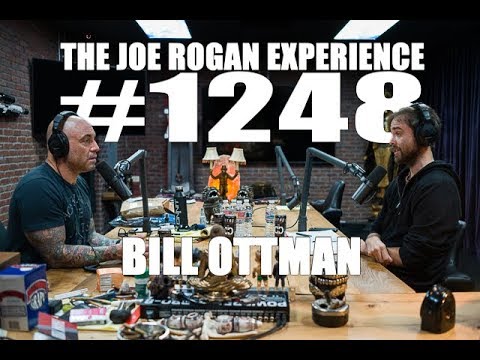
Joe Rogan Experience #1248 - Bill Ottman
Joe Rogan (host), Bill Ottman (guest), Jamie Vernon (guest), Jamie Vernon (guest), Narrator, Narrator, Jamie Vernon (guest)
In this episode of The Joe Rogan Experience, featuring Joe Rogan and Bill Ottman, Joe Rogan Experience #1248 - Bill Ottman explores open-Source Social Media, Free Speech, And The Future Online Joe Rogan and Minds.com CEO Bill Ottman discuss how major social platforms like Facebook, Twitter, and YouTube centralize power, track users, throttle reach with opaque algorithms, and increasingly police speech in ways that feel arbitrary and politically biased.
Open-Source Social Media, Free Speech, And The Future Online
Joe Rogan and Minds.com CEO Bill Ottman discuss how major social platforms like Facebook, Twitter, and YouTube centralize power, track users, throttle reach with opaque algorithms, and increasingly police speech in ways that feel arbitrary and politically biased.
Ottman argues for open-source, privacy-respecting, decentralized alternatives where code and policies are transparent, users control their data, and moderation is based narrowly on legality rather than subjective standards like “hate” or “disinformation.”
They explore how algorithmic “soft censorship,” demonetization, and de‑platforming affect creators, radicalization, mental health, and political discourse, while debating how to handle edge cases like foreign propaganda, extremist content, and disturbing but legal material.
The conversation widens into the psychological impact of social media, potential future tech like neural interfaces, the ethics of content ownership, and how better personal and societal “information hygiene” is becoming as important as food transparency once did.
Key Takeaways
Treat social media use like diet or alcohol: set hard personal boundaries.
Rogan notes that constant phone checking and online arguing erode attention and well-being; he recommends explicit rules (no phones in bed, device-free meals, designated ‘offline’ time) the same way you’d manage junk food or drinking.
Get the full analysis with uListen
Assume mainstream platforms spy and algorithmically shape what you see—act accordingly.
Ottman stresses that big apps track location, browsing, and behavior, then use black-box algorithms to curate feeds and ads; switching browsers, search engines, and apps (e. ...
Get the full analysis with uListen
Creators should diversify their online presence beyond any single platform.
Because demonetization and bans can be sudden and opaque, having audiences on multiple services—especially more open or decentralized ones—reduces dependency on YouTube, Twitter, or Facebook policy shifts and advertiser pressure.
Get the full analysis with uListen
Push for algorithmic and policy transparency as a baseline expectation.
Ottman argues that at the scale of public forums, users and independent experts should be able to inspect code, recommendation logic, and moderation rules, similar to food labeling, so people know how their feeds and data are being manipulated.
Get the full analysis with uListen
Focus on teaching people how to evaluate information, not just removing ‘bad’ content.
Both suggest that trying to centrally decide what counts as disinformation or harmful ideas is fragile and political; building user tools and education around source-checking, context, and discernment may be a more robust response.
Get the full analysis with uListen
Use incentives and social challenges to encourage healthier behavior, not coercion.
They discuss fitness and sobriety challenges (e. ...
Get the full analysis with uListen
Support business models that align profit with user freedom and privacy.
Ottman’s view is that long-term sustainable platforms will be those whose economics don’t depend on surveillance and attention-hacking; users can accelerate that shift by directing their time, content, and payments toward such services.
Get the full analysis with uListen
Notable Quotes
“They’re so abusive to everybody. Why wouldn’t you want to know what’s in your apps?”
— Bill Ottman
“Commerce should not dictate how human beings are allowed to openly communicate with each other.”
— Joe Rogan
“When you subscribe to someone, you should see their stuff. Taking away people’s reach after years of work is not okay.”
— Bill Ottman
“Banning almost never solves the problem. It’s a short-term solution creating a long-term problem.”
— Bill Ottman
“We need personal management when it comes to the use of electronic devices… the same way we look at alcohol consumption or poor food choices.”
— Joe Rogan
Questions Answered in This Episode
If major platforms fully open-sourced their algorithms tomorrow, what concrete changes in user behavior and public trust would we realistically see?
Joe Rogan and Minds. ...
Get the full analysis with uListen AI
Where should the legal line be drawn for online speech and content, and who (if anyone) should interpret gray areas like ‘hate’ or ‘obscenity’?
Ottman argues for open-source, privacy-respecting, decentralized alternatives where code and policies are transparent, users control their data, and moderation is based narrowly on legality rather than subjective standards like “hate” or “disinformation.”
Get the full analysis with uListen AI
Can decentralized, open platforms ever match the usability and polish of today’s giants without drifting toward the same surveillance and control incentives?
They explore how algorithmic “soft censorship,” demonetization, and de‑platforming affect creators, radicalization, mental health, and political discourse, while debating how to handle edge cases like foreign propaganda, extremist content, and disturbing but legal material.
Get the full analysis with uListen AI
How should societies handle foreign influence campaigns and troll farms without turning that concern into a pretext for broad political censorship?
The conversation widens into the psychological impact of social media, potential future tech like neural interfaces, the ethics of content ownership, and how better personal and societal “information hygiene” is becoming as important as food transparency once did.
Get the full analysis with uListen AI
What kinds of ‘social currencies’ or reward systems could encourage pro-social online behavior without becoming dystopian reputation scores?
Get the full analysis with uListen AI
Transcript Preview
5, 4, 3, 2, 1. Legit? (slaps hands) Hello, Bill.
Hey, man.
What's going on?
(smacks lips) Here.
You are here.
Yes.
With a book, you got a book of shit.
I got a book.
You, you come prepared.
I mean, yeah, I'm trying to write. I'm trying to get back into handwriting.
Uh, for people who don't know, Bill is the CEO and co-founder of Minds.com, and we've been going back and forth through email, and you got hoaxed by some dude who said he was Joey Diaz.
It did happen.
He really believed. He's like, "Joey's been on my network," and I'm like, "Mmm." (smacks lips) "I doubt it."
He was imagining me, messaging me-
"I doubt it."
... in Joey's voice-
Yeah.
... like, basically cloning it. Like, there's weird people out there, man.
Yeah. Well, that's not hard to do.
Yeah.
You know?
Yeah.
You watch enough Joey-
Basically just cloning his, his tweets.
(laughs) "Cocksucker."
Yeah.
Yeah, yeah. Yeah, every Monday morning or so, there's a, uh, there's a tweet about, "Someone needs to suck your dick." (laughs) That's it. "They need to suck your dick. You need to let them know." That's, uh, o- on the regular. Um, what's the notes, man?
(smacks lips) Just some ramblings from this morning.
Yeah?
Yeah.
Important stuff?
This is actually the first thing that I, uh, I've written in this notebook. I've not been doing handwriting much at all in the last years, probably. Mostly digital, which is not good because I actually majored in English, so.
Yeah, you definitely lose your ability to write words. It's funny, I, I tried writing in, um, uh, uh, for whatever reason, I write mostly in all caps, you know, 'cause I just mo- mostly just write notes. But I tried writing with, like, lowercase letters, and then I tried writing in cursive, and my cursive is like... It's almost like I have to relearn it.
Yeah, I was finding it just, like, trailing off at the end of certain words. But I blend it all together.
You what?
I blend it all together with capital and lowercase.
Oh, why you do that?
I mean, well, just as a normal person would, proper grammar.
Oh. (laughs)
(laughs)
I thought you were just mixing them up randomly.
No, no.
Okay.
Though I did write my, uh, college thesis in all lowercase.
Why?
Typed. I don't know, I just-
What, are you protesting?
Yeah, kinda. It was stupid.
Hmm. It's like a cool move, right? "I'm not gonna use any uppercase. Who cares, man?"
There's weird, like, postmodern theory about, like, capitalization.
Oh, really?
And that's kind of what I was talking about. I got a little bit indoctrinated at, at UVM to be-
Install uListen to search the full transcript and get AI-powered insights
Get Full TranscriptGet more out of YouTube videos.
High quality summaries for YouTube videos. Accurate transcripts to search & find moments. Powered by ChatGPT & Claude AI.
Add to Chrome