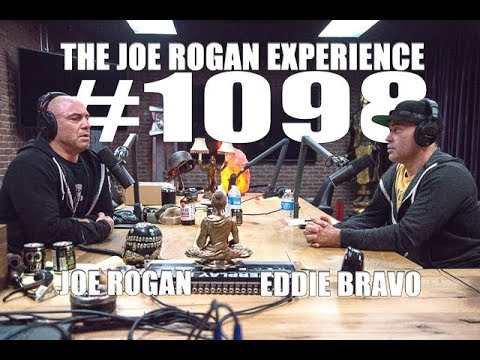
Joe Rogan Experience #1098 - Eddie Bravo
Eddie Bravo (guest), Joe Rogan (host), Narrator, Narrator, Guest (guest), Narrator, Narrator, Narrator, Narrator, Narrator
In this episode of The Joe Rogan Experience, featuring Eddie Bravo and Joe Rogan, Joe Rogan Experience #1098 - Eddie Bravo explores joe Rogan, Eddie Bravo Dive Into Comedy, Conspiracies, and Combat Jiu-Jitsu Joe Rogan and Eddie Bravo move from shop talk about standup comedy into wide‑ranging discussions on government corruption, media manipulation, school shootings, and extreme conspiracy theories involving child trafficking and false flags.
Joe Rogan, Eddie Bravo Dive Into Comedy, Conspiracies, and Combat Jiu-Jitsu
Joe Rogan and Eddie Bravo move from shop talk about standup comedy into wide‑ranging discussions on government corruption, media manipulation, school shootings, and extreme conspiracy theories involving child trafficking and false flags.
They compare the evolution of standup and jiu-jitsu, emphasizing deliberate practice, recording, and refining as analogous paths to mastery.
The conversation detours into drugs (SSRIs, MDMA, weed), nutrition, corporate science corruption, and how institutions—from schools to big pharma—shape public belief.
They close by breaking down the Tony Ferguson–Khabib Nurmagomedov fight fallout, title stripping politics in the UFC, and promoting Eddie’s Combat Jiu-Jitsu and EBI events.
Key Takeaways
Recording and reviewing your work radically accelerates skill development.
Rogan stresses that listening back to shaky new bits, transcribing them, and tightening wording can cut years off the joke‑development curve; the same principle applies to any craft where iterative feedback sharpens performance.
Get the full analysis with uListen
True mastery feels automatic, like tying your shoes.
They liken high‑level standup bits and jiu-jitsu sequences to shoe‑tying: after enough repetition, execution bypasses conscious thought, freeing mental bandwidth for timing, audience read, or opponent reactions.
Get the full analysis with uListen
Original perspective separates elite performers from formula followers.
They critique comics who chase topics others already made famous instead of bringing a genuinely new angle, arguing that long-term impact comes from noticing and articulating what others haven’t, not recycling proven premises.
Get the full analysis with uListen
Be highly skeptical of one‑sided narratives—especially on polarizing issues.
Rogan notes that critics of Trump ignore his push on sex‑trafficking enforcement, while gun‑control advocates often avoid discussing psychiatric meds; they argue that refusing to acknowledge inconvenient facts makes your criticism easier to dismiss.
Get the full analysis with uListen
Legal status and regulation often matter more than the drug itself.
Their MDMA and marijuana discussion suggests the biggest risks come from illegality—unknown purity, dosage, and adulterants—whereas regulated, therapeutic use (e. ...
Get the full analysis with uListen
Institutional science can be structurally biased by money and desired outcomes.
They cite sugar, tobacco, pesticides, and pharma as examples where funders push for favorable results and bury negative studies, implying that consumers should distinguish between proven, lived‑reality science and unverified claims backed by conflicted interests.
Get the full analysis with uListen
Rule sets and equipment deeply shape how combat sports look—and how damaging they are.
Bravo argues bare-knuckle or minimal‑wrap fighting would change striking choices and reduce some brain trauma by making hands more fragile, while their breakdown of early leg‑kick history shows how small rules changes (allowing low kicks) revolutionized kickboxing and MMA.
Get the full analysis with uListen
Notable Quotes
“You take a lot of time out of the development of a joke if you just listen to the previous versions of it.”
— Joe Rogan
“Your body is magic. You just gotta tell it 1,000 times and then it finally listens and it’ll do it itself.”
— Eddie Bravo
“If you don’t give [Trump] credit for things that he does that are important, nobody’s gonna listen to you when you’re criticizing him either.”
— Joe Rogan
“If you have to have faith in science, that’s like a religion. That’s scientism.”
— Eddie Bravo
“The idea that you’re important or that you’re the most significant thing around you is pretty ridiculous.”
— Joe Rogan
Questions Answered in This Episode
Where is the line between healthy skepticism and unfalsifiable conspiracy thinking, and how can viewers critically evaluate claims like false flags or elite sex‑rings?
Joe Rogan and Eddie Bravo move from shop talk about standup comedy into wide‑ranging discussions on government corruption, media manipulation, school shootings, and extreme conspiracy theories involving child trafficking and false flags.
Get the full analysis with uListen AI
How much responsibility do comedians and public figures have to fact‑check statistics or sensational stories before sharing them with massive audiences?
They compare the evolution of standup and jiu-jitsu, emphasizing deliberate practice, recording, and refining as analogous paths to mastery.
Get the full analysis with uListen AI
If MDMA and psychedelics become mainstream therapeutic tools, how should society regulate them to maximize benefits while minimizing abuse and commercialization?
The conversation detours into drugs (SSRIs, MDMA, weed), nutrition, corporate science corruption, and how institutions—from schools to big pharma—shape public belief.
Get the full analysis with uListen AI
In combat sports, should promotions revisit gloves, rule sets, and scoring criteria if the goal is both fighter safety and a more realistic reflection of effective fighting?
They close by breaking down the Tony Ferguson–Khabib Nurmagomedov fight fallout, title stripping politics in the UFC, and promoting Eddie’s Combat Jiu-Jitsu and EBI events.
Get the full analysis with uListen AI
How can individuals balance long‑term goals (like “making it” or retiring comfortably) with Rogan and Bravo’s critique that chasing destinations often prevents you from actually living in the present?
Get the full analysis with uListen AI
Transcript Preview
(sighs)
No headphones?
I'd rather not have headphones.
You're getting crazy. I'll have the- I'll have the two.
No, because I, I learned that, I learned that hearing my own voice in my head makes, makes me focus on it. And I don't wanna focus on the sound of my voice.
Oh.
I wanna focus on the thoughts.
Right, right, right, right. Yeah.
I'm focusing on, "Ooh." Just, it's like blowing out in my head and all this shit's going on.
That's smart. Tell me when.
What's up?
What's up?
Yeah.
Oh. (laughs)
(laughs)
We were talking about whether or not you should have headphones on or not have headphones on. The... Are we up?
No.
No? If you're hearing the audio recording this, what's happening is we switched to a new TriCaster. We were having problems with our old one. The TriCaster is the machine that allows Jamie to switch cameras and put everything up on the internet and hopefully include Skype so we could get some people from, like-
It's getting signal, but there's no video showing.
Hmm. Are we gonna restart?
I don't know. I'm trying to make sure that that's actually true. Sorry.
That's okay. Uh, we might have to restart, folks. We're trying live while we're going live with some new shit, but I want, I want people on YouTube-
I think it's the TriCaster. We were having problems with our old one. And it's-
Is it?
... audio works.
Audio, but no video.
I don't know why. I'll figure that out in a second.
Ladies and gentlemen, if you are just staring at a blank screen, would you have to shut this show down-
I shouldn't.
... to get the video back up?
I shouldn't have to. It should work, but-
All right. Just do a double camera, a, a two shot so you could have-
I think it's gonna be okay now. I think we're still-
Is it live now?
I double, don't want to frickin'...
<< Tech motherfucking ♫ ♫ knowledge. >>
It would suck, it would suck if, like, we did, like, in half an hour it turns out none of it got picked up or we did a whole show.
Well, we're recording it and it's-
I'm recording it. Yeah, yeah, yeah. I'm good to go.
... and it's going on YouTube right now, for sure.
Right.
It just, they don't see us right now. He's trying to fix that. << Tech motherfucking ♫ ♫ technology. >>
Maybe not.
We were having problems with our old TriCaster crashing a lot, so we got a new TriCaster, but it turns out that... What is it that doesn't match up? What part is wrong? The control panel?
All right. See, there it goes. There it goes. Yeah. I think we're good now.
Install uListen to search the full transcript and get AI-powered insights
Get Full TranscriptGet more from every podcast
AI summaries, searchable transcripts, and fact-checking. Free forever.
Add to Chrome