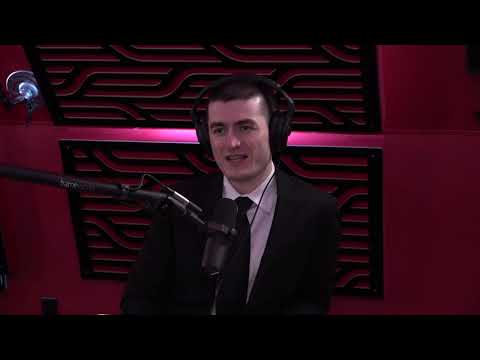
Joe Rogan Experience #1600 - Lex Fridman
Narrator, Narrator, Joe Rogan (host), Lex Fridman (guest), Joe Rogan (host), Joe Rogan (host), Narrator
In this episode of The Joe Rogan Experience, featuring Narrator and Narrator, Joe Rogan Experience #1600 - Lex Fridman explores joe Rogan and Lex Fridman Debate Freedom, Power, Tech, and Truth Joe Rogan and Lex Fridman range from comedy and martial arts to deep discussions about government power, free speech, and how technology reshapes society. They contrast anarchism, authoritarianism, and American democracy, using figures like Michael Malice, Putin, and U.S. leaders to examine incentives, corruption, and personal responsibility. The conversation weaves in homelessness, COVID policy, Big Tech censorship, encryption, autonomous vehicles, psychedelics, and the future of human communication. Throughout, they return to themes of discipline, personal growth, humor as a social safety valve, and a shared love of American freedom, closing with a Maya Angelou poem about caged and free birds.
Joe Rogan and Lex Fridman Debate Freedom, Power, Tech, and Truth
Joe Rogan and Lex Fridman range from comedy and martial arts to deep discussions about government power, free speech, and how technology reshapes society. They contrast anarchism, authoritarianism, and American democracy, using figures like Michael Malice, Putin, and U.S. leaders to examine incentives, corruption, and personal responsibility. The conversation weaves in homelessness, COVID policy, Big Tech censorship, encryption, autonomous vehicles, psychedelics, and the future of human communication. Throughout, they return to themes of discipline, personal growth, humor as a social safety valve, and a shared love of American freedom, closing with a Maya Angelou poem about caged and free birds.
Key Takeaways
Government should minimize control but must still monopolize legitimate violence.
Rogan and Fridman push back on pure anarchism, arguing that while government should be stripped from many domains, police, courts, and military are essential to remove violence from day‑to‑day life so business, science, and culture can flourish.
Get the full analysis with uListen
Homelessness policy needs structure and housing solutions, not permissive chaos.
They argue that simply allowing encampments, public defecation, and unchecked camping (as in parts of California) attracts more homelessness and degrades cities; instead, governments should invest in designated housing and programs rather than turning public space into semi‑lawless zones.
Get the full analysis with uListen
Lockdowns and public‑health policy must balance disease control with long‑term societal damage.
Fridman criticizes U. ...
Get the full analysis with uListen
Big Tech infrastructure control is more dangerous than content moderation alone.
They see Amazon cutting off Parler’s hosting as a serious escalation, because it lets infrastructure providers decide which entire platforms exist, not just which posts are allowed—threatening competition and effectively narrowing the range of acceptable discourse.
Get the full analysis with uListen
End‑to‑end encryption and private communication are critical civil liberties.
Rogan objects to media narratives that frame Signal/Telegram as tools of extremists, arguing that privacy is a basic right and conflating encryption with terrorism invites a new wave of post‑9/11–style surveillance overreach.
Get the full analysis with uListen
Autonomous driving will likely be safer long‑term, but paths differ sharply.
Fridman contrasts Tesla’s aggressive, data‑driven rollout on public roads with Waymo’s constrained, highly mapped Phoenix deployment; he sees both promise and risk, warning that human psychology and trust must be considered as much as sensor accuracy.
Get the full analysis with uListen
Discipline and pushing limits are powerful but can easily become self‑destructive.
Stories about David Goggins, Cam Hanes, and extreme challenges highlight the value of testing your mental limits—yet Fridman and Rogan both note the tradeoffs in injuries, overuse, and lost time for other pursuits, suggesting people need a preservation mindset as they age.
Get the full analysis with uListen
Psychedelics may be as valuable for creativity and meaning as for treating pathology.
Citing researchers like Matthew Johnson and Carl Hart, they discuss psilocybin, DMT, and other substances not only as therapies for addiction or trauma, but as structured tools for exploring consciousness and enhancing insight—if studied rigorously and used responsibly.
Get the full analysis with uListen
Media and political framing dangerously reduce complex voters to moral caricatures.
They reject the idea that all Trump voters are racists or all Biden voters are anti‑American, arguing that such simplifications ignore genuine policy disagreements, inflame division, and make rational, centrist problem‑solving nearly impossible.
Get the full analysis with uListen
Podcasts and long‑form conversation are emerging as a corrective to legacy media.
Fridman and Rogan see open‑ended podcasting (e. ...
Get the full analysis with uListen
Notable Quotes
“It feels like trying to solve the homelessness problem is in direct tension with trying to take care of people who are struggling.”
— Lex Fridman
“I think we run a real dangerous risk in this country of separating people into good versus evil and not just respecting people's differences and differences of opinions.”
— Joe Rogan
“On the path to reading each other's minds, there's going to be a lot of technologies that allow you to read each other's minds in more subtle ways before it's like full‑on waterfall, Neuralink.”
— Lex Fridman
“You can get famous doing a thing that you love, or you can try to be famous—and they are two very different things.”
— Joe Rogan
“Comedy is a way to reveal that ridiculousness... they point out the elephant in the room. Like, ‘This is absurd.’”
— Lex Fridman
Questions Answered in This Episode
How should democratic societies balance public safety and economic stability during crises like pandemics without slipping into either authoritarianism or chaos?
Joe Rogan and Lex Fridman range from comedy and martial arts to deep discussions about government power, free speech, and how technology reshapes society. ...
Get the full analysis with uListen AI
Where should the line be drawn between platform moderation, infrastructure control (like AWS dropping Parler), and outright censorship in a digital public square?
Get the full analysis with uListen AI
Are Elon Musk’s and Tesla’s aggressive approaches to autonomous driving ethically justified by potential long‑term safety gains, or should they be constrained to Waymo‑style pilots?
Get the full analysis with uListen AI
If psychedelics become mainstream tools for both therapy and creative enhancement, how should they be regulated, taught, and integrated to avoid both abuse and over‑medicalization?
Get the full analysis with uListen AI
What practical steps could reduce toxic political polarization and restore room for centrist, nuanced views that acknowledge both America’s flaws and its strengths?
Get the full analysis with uListen AI
Transcript Preview
(drumming music) Joe Rogan podcast, check it out.
The Joe Rogan Experience.
Train by day, Joe Rogan podcast by night. All day. (instrumental music plays) Rex, I had a surprise for you, but it didn't work out.
(laughs)
I had a suit and a tie-
Yeah.
... and I was gonna come in dressed like you.
Exactly.
Full ... Yes, full on. W- white shirt, suit, tie.
Fitted?
Yes, fitted, but the problem is my fucking shirt was at the cleaners, so then I tried to use, um ... I have, uh, some other white shirts that are, like, these really stretchy shirts that you can wear 'em if they're open, but if I'm trying to put a tie on, they literally don't fit around my neck. So I'm doing this and I'm killing myself. And then I'm like, "Well, maybe I'll leave it open."
(laughs)
And they're, they're just ... There's certain-
Dressing up like first day of school.
Yeah.
Damn. I, I appreciate it. It's like-
I was-
I'm honored.
I was gonna m- mimic you.
Yeah. Yeah, uh, do you know ... Remember Michael Malice?
Yes.
He actually ... I did a podcast with him and he (laughs) he wore, uh, the opposite-
Oh.
... which is a white-
Tie.
... suit and a white tie and a black sh- ... I mean, he is a sort of the epitome of the loving kind of troll.
Yes.
That's like the ultimate troll. He, he wore the exact opposite. He got the exact same haircut as me-
(laughs)
... which I don't even know what that means exactly.
Just got your hair short.
Just (imitates hair cutting with razor) cuts your hair short.
Yeah, that's all it means.
But it, it was, uh ... It was a magical moment. That's, that's what trolling at its best does.
Mm.
It's like you feel loved.
Oh, that's funny. He's an interesting guy. Michael Malice is a-
That's it.
... very interesting guy 'cause, uh, he's got some wacky beliefs that I don't beli- ... I, I don't subscribe to at all.
Anarchy.
Yeah, complete anarchy. No police. I don't think we should have police.
No.
Like, like, what world do you live in, any you weigh three pounds-
(laughs)
... and y- you don't even have a gun. You don't (laughs) have a police.
Yeah.
Like, what are you talking about?
Yeah.
But he's a brilliant guy.
Brilliant.
I- i- it's, uh, it's interesting. Like I- I don't subscribe to a lot of his ideas, but I think, um ... (smacks lips) He, uh, he- he's also ... Always has a half smile when he's saying things.
Yeah.
Install uListen to search the full transcript and get AI-powered insights
Get Full TranscriptGet more from every podcast
AI summaries, searchable transcripts, and fact-checking. Free forever.
Add to Chrome