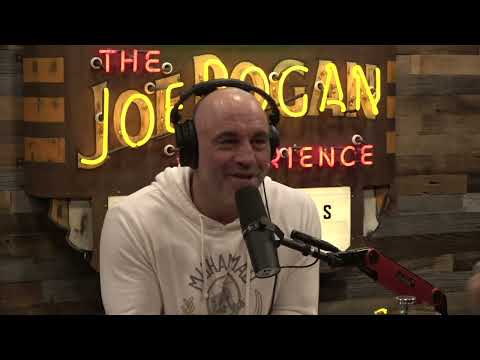
Joe Rogan Experience #1816 - Gad Saad
Joe Rogan (host), Gad Saad (guest), Narrator, Narrator, Narrator, Narrator, Narrator
In this episode of The Joe Rogan Experience, featuring Joe Rogan and Gad Saad, Joe Rogan Experience #1816 - Gad Saad explores gad Saad’s 86-Pound Transformation, Woke Culture, and Real Truth Joe Rogan and Gad Saad open with Saad’s 86‑pound weight loss, detailing the habits, discipline, and mindset shifts behind sustained change—especially daily movement, tight calorie tracking, and abandoning ‘all or nothing’ thinking. They then move into broader themes of discipline, creativity, and “turning pro” in one’s work, contrasting honest effort with cultural trends that reward victimhood, body-positivity excesses, and ideological comfort.
Gad Saad’s 86-Pound Transformation, Woke Culture, and Real Truth
Joe Rogan and Gad Saad open with Saad’s 86‑pound weight loss, detailing the habits, discipline, and mindset shifts behind sustained change—especially daily movement, tight calorie tracking, and abandoning ‘all or nothing’ thinking. They then move into broader themes of discipline, creativity, and “turning pro” in one’s work, contrasting honest effort with cultural trends that reward victimhood, body-positivity excesses, and ideological comfort.
A large portion of the conversation critiques modern ‘woke’ ideology—fatphobia rhetoric, beauty denial, postmodern relativism, gender and pronoun politics, censorship, and the idea of a ‘Ministry of Truth’—arguing these are parasitic ideas that destroy objective reality and free speech. They discuss how such beliefs spread through academia, social media, and institutions, while pointing to early signs of a backlash and “peak wokeness.”
Rogan and Saad also explore evolutionary psychology, mating and beauty dynamics, celebrity culture, and the psychological effects of social media-driven echo chambers. They debate ethics (death penalty, consequentialism vs. deontology), wrongful convictions, policing, and how distorted views of human nature lead to disastrous public policy.
Throughout, they return to core themes: taking radical personal responsibility (for health, work, and character), defending uncomfortable truths over feelings, and cultivating intellectual courage in academia and public life. Saad closes by reflecting on happiness, parenting, and choosing the right partner and career as foundations of a “good life.”
Key Takeaways
Sustainable weight loss is mostly diet plus simple, relentless habits—not heroic workouts.
Saad lost 86 pounds by walking 15–20,000 steps daily, tightly tracking every calorie with MyFitnessPal (around 1,600–1,700/day), weighing himself weekly, and largely cutting carbs. ...
Get the full analysis with uListen
Discipline across domains—body, work, and life—is less painful than avoidance.
Rogan and Saad argue it’s actually more stressful to leave problems festering (health, writing, obligations) than to confront them. ...
Get the full analysis with uListen
Body-positivity becomes harmful when it denies basic health realities.
They distinguish compassion for individuals from endorsing narratives that obesity is healthy or that dieting is ‘fatphobic. ...
Get the full analysis with uListen
Postmodern relativism and woke ideology erode truth and rational debate.
Saad recounts extreme examples—like a postmodern student denying that only women give birth or that the sun rises in the east—as emblematic of a broader trend: treating all facts as social constructs. ...
Get the full analysis with uListen
Free speech must be defended even for offensive or false ideas.
Both insist that suppressing ‘misinformation’ (e. ...
Get the full analysis with uListen
Academia’s lack of intellectual courage lets bad ideas spread unchecked.
Saad criticizes universities for being overwhelmingly left-leaning and often activist rather than scientific, especially in sociological and cultural disciplines. ...
Get the full analysis with uListen
A good life hinges on who you marry and what work you choose.
Drawing from his upcoming book, Saad highlights choosing the right spouse and career as the two biggest determinants of long-term happiness. ...
Get the full analysis with uListen
Notable Quotes
“You gotta get better the same way you got sick, slowly over time.”
— Joe Rogan
“There are a thousand different temptations in a day for you to violate your goal... You don’t have to be perfect, but 997 out of 1000 times, you have to take the right road.”
— Gad Saad
“I never cede one millimeter of truth in the pursuit of not hurting your feelings.”
— Gad Saad
“Fucking off is not good for you. You should be a professional with your body, be a professional with your work.”
— Joe Rogan
“History is not shaped by fence-sitters. It takes intellectually bold people, and we certainly don’t choose our professors based on that trait.”
— Gad Saad
Questions Answered in This Episode
Where is the line between compassionate body-positivity and enabling clearly harmful health behaviors, and who gets to draw it?
Joe Rogan and Gad Saad open with Saad’s 86‑pound weight loss, detailing the habits, discipline, and mindset shifts behind sustained change—especially daily movement, tight calorie tracking, and abandoning ‘all or nothing’ thinking. ...
Get the full analysis with uListen AI
How can universities realistically reintroduce intellectual courage and viewpoint diversity without simply flipping ideological capture from left to right?
A large portion of the conversation critiques modern ‘woke’ ideology—fatphobia rhetoric, beauty denial, postmodern relativism, gender and pronoun politics, censorship, and the idea of a ‘Ministry of Truth’—arguing these are parasitic ideas that destroy objective reality and free speech. ...
Get the full analysis with uListen AI
What safeguards—if any—could make the death penalty philosophically acceptable in a world where wrongful convictions and prosecutorial misconduct are real?
Rogan and Saad also explore evolutionary psychology, mating and beauty dynamics, celebrity culture, and the psychological effects of social media-driven echo chambers. ...
Get the full analysis with uListen AI
Are we truly nearing ‘peak wokeness,’ and what concrete indicators would show that a cultural pendulum is swinging back toward reason?
Throughout, they return to core themes: taking radical personal responsibility (for health, work, and character), defending uncomfortable truths over feelings, and cultivating intellectual courage in academia and public life. ...
Get the full analysis with uListen AI
In an era of social media echo chambers, how can individuals practically train themselves to prioritize truth over tribal loyalty and emotional comfort?
Get the full analysis with uListen AI
Transcript Preview
(drumming) Joe Rogan podcast, check it out.
The Joe Rogan Experience.
Train by day, Joe Rogan podcast by night, all day. (rock music) You look like you've lost a large child from your body.
(laughs) 86 pounds.
(whooshing sound) That's right, that's a large child.
Now, I know that you wanna take credit for it because-
Fat shaming works.
Exactly.
(laughs)
But I can't give you all the credit.
No, you-
And, and then-
... you deserve all the credit.
Thank you.
I didn't do anything.
So, because-
I just was concerned for your well-being, and so I was just saying, if you really are saying that you wanna get healthy, and you really are saying that you wanna play soccer and do all these things again, like you gotta change your diet.
A friend has to be brutally honest with you.
Yeah, well, that's a hard one. That's a hard one because nobody wants to hear they're gaining weight-
Yeah.
... or they've gained weight or that they have to make radical changes to their life.
I'm actually at the lowest weight since, I think, '88.
That's incredible.
I'm size waist 33.
How much better do you feel?
Phenomenal. Outrageous.
Isn't it incredible?
It's unbelievable.
Like, if they could give you that in a pill, just the feeling, how it feels to be 86 pounds lighter?
Exactly.
Oh my God.
I mean, just to give you a sense so that we can put it into metrics, when I was overweight, our lovemaking session was only an hour and a half of vigorous sex.
(laughs)
Whereas now, I've doubled it.
Congratulations.
So thank you.
How do you have so much time?
(laughs)
It's incredible.
It's a... My wife is Lebanese. She's spicy. She demands a lot of me.
What did you do, uh, other than exercise and like what did... Like how did you shift your diet?
So, so two things. Number one, 15 to 20,000 steps a day no matter what.
No matter what?
So it's been almost now two and a half years that I haven't done a single day of less than 10,000 steps. Now the steps could be treadmill, it could be walking outside, it could be running vigorously on the, you know, out- or whatever, it could be biking. But I always have with me this, actually I'll show-
Is it one of those pedometers?
It's one of those pedometer things, and uh-
Mm-hmm.
... I'm obsessive about maintaining... So just by having this clear objective that I have to reach makes it that no matter what, I've gotta get off, you know, off the proverbial couch and walk around. It's minus 20 in Montreal. I'm walking outside until I reach that.
Install uListen to search the full transcript and get AI-powered insights
Get Full TranscriptGet more from every podcast
AI summaries, searchable transcripts, and fact-checking. Free forever.
Add to Chrome