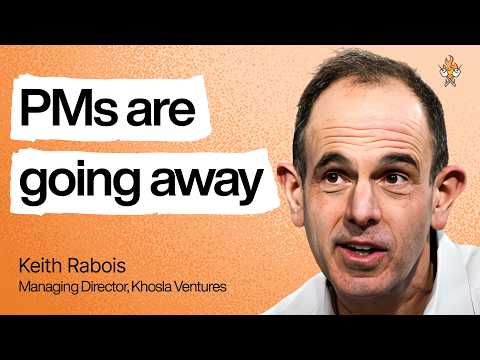
Hard truths about building in the AI era | Keith Rabois (Khosla Ventures)
Keith Rabois (guest), Lenny Rachitsky (host)
In this episode of Lenny's Podcast, featuring Keith Rabois and Lenny Rachitsky, Hard truths about building in the AI era | Keith Rabois (Khosla Ventures) explores keith Rabois on talent density, speed, and AI-era careers Rabois argues the most important startup determinant is talent density—“the team you build is the company you build”—and claims founders who can assess talent accurately can succeed even without other standout skills.
Keith Rabois on talent density, speed, and AI-era careers
Rabois argues the most important startup determinant is talent density—“the team you build is the company you build”—and claims founders who can assess talent accurately can succeed even without other standout skills.
He introduces the “barrels vs. ammunition” framework: only a small number of people can drive initiatives end-to-end, and adding headcount without adding more “barrels” increases coordination tax and slows progress.
He recommends practical hiring upgrades like ruthless referencing (often 20+ calls), using better-framed reference questions, and running 30-day post-hire evaluations to tighten the learning loop.
He predicts AI compresses traditional role boundaries (PM/design/engineering), increases the premium on business acumen and “what to build and why,” and enables individuals (including executives like CMOs) to ship more directly.
He defends several contrarian operating beliefs—avoid consumer customer interviews, prioritize winning over psychological safety, criticize in public for system-level alignment—and emphasizes speed/tempo as an early marker of exceptional companies.
Key Takeaways
Treat talent density as the core startup strategy, not a support function.
Rabois repeats Vinod Khosla’s maxim—“The team you build is the company you build”—and argues great people make markets, product, and execution easier, while mediocre hires make everything harder.
Get the full analysis with uListen
Most scaling failures come from hiring more “ammunition” without increasing “barrels.”
If only a handful of people can take work from inception to shipped success, adding more staff stacks behind the same initiatives, raising collaboration/coordination costs and lowering output per dollar.
Get the full analysis with uListen
A “barrel” is outcome ownership with proactive escalation, not just competence.
Barrels deliver “come hell or high water,” can acquire resources, motivate others, and return early with root-cause diagnosis plus options when blocked—allowing leaders to “fire and forget.”
Get the full analysis with uListen
Ruthless referencing is one of the most teachable ways to improve hiring accuracy.
He cites DoorDash’s approach (20 references per senior hire) and a Greylock heuristic: keep referencing until you find a negative; also, ask references what would make the candidate most successful and what would cause failure.
Get the full analysis with uListen
The wording of reference questions can flip an investing/hiring decision.
His Faire example: “Was Max a good employee? ...
Get the full analysis with uListen
Run a 30-day ‘would we rehire?’ check to create a fast hiring feedback loop.
Rabois cites research that 30-day retrospectives on hiring decisions can be nearly as predictive as 1–2 year outcomes, enabling faster iteration on interview and calibration mistakes.
Get the full analysis with uListen
In the AI era, business acumen and ‘what to build’ matter more than job titles.
He expects PM as a traditional roadmap intermediary to diminish because capabilities change weekly; people across engineering/design/product must think like CEOs: define value, pick bets, and ship quickly.
Get the full analysis with uListen
Speed/tempo is a compounding advantage and an early signal of elite companies.
He describes board-meeting-to-board-meeting execution—problems identified and measurably addressed within weeks—as a hallmark he observed at Square, Faire, and Ramp, and even used to preempt Ramp’s Series A.
Get the full analysis with uListen
Don’t compete for the obvious “hot” candidates; build around undiscovered talent.
He frames startups as operating under a severe salary cap; the edge comes from identifying people “black-box” recruiting will misread (often due to lack of conventional data), then rapidly giving them scope and growth.
Get the full analysis with uListen
For consumer and SMB products, customer interviews often mislead more than help.
He claims customers can’t reliably explain subconscious decisions, so interview insights can get “stuck” in the team’s brain and distort strategy; he only endorses deep customer development for enterprise with a small set of must-win accounts.
Get the full analysis with uListen
High performance often conflicts with psychological safety norms.
He argues winning teams require pressure, directness, and high standards; he prefers coaching/support when companies are struggling but becomes more critical when they’re winning to prevent complacency.
Get the full analysis with uListen
Public criticism can optimize the ‘system,’ not just the individual.
Done skillfully, public feedback signals to the org that leaders see and are addressing issues, invites others to help, and avoids hidden doubts spreading—though he notes great coaches mix public and private feedback.
Get the full analysis with uListen
Evaluate AI startups on durability against foundation labs and on accumulating advantages.
He worries foundational model progress may remove “oxygen” for thin wrappers, so he looks for credible paths to compounding moats (not just early traction) and founders who can articulate how those advantages emerge over time.
Get the full analysis with uListen
Notable Quotes
““The team you build is the company you build.””
— Keith Rabois
““If you have the right people—everything else will be easy, and if you have the wrong people, everything else is gonna be difficult.””
— Keith Rabois
““There was between 12 to 17 barrels in the organization [at PayPal]. … A more common answer for a very good company [is] two.””
— Keith Rabois
““The idea of a PM makes no sense basically in the future.””
— Keith Rabois
““I hate talking to customers. I refuse to allow colleagues of mine to talk to customers.””
— Keith Rabois
Questions Answered in This Episode
In your barrels vs. ammunition model, what early signals reliably distinguish a ‘true barrel’ from a high-performing ‘ammunition’ contributor who just needs clearer ownership?
Rabois argues the most important startup determinant is talent density—“the team you build is the company you build”—and claims founders who can assess talent accurately can succeed even without other standout skills.
Get the full analysis with uListen AI
How do you operationalize ‘ruthless referencing’ without turning it into a slow, founder-time-consuming bottleneck—who runs it, what scripts do you use, and when do you stop?
He introduces the “barrels vs. ...
Get the full analysis with uListen AI
You claim 30-day post-hire reflection is nearly as predictive as 1–2 years—what specific questions do you ask the hiring panel, and how do you prevent hindsight bias?
He recommends practical hiring upgrades like ruthless referencing (often 20+ calls), using better-framed reference questions, and running 30-day post-hire evaluations to tighten the learning loop.
Get the full analysis with uListen AI
If customer interviews are harmful for consumer/SMB, what is your preferred evidence stack instead (behavioral data, smoke tests, distribution experiments, founder intuition)—and in what order?
He predicts AI compresses traditional role boundaries (PM/design/engineering), increases the premium on business acumen and “what to build and why,” and enables individuals (including executives like CMOs) to ship more directly.
Get the full analysis with uListen AI
On ‘criticize in public’: what guardrails prevent this from becoming humiliation or politics, especially across cultures and personality types?
He defends several contrarian operating beliefs—avoid consumer customer interviews, prioritize winning over psychological safety, criticize in public for system-level alignment—and emphasizes speed/tempo as an early marker of exceptional companies.
Get the full analysis with uListen AI
Transcript Preview
The idea of a PM makes no sense in the future. The skill is more like being a CEO now, which is what are we building and why?
There's a lot of anxiety in the job market.
AI is gonna radically reorient lots of people's careers and maybe including mine. What I've noticed in some of the best organizations is the number one consumer of tokens is the CMO. They don't need to rely upon deputies and deputies and deputies to get actual work product.
I wanna hit on some contrarian takes that you have. Your advice, you don't actually want to be talking to customers.
I hate talking to customers. I refuse to allow colleagues of mine to talk to customers.
You have this idea of criticizing in public versus in private.
High-performance machines don't have psychological safety. They're about winning.
You're uniquely great at helping companies build world-class teams.
If a founder shows the ability early in his or her career to assess talent ruthlessly and accurately, he or she can go very far with no [chuckles] other abilities whatsoever.
It feels like it's never been harder to attract the best talent.
Really talented people, when things are going well, they're not happy. The morale actually does go down when people are skating. The single role for the CEO is offsetting that complacency. The better you're doing, the more the CEO should push.
Today my guest is Keith Rabois. Keith's resume both as an operator and investor is absurd. He was an early investor in Stripe, Palantir, Airbnb, YouTube, DoorDash, Ramp, and dozens of other companies. He's part of the famous PayPal Mafia, where he was executive vice president of business development and policy. He's also been chief operating officer at Square, VP of corporate development at LinkedIn. He's also co-founded two companies, and he's currently managing director at Khosla Ventures. It's safe to say that Keith is in the ninety-nine point ninth percentile at identifying talent, building teams, and operating world-class companies. Before we get into it, don't forget to check out lennysproductpass.com for an incredible set of deals available exclusively to Lenny's Newsletter subscribers. With that, I bring you Keith Rabois. [gentle music] Keith, thank you so much for being here, and welcome to the podcast.
It's a pleasure to be with you.
Okay. So when we were starting this recording, you told me you're doing this from an iPad, which I've never had, and you shared a crazy fact that you haven't used a computer in, like, years. Talk, talk about what's going on there.
Yeah. So, uh, when I, when I started working at Square, Jack Dorsey was running the company off an iPad, and so I immediately converted in September 2010, and haven't looked back. I haven't touched a computer since September 2010. Everything I do in my life is either done from my phone, my watch, or my iPad.
What's so interesting about this, as you were talking, is just there's this trend of engineers starting to code from their phone. Like I had Boris Cherny on and Simon Willison, these two engineers that are, like, tech ex-engineers, and they're just, like, coding from their phone talking to AI, and I feel like you've [chuckles] you've been preparing for this for a long time.
Install uListen to search the full transcript and get AI-powered insights
Get Full TranscriptGet more from every podcast
AI summaries, searchable transcripts, and fact-checking. Free forever.
Add to Chrome