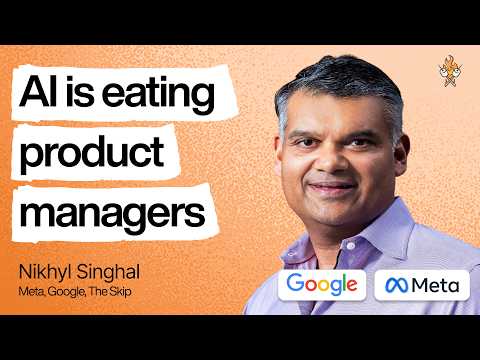
Why half of product managers are in trouble | Nikhyl Singhal (Meta, Google)
Lenny Rachitsky (host), Nikhyl Singhal (guest)
In this episode of Lenny's Podcast, featuring Lenny Rachitsky and Nikhyl Singhal, Why half of product managers are in trouble | Nikhyl Singhal (Meta, Google) explores pM skills are flipping as AI demands builders and judgment AI is pushing product work away from “information moving” and toward hands-on building plus high-quality judgment about what to ship and why.
PM skills are flipping as AI demands builders and judgment
AI is pushing product work away from “information moving” and toward hands-on building plus high-quality judgment about what to ship and why.
Companies are likely to shed large parts of their workforce and then rehire fewer, “AI-first” people, creating both opportunity for builders and risk for non-builders.
Because software iteration is getting dramatically cheaper and faster, PMs will face many more potential changes and must become better at prioritization, systems thinking, and evaluating tradeoffs.
Career signals are shifting from brand-name resumes and past launches to demonstrable modern tool fluency, current craft, and speed of execution.
The transition is psychologically hard and exhausting, but many PMs find a “moment of joy” once they build something themselves, which becomes the antidote to burnout and the catalyst for reinvention.
Key Takeaways
The “information-mover PM” is becoming obsolete.
Singhal argues many PMs spent recent years translating status, shaping narratives, and moving docs up chains; AI and new operating models reduce the need for that, favoring people who directly build and decide.
Get the full analysis with uListen
Judgment becomes the highest-paid PM skill as testing gets cheap.
If products can ship 10–100× more experiments, the bottleneck is no longer execution mechanics but deciding what matters, what’s sustainable, and what fits the system and brand.
Get the full analysis with uListen
Expect workforce churn: big layoffs followed by smaller AI-first hiring waves.
He predicts “massive shedding” then rehiring fewer people with modern, AI-native skills—meaning employability hinges on current tool fluency and hands-on capability, not title history.
Get the full analysis with uListen
Your brand and past wins matter less than how modern you are today.
Hiring conversations are shifting toward scenario-based evaluation (tools, thinking, judgment) because prior-era delivery methods may not translate to today’s AI-accelerated product building.
Get the full analysis with uListen
Build internal leverage, not just external features.
A strong near-term move is creating “chief of staff” workflows, agents, and automation that eliminate status reports, reviews, and manual coordination—software that scales your org’s decisioning.
Get the full analysis with uListen
Crossing the reinvention threshold requires pace, ego reduction, and a ‘skip’ mindset.
He advises increasing pace for the next 12–24 months, being willing to step down in scope/title to stay current, and optimizing for the job after the next—getting onto the “boat” that’s headed to the new operating model.
Get the full analysis with uListen
The first ‘moment of joy’ is a practical antidote to fear and burnout.
Many people convert from anxiety to momentum after building one personally meaningful tool; leaders can accelerate adoption by helping teams find and share these wins so reinvention feels energizing rather than punitive.
Get the full analysis with uListen
Notable Quotes
“The information-mover is essentially going to become a dinosaur.”
— Nikhyl Singhal
“In the next 12 to 24 months, we're gonna see massive shedding of staffs and then massive rehiring.”
— Nikhyl Singhal
“If you don't love building stuff, you're in trouble.”
— Nikhyl Singhal
“In two years, I think there won't be any more bad software.”
— Nikhyl Singhal
“Your goal when you're in your power years is to equally disappoint everyone in your life.”
— Nikhyl Singhal
Questions Answered in This Episode
How do you practically define “builder” PM behavior in a way that isn’t just “PM who codes,” and what are concrete signals in interviews?
AI is pushing product work away from “information moving” and toward hands-on building plus high-quality judgment about what to ship and why.
Get the full analysis with uListen AI
If AI makes it easy to generate 10–100× more product changes, what specific prioritization frameworks or decision filters do you recommend to avoid thrash?
Companies are likely to shed large parts of their workforce and then rehire fewer, “AI-first” people, creating both opportunity for builders and risk for non-builders.
Get the full analysis with uListen AI
Which parts of ‘alignment’ disappear with AI (status/theatrics) versus remain essential (conflict resolution, strategy tradeoffs), and how should PMs retrain?
Because software iteration is getting dramatically cheaper and faster, PMs will face many more potential changes and must become better at prioritization, systems thinking, and evaluating tradeoffs.
Get the full analysis with uListen AI
You predict major shedding and AI-first rehiring—what are the top 3 portfolio projects a mid-level PM should complete in 60 days to be in the “rehire” bucket?
Career signals are shifting from brand-name resumes and past launches to demonstrable modern tool fluency, current craft, and speed of execution.
Get the full analysis with uListen AI
What do you see as the most common failure mode when PMs try to build internal agents/tools for their org (data access, trust, adoption, security)?
The transition is psychologically hard and exhausting, but many PMs find a “moment of joy” once they build something themselves, which becomes the antidote to burnout and the catalyst for reinvention.
Get the full analysis with uListen AI
Transcript Preview
The skills that used to be really valued in product managers are changing substantially.
It's gonna be chaos. Our industry is very much in stress. Nothing's constant. Everyone's in a state of alert. If you talk to product leaders three years ago, their day was largely moving information. The information-mover is essentially going to become a dinosaur.
I just did this report on the job market. Interestingly, we have the most open PM roles globally in three-plus years.
This is a complete renaissance for the product industry, but it comes with a lot of strings attached. In the next 12 to 24 months, we're gonna see massive shedding of staffs and then massive rehiring. You might see a company shed 30,000 and hire 8,000, but the 8,000 people are gonna all be AI first. The builders are gonna have the time of their lives, but if you don't love building stuff, you're in trouble.
What are some things that people should do to thrive in this future that is emerging?
You have to find ability to increase pace. You've gotta find that reserve. The next two years requires a lot of fire in the belly.
Today, my guest is Nikhyl Singhal. Nikhyl is, in my opinion, right now, the number one best source of career advice for product managers and for tech people in general. He was a longtime exec at Meta and at Google, CPO at Credit Karma. He's also a four-time founder, and he leads the best community out there for heads of product and chief product officers called The Skip Community. He also has a larger community for tech professionals called The Skip Coach. And through these communities and his 30 years of building consumer products at scale, and also his podcast, which I've recently partnered with, he is constantly gathering and meeting with and speaking with top product leaders around the world about what's happening and what's changing in the lives of product managers and tech workers in general, and the answer is a lot. This is an episode that every single product person needs to listen to, and you won't find a more real talk and actionable overview of what is going on and where things are heading in your career, and also what you should be doing about it right now. Seriously, do not miss this conversation. Before we get into it, don't forget to check out lennysproductpass.com for an incredible set of deals available exclusively to Lenny's Newsletter subscribers. With that, I bring you Nikhyl Singhal. [gentle music] Nikhyl, thank you so much for being here, and welcome back to the podcast.
Yeah. Thank you, Lenny. I appreciate, uh, version two. Uh, and all my notes were like Lenny version two, so I'm quite excited about, uh, being, uh, back on the show. You've done so well since the last time that I v- visited and, uh, appreciate the opportunity to, to, to share with you, uh, my current thinking.
Yeah. So you were actually one of the launch episodes, the first 20, 30 guests that I had on the podcast. This was two or three years ago, something like that, and a lot has changed in the world of product management since then, and we're gonna be basically spending this entire episode talking about what is changing in the role and the career of a product manager. And what I especially love about you, talking to you and hearing your insights, is you don't sugarcoat what's going on. You're very real about like, "Here's what you need to know about what is going on." So we're gonna be talking about the good and the bad and just, like, a lot of advice for product managers in particular. To kick things off, give us just kind of the big picture view into what is changing for product managers, the good and then maybe the, the scary stuff.
Install uListen to search the full transcript and get AI-powered insights
Get Full TranscriptGet more from every podcast
AI summaries, searchable transcripts, and fact-checking. Free forever.
Add to Chrome