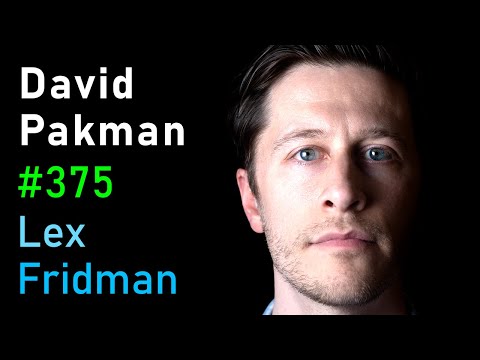
David Pakman: Politics of Trump, Biden, Bernie, AOC, Socialism & Wokeism | Lex Fridman Podcast #375
David Pakman (guest), Lex Fridman (host), Narrator, Narrator
In this episode of Lex Fridman Podcast, featuring David Pakman and Lex Fridman, David Pakman: Politics of Trump, Biden, Bernie, AOC, Socialism & Wokeism | Lex Fridman Podcast #375 explores david Pakman Dissects Labels, Trump, Biden, Wokeism, and Media Polarization Lex Fridman and David Pakman explore how political labels (liberal, progressive, socialist, etc.) have shifted in meaning and are often weaponized to shut down rather than start conversations.
David Pakman Dissects Labels, Trump, Biden, Wokeism, and Media Polarization
Lex Fridman and David Pakman explore how political labels (liberal, progressive, socialist, etc.) have shifted in meaning and are often weaponized to shut down rather than start conversations.
They analyze Donald Trump and Joe Biden’s strengths, weaknesses, and electoral prospects, including Trump’s handling of COVID, Biden’s age and record, and structural issues in the DNC and GOP.
Pakman reflects on his own role as a left-wing commentator: dealing with online outrage (notably his Nashville shooting tweet), audience capture, Twitter dynamics, and the incentives of YouTube and modern media.
They also touch on deeper issues: wokeism and free speech, the COVID communication fiasco, conspiracies, January 6, foreign policy (Ukraine, Israel–Palestine), the future of education and AI, and how to stay sane and honest in a toxic political ecosystem.
Key Takeaways
Political labels are fluid and frequently weaponized.
Terms like liberal, progressive, socialist, and leftist no longer have stable meanings; they’re used as signals and insults more than precise descriptions, often stifling nuanced policy debate unless explicitly defined each time.
Get the full analysis with uListen
Progressivism today aligns more with social democracy than socialism.
Pakman distinguishes social democracy (regulated capitalism with more socialized services, like in Northern Europe) from democratic socialism (social ownership of the means of production), and places himself in the social-democratic/progressive camp.
Get the full analysis with uListen
Modern media rewards outrage and mockery, but you can consciously balance it.
Pakman admits his show and Twitter use snark and sensational stories because that’s what the platforms reward, yet he deliberately mixes in deeper policy segments and urges his audience to build a broader “knowledge pyramid” beyond commentary.
Get the full analysis with uListen
Handling online backlash requires boundaries and selective attention.
After his sarcastic Nashville shooting tweet led to mass outrage, threats, and advertisers dropping him, he learned that deleting content doesn’t stop a dogpile once screenshots exist, and that he must limit exposure to comments and protect family privacy.
Get the full analysis with uListen
Trump’s main strengths are rhetorical and performative, not policy depth.
Pakman credits Trump with strong stagecraft, populist messaging, and risk-taking that resonated with disaffected voters, but argues his big promises (healthcare, North Korea, wall, tariffs) were largely unrealistic or poorly understood by Trump himself.
Get the full analysis with uListen
COVID eroded trust in science due to poor communication and politicization.
Both highlight how overconfident messaging, reversals on masks, and partisan alignment around vaccines damaged public trust; Pakman emphasizes the need to communicate uncertainty honestly, while Lex stresses scientific humility as a lost art in leadership.
Get the full analysis with uListen
‘Wokeism’ is real but smaller than the culture-war narrative suggests.
Pakman acknowledges excesses on the left—bullying, speech-policing, identity litmus tests—but argues right-wing media exaggerates them; polling suggests many Americans still think society hasn’t gone far enough in addressing discrimination, even as some institutions overcorrect.
Get the full analysis with uListen
Notable Quotes
“There are terms that can be used to start a conversation or to stop it.”
— David Pakman
“I’m very open with my audience: the vast majority of what I do is the top of that [junk food] pyramid.”
— David Pakman
“Only someone who doesn’t know anything about the size and scope of these issues could so arrogantly say that they could solve them in that way and on that timeframe.”
— David Pakman
“I don’t consume a lot of the type of content I produce.”
— David Pakman
“If you believe that we are on an inflection point of sorts in changes to society and acceleration of technology, I think it’s really tough to know in 2090 what will actually be the biggest threat.”
— David Pakman
Questions Answered in This Episode
How should we redesign political discourse so labels clarify rather than obscure what people believe?
Lex Fridman and David Pakman explore how political labels (liberal, progressive, socialist, etc. ...
Get the full analysis with uListen AI
Where is the ethical line between effective, attention-grabbing commentary and harmful sensationalism in politics media?
They analyze Donald Trump and Joe Biden’s strengths, weaknesses, and electoral prospects, including Trump’s handling of COVID, Biden’s age and record, and structural issues in the DNC and GOP.
Get the full analysis with uListen AI
What would a responsible, honest communication strategy have looked like during COVID—from both political and scientific leaders?
Pakman reflects on his own role as a left-wing commentator: dealing with online outrage (notably his Nashville shooting tweet), audience capture, Twitter dynamics, and the incentives of YouTube and modern media.
Get the full analysis with uListen AI
How can universities balance diversity, equity, and inclusion efforts with a robust commitment to free inquiry and merit?
They also touch on deeper issues: wokeism and free speech, the COVID communication fiasco, conspiracies, January 6, foreign policy (Ukraine, Israel–Palestine), the future of education and AI, and how to stay sane and honest in a toxic political ecosystem.
Get the full analysis with uListen AI
As AI reshapes how we learn and think, what should replace the traditional four-year degree as a marker of competence and citizenship?
Get the full analysis with uListen AI
Transcript Preview
I tweet that, and then I finish the day. And I wake up the next morning and I glance at my phone. I'm seeing all these verified accounts that are, you know, quote-tweeting it and demanding a retraction and whatever. And I go, "Uh-oh, okay, this looks like it's getting, looks like it's getting some attention." Um, I then continue about my day. Around noon, I hear from my dad that he got 100 messages from, "You should have aborted your son," to, "We're gonna find all of you," to whatever else. My dad has no idea what's going on. He's like, "I don't know what this is, but I have 100 DMs," to everything else you can imagine. Um, and I start to get emails about, you know, "We... you know, uh, your Jewish faith," this and that and the other thing. And so at that point, to me, I thought, "This is just going to get worse and worse and worse," and so I deleted the tweet. And I really regret doing that, because over the 48 hours that followed, yes, the attacks escalated, it went through Candace Owens and then at foxnews.com, Newsmax, kind of peaking with, with Donald Trump Jr., and it was horrible.
The following is a conversation with David Pakman, a left-wing progressive political commentator and host of The David Pakman Show. I hope to continue to have many conversations on politics with prominent, insightful, and sometimes controversial figures across the political spectrum. David and I have been planning to speak for a long time, and I'm sure we'll speak many more times. This conversation was challenging, eye-opening, and fun. This is the Lex Fridman Podcast. To support it, please check out our sponsors in the description. And now, dear friends, here's David Pakman. Are there interesting differences to you between terms like liberal, Democrat, left wing, leftist, progressive, socialist, communist, Marxist, far left, center left, all of these labels? Is there interesting distinctions between them?
Yeah, there's two sets of distinctions. One is, if you just want to say, let's define each of these as political terms, they're all different terms. You can be a progressive ideologically, but not be a member of the Democratic Party. Many say the Democratic Party isn't even really very progressive. So these are certainly terms that we could define, uh, in order to have a conversation about the next thing, kind of as a precursor to a conversation. Sometimes the terms are used in order to tag someone with a certain ideology that's not really linked to policy or any particular political question. But they can be used positively or negatively to just kind of say, "Here is the image of this individual that I have in my mind." So, like Marxist is right now very popularly being used by some on the right, um, to attack Democrats. There's very few actual Marxists, certainly not in positions of power in the United States, but even among the general population. Um, so I think it's important to distinguish, are we defining these terms because we want to compare and contrast the ideas that a particular group might bring to the discussion? Or are we using them as insults or to stifle conversation? There are terms that can be used to start a conversation or to stop it.
Install uListen to search the full transcript and get AI-powered insights
Get Full TranscriptGet more from every podcast
AI summaries, searchable transcripts, and fact-checking. Free forever.
Add to Chrome