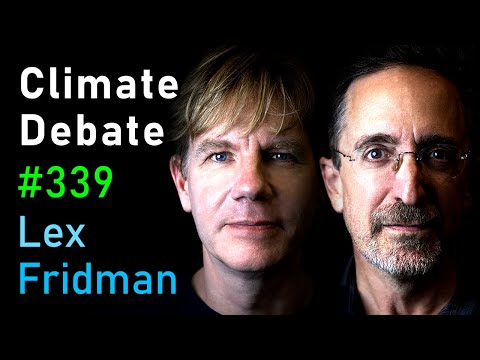
Climate Change Debate: Bjørn Lomborg and Andrew Revkin | Lex Fridman Podcast #339
Bjørn Lomborg (guest), Andrew Revkin (guest), Lex Fridman (host), Lex Fridman (host), Narrator, Narrator, Narrator, Narrator, Narrator
In this episode of Lex Fridman Podcast, featuring Bjørn Lomborg and Andrew Revkin, Climate Change Debate: Bjørn Lomborg and Andrew Revkin | Lex Fridman Podcast #339 explores climate Policy, Not Climate Doom: Rethinking Risk, Energy, and Action Lex Fridman hosts Bjørn Lomborg and climate journalist Andrew Revkin for a wide-ranging, non-adversarial conversation about climate change, risk, and policy. They argue that while human-caused global warming is real and important, public discourse has become dominated by unhelpful extremes: denial on one side and apocalyptic doom on the other.
Climate Policy, Not Climate Doom: Rethinking Risk, Energy, and Action
Lex Fridman hosts Bjørn Lomborg and climate journalist Andrew Revkin for a wide-ranging, non-adversarial conversation about climate change, risk, and policy. They argue that while human-caused global warming is real and important, public discourse has become dominated by unhelpful extremes: denial on one side and apocalyptic doom on the other.
Both emphasize that climate change is one problem among many, and that focusing narrowly on CO₂ and catastrophe often crowds out more effective actions like reducing vulnerability, smart urban planning, and targeted public health and development interventions.
They highlight energy innovation, particularly making clean energy cheaper than fossil fuels, as the most powerful long-term lever, and criticize expensive, symbolic policies and virtue-signaling (e.g., poorly targeted EV subsidies) that deliver little climate benefit per dollar.
The discussion widens into how media, politics, scientific culture, and human psychology distort climate conversations, and into a broader philosophy of progress: using cost-effective solutions, social innovation, and better communication to improve human well-being without paralyzing people with fear.
Key Takeaways
Distinguish climate change from climate catastrophe to avoid paralysis.
Lomborg and Revkin stress that mainstream science supports significant human-caused warming, but not the near-term extinction scenarios many young people fear. ...
Reducing vulnerability often yields faster, cheaper benefits than cutting CO₂.
Disaster losses are driven far more by where and how we build (floodplains, coasts, fire-prone hillsides) than by incremental changes in weather so far. ...
Climate policy should be judged by cost-effectiveness, not symbolism.
Using economic tools, Lomborg argues many popular policies (e. ...
Innovation, not forced austerity, is the only scalable decarbonization path.
Both guests argue that trying to make fossil fuels prohibitively expensive, before competitive alternatives exist, is politically and morally fraught—especially for the poor who depend on cheap energy. ...
Media incentives and political narratives skew climate perceptions.
Journalistic norms (searching for a ‘front-page’ scare angle), advocacy framing (“climate crisis/emergency”), and political blame-games (e. ...
Energy justice means different paths for rich and poor countries.
Rich nations, having emitted most historical CO₂, can and should cut faster, but Lomborg and Revkin argue it’s unjust to block poor countries from using their gas, LPG, or even coal where it’s the only viable path out of energy poverty. ...
Constructive climate progress comes from cooperation on specific actions, not winning abstract belief battles.
Revkin notes that polling shows little red/blue divide on many concrete steps—like energy innovation, grid upgrades, or pollution control—if you don’t label them as “climate. ...
Notable Quotes
“Climate change is a problem, but it’s not the end of the world—and treating it like an asteroid about to hit Earth makes us do less good, not more.”
— Bjørn Lomborg
“We don’t have a climate crisis in America. We have a decision crisis.”
— Andrew Revkin
“Disasters are not natural; they’re designed. Nature throws darts, but we decide how big the bullseye is and who stands on it.”
— Andrew Revkin
“People all around the world, their lives are basically dependent on fossil fuels. Making that energy unaffordable before we have alternatives is almost morally reprehensible.”
— Bjørn Lomborg
“Having looked at this for 35 years, I don’t fight the belief-versus-disbelief fight anymore. The real question is: what kind of energy future do you want, and how do we actually get there?”
— Andrew Revkin
Questions Answered in This Episode
If we reframed climate change primarily as a risk management and vulnerability problem, how would that concretely change national and local policies over the next decade?
Lex Fridman hosts Bjørn Lomborg and climate journalist Andrew Revkin for a wide-ranging, non-adversarial conversation about climate change, risk, and policy. ...
What mix of public and private investments in energy R&D and infrastructure would realistically be needed to make clean energy cheaper than fossil fuels worldwide?
Both emphasize that climate change is one problem among many, and that focusing narrowly on CO₂ and catastrophe often crowds out more effective actions like reducing vulnerability, smart urban planning, and targeted public health and development interventions.
How can media organizations and major scientific bodies communicate climate risks honestly without resorting to exaggerated ‘crisis’ framing that may backfire or paralyze people?
They highlight energy innovation, particularly making clean energy cheaper than fossil fuels, as the most powerful long-term lever, and criticize expensive, symbolic policies and virtue-signaling (e. ...
In poor countries with fossil resources, what criteria should determine when financing gas, LPG, or even coal is ethically justified as a development tool versus when it locks in harmful paths?
The discussion widens into how media, politics, scientific culture, and human psychology distort climate conversations, and into a broader philosophy of progress: using cost-effective solutions, social innovation, and better communication to improve human well-being without paralyzing people with fear.
How can cost-benefit thinking be integrated into democratic decision-making without reducing complex moral questions (like intergenerational justice or biodiversity loss) to just dollar values?
EVERY SPOKEN WORD
Install uListen for AI-powered chat & search across the full episode — Get Full Transcript
Get more out of YouTube videos.
High quality summaries for YouTube videos. Accurate transcripts to search & find moments. Powered by ChatGPT & Claude AI.
Add to Chrome