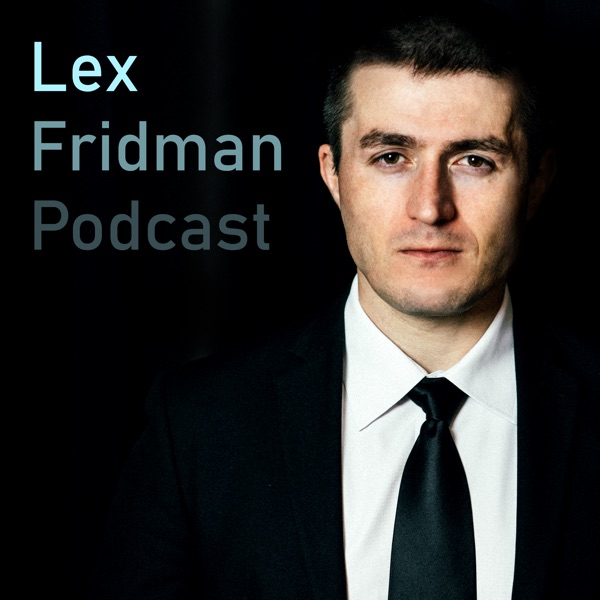
 Lex Fridman Podcast
Tyler Cowen: Economic Growth & the Fight Against Conformity & Mediocrity | Lex Fridman Podcast #174
Lex Fridman and Tyler Cowen on tyler Cowen defends growth, weirdos, and big business against stagnation.
In this episode of Lex Fridman Podcast, featuring Lex Fridman and Tyler Cowen, Tyler Cowen: Economic Growth & the Fight Against Conformity & Mediocrity | Lex Fridman Podcast #174 explores tyler Cowen defends growth, weirdos, and big business against stagnation Lex Fridman and economist Tyler Cowen explore how economics functions less as a predictive science and more as a tool for asking better questions about growth, risk, and human behavior. Cowen argues that American-style capitalism, immigration, and a culture that tolerates weirdness are central engines of innovation, even as they create inequality, precarity, and social tension. They debate existential risks from technology and nuclear weapons, the future of economic growth and crypto, and how institutions like universities, big business, China, and Russia shape opportunity. The conversation ranges into culture—art, food, love, UFOs, and meaning—illustrating Cowen’s view that human flourishing comes from small groups, good mentors, and a relentless fight against conformity and mediocrity.
At a glance
WHAT IT’S REALLY ABOUT
Tyler Cowen defends growth, weirdos, and big business against stagnation
- Lex Fridman and economist Tyler Cowen explore how economics functions less as a predictive science and more as a tool for asking better questions about growth, risk, and human behavior. Cowen argues that American-style capitalism, immigration, and a culture that tolerates weirdness are central engines of innovation, even as they create inequality, precarity, and social tension. They debate existential risks from technology and nuclear weapons, the future of economic growth and crypto, and how institutions like universities, big business, China, and Russia shape opportunity. The conversation ranges into culture—art, food, love, UFOs, and meaning—illustrating Cowen’s view that human flourishing comes from small groups, good mentors, and a relentless fight against conformity and mediocrity.
IDEAS WORTH REMEMBERING
7 ideasEconomics’ real value is framing better questions, not precise forecasts.
Cowen emphasizes that tools like game theory rarely predict specific outcomes (e.g., USA–USSR nuclear peace) but radically improve how we think about strategy, incentives, and cooperation.
Low‑probability catastrophic events become near‑inevitable over long time horizons.
He argues that as weapons of mass destruction and destructive technologies become cheaper and more accessible, a "trembling hand" outlier (a Hitler-type actor with powerful tools) almost surely appears over centuries, even if yearly probabilities remain low.
American capitalism is deeply flawed yet uniquely powerful at fostering opportunity and weirdness.
Cowen praises big business and U.S. business culture for rapid innovation (e.g., vaccines, Amazon, Zoom) and for rewarding eccentric, high-variance talent, while acknowledging racial injustice, weak social safety nets, and precarious lives compared to Northwestern Europe.
Immigration and meritocracy are central to scientific and economic dynamism.
He strongly supports greatly expanded skilled immigration—"open borders for Belarus" as a slogan—and argues that immigrants often bring the stubbornness and drive (e.g., mRNA pioneers) that native-born citizens cushioned by comfort may lack.
Growth may be re-accelerating due to computation-driven breakthroughs.
Cowen, once a stagnation pessimist, is now more optimistic, citing mRNA vaccines, battery and green tech, CRISPR, and prospective automation as evidence that computing is unlocking a new wave of innovation and future GDP growth—though with new risks.
Free markets need strong legal and institutional scaffolding to work well.
He rejects pure anarchism and simplistic "free market" slogans, stressing that property rights, rule of law, and carefully chosen exceptions (e.g., domestic vaccine production, defense supply chains) are essential to avoid mafias and strategic vulnerability.
Human flourishing is built on mentors and small, focused peer groups.
Cowen’s core life advice is to find mentors in every area you care about and to build small groups of peers who obsess over shared problems—because most major intellectual and creative advances emerge from such clusters, not solitary geniuses.
WORDS WORTH SAVING
5 quotesEconomics will never be very predictive. It’s most useful for helping you ask better questions.
— Tyler Cowen
We’re a nation of weirdos, and weirdos are creative.
— Tyler Cowen
Big business has mostly been a hero in American history.
— Tyler Cowen
The wisdom is in the coming together of different points of view.
— Tyler Cowen
All societies are in some regards anarchistic. You want a good anarchy rather than a bad anarchy.
— Tyler Cowen
QUESTIONS ANSWERED IN THIS EPISODE
5 questionsIf economics is primarily about asking better questions, which questions are we still failing to ask about technology and growth?
Lex Fridman and economist Tyler Cowen explore how economics functions less as a predictive science and more as a tool for asking better questions about growth, risk, and human behavior. Cowen argues that American-style capitalism, immigration, and a culture that tolerates weirdness are central engines of innovation, even as they create inequality, precarity, and social tension. They debate existential risks from technology and nuclear weapons, the future of economic growth and crypto, and how institutions like universities, big business, China, and Russia shape opportunity. The conversation ranges into culture—art, food, love, UFOs, and meaning—illustrating Cowen’s view that human flourishing comes from small groups, good mentors, and a relentless fight against conformity and mediocrity.
How can societies preserve the upside of "weirdness" and eccentricity without sacrificing social cohesion and security?
What institutional reforms would best balance American-style dynamism with stronger community and safety nets?
Are current universities salvageable as engines of original thought, or will most future innovation move outside traditional academia?
Where is the line between realistic pessimism about catastrophic risk and counterproductive fatalism that stifles innovation?
EVERY SPOKEN WORD
Install uListen for AI-powered chat & search across the full episode — Get Full Transcript
Get more out of YouTube videos.
High quality summaries for YouTube videos. Accurate transcripts to search & find moments. Powered by ChatGPT & Claude AI.
Add to Chrome