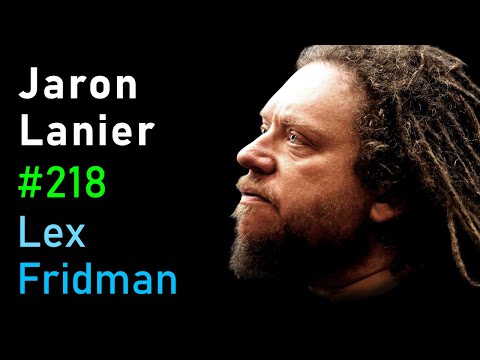
Jaron Lanier: Virtual Reality, Social Media & the Future of Humans and AI | Lex Fridman Podcast #218
Lex Fridman (host), Jaron Lanier (guest), Narrator, Narrator, Narrator, Narrator, Lex Fridman (host)
In this episode of Lex Fridman Podcast, featuring Lex Fridman and Jaron Lanier, Jaron Lanier: Virtual Reality, Social Media & the Future of Humans and AI | Lex Fridman Podcast #218 explores jaron Lanier Warns: Rebuild Tech To Honor Human Dignity, Not Algorithms Jaron Lanier and Lex Fridman explore virtual reality, social media, AI, economics, and the human condition through a mix of technical insight and philosophical reflection. Lanier argues that VR’s greatest value is how it renews our perception of the physical world, and that current AI is best understood as powerful but limited algorithms, not autonomous creatures. He critiques ad-driven social media and speculative crypto-economies as systems that distort human behavior, advocating instead for “data dignity” and markets that reward human creativity rather than lizard-brain engagement. The conversation closes on music, mortality, meaning, and the practical difficulty and importance of kindness and political “perpetual annoyance” in a free society.
Jaron Lanier Warns: Rebuild Tech To Honor Human Dignity, Not Algorithms
Jaron Lanier and Lex Fridman explore virtual reality, social media, AI, economics, and the human condition through a mix of technical insight and philosophical reflection. Lanier argues that VR’s greatest value is how it renews our perception of the physical world, and that current AI is best understood as powerful but limited algorithms, not autonomous creatures. He critiques ad-driven social media and speculative crypto-economies as systems that distort human behavior, advocating instead for “data dignity” and markets that reward human creativity rather than lizard-brain engagement. The conversation closes on music, mortality, meaning, and the practical difficulty and importance of kindness and political “perpetual annoyance” in a free society.
Key Takeaways
VR’s deepest value is the contrast it creates with reality.
Lanier argues the most powerful moment in VR is removing the headset; the comparison makes the physical world feel newly vivid, strange, and precious, suggesting VR should ultimately deepen, not replace, our appreciation of reality.
Get the full analysis with uListen
Treat current AI as tools, not creatures, to stay competent.
He insists there is no mystical ‘AI,’ only human-made algorithms; once you start granting them agency or consciousness, you lose engineering rigor and risk ceding responsibility for design, ethics, and outcomes.
Get the full analysis with uListen
Engagement algorithms amplify our worst impulses by design.
Because social platforms optimize on very crude feedback (clicks, time watched), they preferentially reward fight-or-flight responses—fear, anger, paranoia, and lust—slowly nudging societies toward xenophobia, irritability, and division.
Get the full analysis with uListen
Fixing social media requires changing economic incentives, not just UX tweaks.
Lanier views the core problem as the ad-based ‘cognitive access blackmail’ model: businesses must pay to be noticed at all. ...
Get the full analysis with uListen
‘Data dignity’ imagines people as paid partners in AI, not raw material.
His future vision: workers (e. ...
Get the full analysis with uListen
Decentralization alone doesn’t guarantee freedom or virtue.
Lanier criticizes Bitcoin and similar schemes as economically unproductive, environmentally costly, and often serving criminality or speculation; he argues that politics and “perpetual annoyance” with other people are unavoidable ingredients of real freedom.
Get the full analysis with uListen
Kindness is hard, expert work that takes a lifetime to learn.
He tells young people that genuine, effective kindness requires skill and painful lessons, and pairs this with advice to periodically step away from social pressures to listen to their own experience as something real and meaningful.
Get the full analysis with uListen
Notable Quotes
““I have always found the very most valuable moment in virtual reality to be the moment when you take off the headset.””
— Jaron Lanier
““I don’t believe in AI. I don’t think there’s any AI. There’s just algorithms. We make them. We control them.””
— Jaron Lanier
““Freedom is being perpetually annoyed by other people.””
— Jaron Lanier
““If you include AI inside the circle of empathy, you immediately make yourself a worse engineer.””
— Jaron Lanier
““You can’t both believe in the future and want to live forever. You have to make room for it.””
— Jaron Lanier
Questions Answered in This Episode
If we redesigned social media from scratch using data dignity, how would the first version realistically look and fund itself?
Jaron Lanier and Lex Fridman explore virtual reality, social media, AI, economics, and the human condition through a mix of technical insight and philosophical reflection. ...
Get the full analysis with uListen AI
At what point, if ever, should we consider expanding our ‘circle of empathy’ to include advanced AI systems, and what practical test would justify that?
Get the full analysis with uListen AI
How can policymakers shift economic incentives away from lizard-brain engagement without stifling innovation or free expression?
Get the full analysis with uListen AI
What would a ‘GitHub plus TikTok’ platform for creative collaboration actually require in terms of governance, ownership, and revenue sharing?
Get the full analysis with uListen AI
In daily life, how can individuals cultivate the kind of reflective inner experience Lanier describes while still participating in a hyper-connected digital world?
Get the full analysis with uListen AI
Transcript Preview
The following is a conversation with Jaron Lanier, a computer scientist, visual artist, philosopher, writer, futurist, musician, and the founder of the field of virtual reality. To support this podcast, please check out our sponsors in the description. As a side note, you may know that Jaron is a staunch critic of social media platforms. Him and I agree on many aspects of this, except perhaps I am more optimistic about it being possible to build better platforms and better artificial intelligence systems that put long-term interests and happiness of human beings first. Let me also say, a general comment about these conversations: I try to make sure I prepare well, remove my ego from the picture, and focus on making the other person shine as we try to explore the most beautiful and insightful ideas in their mind. This can be challenging when the ideas that are close to my heart are being criticized. In those cases, I do offer a little pushback, but respectfully, and then move on, trying to have the other person come out looking wiser in the exchange. I think there's no such thing as winning in conversations, nor in life. My goal is to learn and to have fun. I ask that you don't see my approach to these conversations as weakness. It is not. It is my attempt at showing respect and love for the other person. That said, I also often just do a bad job of talking, but you probably already knew that, so please give me a pass on that as well. This is the Lex Fridman Podcast, and here is my conversation with Jaron Lanier. You're considered the founding father of virtual reality. Do you think we will one day spend most or all of our lives in, uh, virtual reality worlds?
I have always found the very most valuable moment in virtual reality to be the moment when you take off the headset and your senses are refreshed and you perceive physicality, uh, afresh, you know, as if you were a newborn baby-
Mm.
... but with a little more experience. So you can really notice just how incredibly strange and delicate and peculiar and impossible the real world is. Um...
So the magic is, and perhaps forever will be, in the physical world?
Well, that's my take on it. That's just me. I mean, I think I don't get to tell everybody else how to think or how to experience virtual reality, and at this point, there have been multiple generations of younger people who've come along and liberated me from having to worry about these things.
(laughs)
Uh, but I should say also, even in, uh, what somet- well, I called it mixed reality back in the day, and these days it's called augmented reality, uh, but with something like a HoloLens, even then, like one of my favorite things is to augment a forest, not because I think the forest needs augmentation, but when you look at the augmentation next to a real tree, the real tree just pops out as being astounding, you know? It's- it's interactive, it's changing slightly all the time if you pay attention. And it's hard to pay attention to that, but when you compare it to virtual reality, all of a sudden you do. And even in practical applications, uh, my- my favorite early application of virtual reality which we prototyped going back to the 80s when I was working with Dr. Joe Rosen at Stanford Med, near- near where we are now, uh, we made the first surgical simulator. And to go from the fake anatomy of the simulation, which is incredibly valuable for many things, for designing procedures, for training, for all kinds of things, then to go to the real person, boy, it's really something. Like, uh, surgeons really get woken up by that transition. It's very cool. So I think the transition is actually more valuable than the simulation.
Install uListen to search the full transcript and get AI-powered insights
Get Full TranscriptGet more out of YouTube videos.
High quality summaries for YouTube videos. Accurate transcripts to search & find moments. Powered by ChatGPT & Claude AI.
Add to Chrome