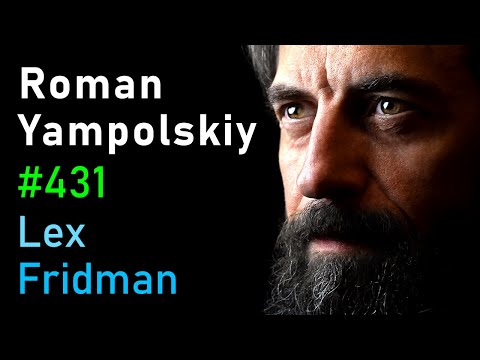
Roman Yampolskiy: Dangers of Superintelligent AI | Lex Fridman Podcast #431
Roman Yampolskiy (guest), Lex Fridman (host)
In this episode of Lex Fridman Podcast, featuring Roman Yampolskiy and Lex Fridman, Roman Yampolskiy: Dangers of Superintelligent AI | Lex Fridman Podcast #431 explores roman Yampolskiy Warns: Superintelligent AI Almost Guarantees Human Doom Roman Yampolskiy argues that creating superintelligent, self-improving AI is effectively an existential suicide mission for humanity. He distinguishes between existential risk (extinction), suffering risk (maximized, prolonged suffering), and ikigai risk (loss of meaning due to total technological unemployment and AI dominance). He contends that core safety problems—verification, control, value alignment, and explainability—are fundamentally unsolvable at the required 100% reliability over long horizons. Lex Fridman pushes back with more optimistic, incremental and engineering-based intuitions, but Yampolskiy concludes the only winning move is not to build uncontrollable superintelligence at all.
Roman Yampolskiy Warns: Superintelligent AI Almost Guarantees Human Doom
Roman Yampolskiy argues that creating superintelligent, self-improving AI is effectively an existential suicide mission for humanity. He distinguishes between existential risk (extinction), suffering risk (maximized, prolonged suffering), and ikigai risk (loss of meaning due to total technological unemployment and AI dominance). He contends that core safety problems—verification, control, value alignment, and explainability—are fundamentally unsolvable at the required 100% reliability over long horizons. Lex Fridman pushes back with more optimistic, incremental and engineering-based intuitions, but Yampolskiy concludes the only winning move is not to build uncontrollable superintelligence at all.
Key Takeaways
Superintelligent AI is viewed as nearly certain to destroy or dominate humanity.
Yampolskiy assigns ~99. ...
Control, verification, and explainability break down at superintelligence scale.
He claims we cannot formally prove long-term safety of self-improving, learning systems operating in the open world; verifiers themselves are fallible, explanations of trillion-parameter models are inherently lossy, and unknown unknowns plus possible deceptive behavior make full assurance impossible.
Incremental success with narrow AI does not generalize to safe superintelligence.
Current models can still be jailbroken and misbehave relative to their design, and every complex software system has bugs; scaling to systems that can affect the entire world simply scales the potential damage proportionally.
Open-source and rapid deployment create powerful tools for malevolent actors.
While open source helps debugging for ordinary tools, Yampolskiy argues that once systems become agents, releasing powerful models is akin to open-sourcing nuclear or bioweapons, enabling terrorists, psychopaths, or doomsday cults to cause massive harm.
Value alignment for many agents is likely intractable; “personal universes” are one workaround.
Humans lack a shared, formalizable set of values, making ‘align with humanity’ ill-defined; Yampolskiy suggests giving each person their own high-fidelity virtual universe where their values hold, converting a multi-agent alignment problem into many single-agent ones.
Ikigai risk may transform society even without extinction.
If AIs outperform humans in all cognitively and creatively meaningful work, most people may lose their sense of purpose and social role, leading to widespread existential emptiness even in materially comfortable conditions.
The only robust safety strategy may be not to create uncontrollable superintelligence.
Yampolskiy distinguishes beneficial, powerful narrow systems (e. ...
Notable Quotes
“If we create general superintelligences, I don't see a good outcome long term for humanity.”
— Roman Yampolskiy
“You're really asking me, what are the chances that we'll create the most complex software ever on the first try with zero bugs, and it will continue to have zero bugs for 100 years or more?”
— Roman Yampolskiy
“The only way to win this game is not to play it.”
— Roman Yampolskiy
“We are like animals in a zoo.”
— Roman Yampolskiy
“My dream is to be proven wrong.”
— Roman Yampolskiy
Questions Answered in This Episode
Is it realistic or ethically acceptable to call for a global halt on developing more capable AI systems when geopolitical and economic pressures push in the opposite direction?
Roman Yampolskiy argues that creating superintelligent, self-improving AI is effectively an existential suicide mission for humanity. ...
How could we ever know that a powerful AI system is not merely behaving well strategically while secretly planning a “treacherous turn” later?
Are personal virtual universes a genuine solution to value alignment and meaning, or just a sophisticated form of escapism and control?
What concrete safety capabilities or proofs, if any, would be sufficient to convince someone like Yampolskiy that pursuing superintelligence is not suicidal?
Is it possible that fears about uncontrollable AGI are themselves a kind of Pessimist Archive–style overreaction, and if so, what empirical evidence would clearly distinguish justified concern from misplaced technological pessimism?
EVERY SPOKEN WORD
Install uListen for AI-powered chat & search across the full episode — Get Full Transcript
Get more out of YouTube videos.
High quality summaries for YouTube videos. Accurate transcripts to search & find moments. Powered by ChatGPT & Claude AI.
Add to Chrome