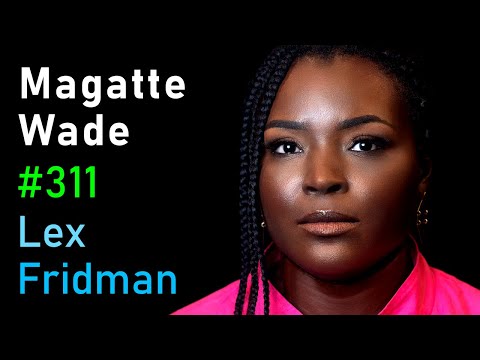
Magatte Wade: Africa, Capitalism, Communism, and the Future of Humanity | Lex Fridman Podcast #311
Magatte Wade (guest), Lex Fridman (host), Narrator, Narrator
In this episode of Lex Fridman Podcast, featuring Magatte Wade and Lex Fridman, Magatte Wade: Africa, Capitalism, Communism, and the Future of Humanity | Lex Fridman Podcast #311 explores entrepreneurial Freedom: Magatte Wade’s Radical Vision for Africa’s Future Magatte Wade argues that Africa is poor not because of its people or history, but because it is the most overregulated region in the world and lacks economic freedom. Drawing on her experience building companies in Senegal and the United States, she contrasts hostile, corrupt bureaucracies with simple, business-friendly environments that unlock entrepreneurship and prosperity.
Entrepreneurial Freedom: Magatte Wade’s Radical Vision for Africa’s Future
Magatte Wade argues that Africa is poor not because of its people or history, but because it is the most overregulated region in the world and lacks economic freedom. Drawing on her experience building companies in Senegal and the United States, she contrasts hostile, corrupt bureaucracies with simple, business-friendly environments that unlock entrepreneurship and prosperity.
She contends that free markets, clear property rights, and limited, sensible regulation are the only proven foundations for large-scale economic prosperity, regardless of a country’s political system or culture. Wade strongly criticizes foreign aid, Marxist and socialist ideologies (including elements of Black Lives Matter and DEI), and “white savior” activism for disempowering Africans and Black people globally.
Instead, she advocates for entrepreneurial solutions, legal and regulatory reform, and radical experiments like startup cities and special economic zones in Africa, modeled on Singapore, Dubai, and parts of China. Underlying her message is a belief in human potential, the moral necessity of unleashing African youth, and a conviction that Africa can leapfrog the world and define humanity’s future if it embraces economic freedom.
Key Takeaways
Economic freedom, not resources or intentions, predicts prosperity.
Wade emphasizes that countries become rich when entrepreneurs can operate in a system with rule of law, clear property rights, and low barriers to starting and running businesses—regardless of culture, natural resources, or political regime.
Overregulation and bad laws are the core drivers of African poverty.
She argues that Africa is the poorest region on earth because it is the most overregulated, citing extreme tariffs, complex tax codes, rigid labor laws, and dysfunctional utilities that make basic operations slow, costly, and corrupt.
Corruption is a symptom of bad rules, not the root cause.
When regulations and tariffs are senselessly high and systems scarce (e. ...
Entrepreneurship is primarily mission-driven, not greed-driven.
Wade describes entrepreneurs as people who “criticize by creating”—they respond to real problems (like declining hibiscus farmers in Senegal) with value-creating businesses, and need profit only as the “red blood cells” that keep the mission alive.
Well‑intentioned aid and “buy-one-give-one” models can destroy local economies.
Programs like Toms Shoes flood markets with free goods, undercutting local producers and forcing small businesses to close, which in turn expands the pool of people dependent on charity rather than shrinking it.
Marxist and socialist frameworks undermine Black prosperity.
She critiques Black Lives Matter’s Marxist roots and earlier Pan-African flirtations with socialism, arguing that while they sought equal rights, their economic prescriptions cripple wealth creation and keep Black populations weak and dependent.
Africa’s demographic boom is a threat or a miracle, depending on freedom.
With Africa’s massive, young population and cities like Lagos set to become the world’s largest, Wade believes the continent will either become a destabilizing “ticking bomb” or a global engine of innovation—determined by whether economic freedom is embraced.
Notable Quotes
“We are the poorest region in the world because we are the most overregulated region in the world.”
— Magatte Wade
“Entrepreneurs are people who criticize by creating.”
— Magatte Wade
“Having a heart for the poor is easy. Having a mind for the poor, that’s the challenge.”
— Magatte Wade
“If you want Black lives to matter, you must be serious about Black prosperity.”
— Magatte Wade
“Money won’t create success. The freedom to make it will.”
— Nelson Mandela (quoted by Lex Fridman at the end)
Questions Answered in This Episode
If overregulation is the main barrier, what concrete first reforms could African countries implement in the next five years to unlock entrepreneurship?
Magatte Wade argues that Africa is poor not because of its people or history, but because it is the most overregulated region in the world and lacks economic freedom. ...
How can startup cities and special economic zones be designed to benefit ordinary citizens rather than becoming enclaves for elites?
She contends that free markets, clear property rights, and limited, sensible regulation are the only proven foundations for large-scale economic prosperity, regardless of a country’s political system or culture. ...
What would a truly ‘conscious capitalism’ model look like in rural African contexts where institutions are weak and trust is low?
Instead, she advocates for entrepreneurial solutions, legal and regulatory reform, and radical experiments like startup cities and special economic zones in Africa, modeled on Singapore, Dubai, and parts of China. ...
How can African leaders balance the desire for geopolitical independence from the West with the need for foreign investment and trade?
In practical terms, how can individuals in the West who care about Africa shift from a ‘savior’ mindset to one that genuinely supports African agency and economic freedom?
EVERY SPOKEN WORD
Install uListen for AI-powered chat & search across the full episode — Get Full Transcript
Get more out of YouTube videos.
High quality summaries for YouTube videos. Accurate transcripts to search & find moments. Powered by ChatGPT & Claude AI.
Add to Chrome