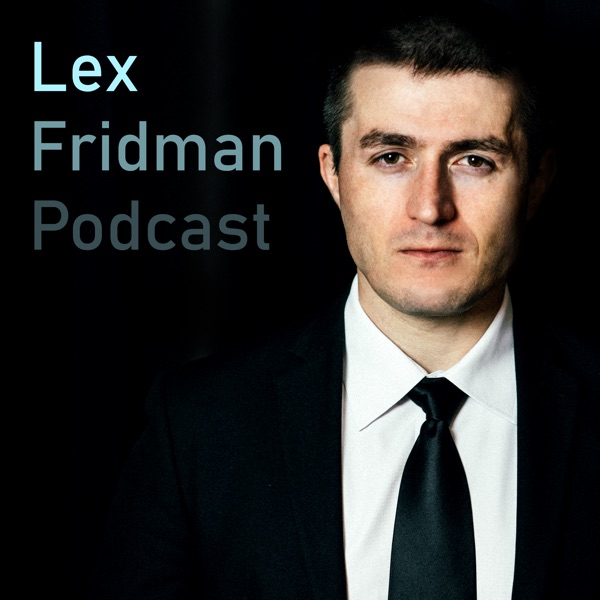
 Lex Fridman Podcast
Annaka Harris: Free Will, Consciousness, and the Nature of Reality | Lex Fridman Podcast #326
Lex Fridman and Annaka Harris on annaka Harris Dissects Free Will, Consciousness, and Reality’s Deep Illusions.
In this episode of Lex Fridman Podcast, featuring Annaka Harris and Lex Fridman, Annaka Harris: Free Will, Consciousness, and the Nature of Reality | Lex Fridman Podcast #326 explores annaka Harris Dissects Free Will, Consciousness, and Reality’s Deep Illusions Annaka Harris joins Lex Fridman to argue that what we usually call "free will"—the sense that a separate, conscious self initiates decisions—is largely an illusion constructed after unconscious brain processes. She distinguishes between a real but fully physical decision-making process in the brain and the misleading feeling of a conscious will that stands outside causality. From there, they explore how breaking intuitions drives scientific progress in consciousness and physics, including panpsychism and the possibility that consciousness is fundamental to reality. The conversation also covers meditation, psychedelics, mental health, and how seeing through the illusion of self might reduce suffering and deepen meaning.
At a glance
WHAT IT’S REALLY ABOUT
Annaka Harris Dissects Free Will, Consciousness, and Reality’s Deep Illusions
- Annaka Harris joins Lex Fridman to argue that what we usually call "free will"—the sense that a separate, conscious self initiates decisions—is largely an illusion constructed after unconscious brain processes. She distinguishes between a real but fully physical decision-making process in the brain and the misleading feeling of a conscious will that stands outside causality. From there, they explore how breaking intuitions drives scientific progress in consciousness and physics, including panpsychism and the possibility that consciousness is fundamental to reality. The conversation also covers meditation, psychedelics, mental health, and how seeing through the illusion of self might reduce suffering and deepen meaning.
IDEAS WORTH REMEMBERING
7 ideasSeparate the *process* of decision-making from the *feeling* of free will.
Brains clearly perform complex decision-making, but the intuitive sense that a conscious "I" steps in from outside physical causality to choose is, Harris argues, an illusion layered on top of unconscious neural activity.
Use illusions of timing to see that consciousness lags behind the brain.
Experiments on sensory binding and button-press timing show that the brain stitches inputs together and can recalibrate delays, revealing that our conscious experience is a constructed narrative that often trails the underlying processing.
Systematically challenge intuitions to unlock progress in hard problems.
From the shape of the Earth to quantum mechanics and consciousness, major breakthroughs have required giving up deeply held intuitions; Harris believes consciousness research is now at exactly this impasse.
Treat consciousness-as-fundamental as a live scientific hypothesis, not dogma.
Harris doesn’t claim certainty but argues that panpsychic or fundamental-consciousness views are underexplored compared to emergentist neuroscience, and may better mesh with cutting-edge physics that treats spacetime as emergent.
Meditation and psychedelics can experientially reveal the illusion of self.
Practices that quiet the default mode network often dissolve the sense of a separate, narrating self, producing a felt unity with the universe that aligns surprisingly well with neuroscientific findings and can ease anxiety and depression.
Reframing free will can reduce blame, regret, and self-torment.
Seeing thoughts and actions as arising from impersonal brain processes and prior causes can support greater acceptance—toward oneself and others—while still leaving room for learning, responsibility, and ethical behavior.
Pursue deep curiosity and passion even without a clear career plan.
Harris’ own path—decades of private inquiry into physics and consciousness that later became a book and documentary—illustrates how sustained obsession with questions you love can organically crystallize into meaningful work.
WORDS WORTH SAVING
5 quotesThe feeling that consciousness swoops in and causes our decisions is, in large part, if not in its entirety, an illusion.
— Annaka Harris
I really think it's important to make a distinction between free will and conscious will.
— Annaka Harris
Most of the big breakthroughs in science required us to let go of intuitions that were feeding us false information about the way the world works.
— Annaka Harris
The truth is that for the most part, the sense of self is kind of at the core of human suffering.
— Annaka Harris
It’s as if I feel like I’m confined to this snow globe based on my human perceptions, and the truth of reality is out there.
— Annaka Harris
QUESTIONS ANSWERED IN THIS EPISODE
5 questionsIf conscious will is an illusion, how should we rethink moral responsibility, praise, and blame in everyday life and the legal system?
Annaka Harris joins Lex Fridman to argue that what we usually call "free will"—the sense that a separate, conscious self initiates decisions—is largely an illusion constructed after unconscious brain processes. She distinguishes between a real but fully physical decision-making process in the brain and the misleading feeling of a conscious will that stands outside causality. From there, they explore how breaking intuitions drives scientific progress in consciousness and physics, including panpsychism and the possibility that consciousness is fundamental to reality. The conversation also covers meditation, psychedelics, mental health, and how seeing through the illusion of self might reduce suffering and deepen meaning.
What concrete experiments or predictions could decisively favor consciousness-as-fundamental over consciousness-as-emergent, rather than leaving it as a philosophical stance?
How far should our moral concern extend if consciousness exists on a spectrum across animals, plants, and possibly artificial systems?
Can widespread experiences of ego-dissolution through meditation or psychedelics realistically shift culture away from individualism without undermining motivation and achievement?
If our perceptions of space, time, and self are all constructed, what—if anything—counts as a stable, knowable "reality" we can orient our lives around?
EVERY SPOKEN WORD
Install uListen for AI-powered chat & search across the full episode — Get Full Transcript
Get more out of YouTube videos.
High quality summaries for YouTube videos. Accurate transcripts to search & find moments. Powered by ChatGPT & Claude AI.
Add to Chrome