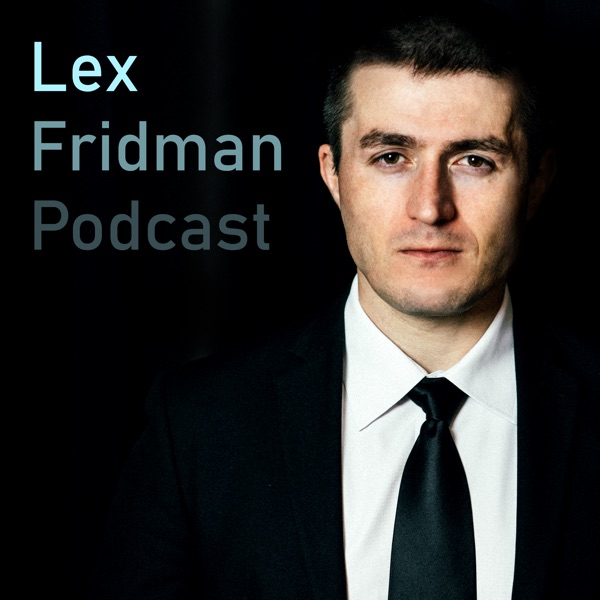
 Lex Fridman Podcast
Vejas Liulevicius: Communism, Marxism, Nazism, Stalin, Mao, and Hitler | Lex Fridman Podcast #444
Lex Fridman and Vejas Liulevicius on ideologies, Dictators, and Mass Death: Communism and Nazism Unmasked.
In this episode of Lex Fridman Podcast, featuring Vejas Liulevicius and Lex Fridman, Vejas Liulevicius: Communism, Marxism, Nazism, Stalin, Mao, and Hitler | Lex Fridman Podcast #444 explores ideologies, Dictators, and Mass Death: Communism and Nazism Unmasked Historian Vejas Liulevicius and Lex Fridman trace the intellectual roots of communism from Marx and Engels through Lenin, Stalin, and Mao, examining how utopian theory collided with human reality. They explore key contradictions inside Marxism—its scientific pretensions, religious overtones, reliance on heroic individuals, and hostility to tradition—and show how these played out in the Soviet Union and China via famine, terror, and systemic lying. In parallel, they analyze Nazism and fascism, emphasizing Nazi racial war aims in Eastern Europe, the Holocaust, and the Nazi–Soviet pact, arguing these regimes represent a new, totalizing kind of dictatorship. The conversation closes by connecting this history to today’s Russia, China, Ukraine war, nuclear risk, and the importance of reading, critical thinking, and intellectual humility in an age of ideology and technology.
At a glance
WHAT IT’S REALLY ABOUT
Ideologies, Dictators, and Mass Death: Communism and Nazism Unmasked
- Historian Vejas Liulevicius and Lex Fridman trace the intellectual roots of communism from Marx and Engels through Lenin, Stalin, and Mao, examining how utopian theory collided with human reality. They explore key contradictions inside Marxism—its scientific pretensions, religious overtones, reliance on heroic individuals, and hostility to tradition—and show how these played out in the Soviet Union and China via famine, terror, and systemic lying. In parallel, they analyze Nazism and fascism, emphasizing Nazi racial war aims in Eastern Europe, the Holocaust, and the Nazi–Soviet pact, arguing these regimes represent a new, totalizing kind of dictatorship. The conversation closes by connecting this history to today’s Russia, China, Ukraine war, nuclear risk, and the importance of reading, critical thinking, and intellectual humility in an age of ideology and technology.
IDEAS WORTH REMEMBERING
7 ideasMarx fused historical determinism with heroic agency, creating an intoxicating ideology.
He claimed history moves inevitably toward a classless utopia, yet still leaves room for ‘special individuals’ to accelerate revolution—giving intellectuals and revolutionaries both a sense of righteousness and destiny.
Marxism cloaked utopian politics in the prestige of ‘science,’ enabling extreme measures.
By presenting revolution as scientifically necessary rather than morally debatable, later leaders like Lenin, Stalin, and Mao could justify radical violence and social engineering as rational, inevitable steps toward history’s end.
Communist regimes repeatedly punished initiative and honesty, producing ‘negative selection.’
From collectivization to the Great Terror and Mao’s campaigns, those who were most capable, entrepreneurial, or intellectually independent were often targeted, while lying up the chain became rational self‑defense, hollowing out state capacity.
Stalinist collectivization and Mao’s Great Leap Forward turned theory into man‑made catastrophe.
Both sought to ‘modernize’ agriculture via coercive collectivization and pseudo‑scientific schemes; instead they destroyed incentives, provoked mass falsification of data, and caused famines that killed tens of millions.
Nazism and Stalinism were mortal enemies yet structurally similar totalitarian projects.
Though ideologically opposed—class vs. race—they shared features Arendt called totalitarian: single‑party rule, leader cults, pervasive terror, propaganda, and ambitions to reshape humanity and history without moral limits.
World War II and the Holocaust were rooted in long‑standing Nazi plans for racial empire in the East.
Hitler’s drive for Lebensraum, enslavement and eventual decimation of Slavs, and extermination of Jews was not an accident of war but a core program elaborated in Mein Kampf and detailed schemes like Generalplan Ost.
Without honest reckoning, societies easily recycle dangerous myths about their past.
Post‑Soviet Russia never had a ‘Nuremberg’ for communism; instead, Putin fuses Tsarist, Soviet, and nationalist narratives into a flexible, often contradictory story that supports renewed imperial aggression, exemplified in Ukraine.
WORDS WORTH SAVING
5 quotesThose who have most enterprise, those who are most entrepreneurial, those who have most self-discipline, those who are best organized will be winnowed again and again and again, sending the message that mediocrity is comparatively much safer than talent.
— Vejas Liulevicius
There are few things that are as intoxicating as being convinced that your actions not only are right in the abstract, but are also destined to be successful.
— Vejas Liulevicius
The outcome here is a horrific man-made famine, not a natural disaster, not bad harvest, but a man-made famine.
— Vejas Liulevicius
What remained though was the confidence of being on the right side of history.
— Vejas Liulevicius
Science is one of the most beautiful creations of humanity, but is also a thing that could be used by politicians and dictators to do horrific things.
— Lex Fridman
QUESTIONS ANSWERED IN THIS EPISODE
5 questionsTo what extent were the horrors of Stalinism and Maoism inherent in Marxist theory versus contingent on particular personalities and historical accidents?
Historian Vejas Liulevicius and Lex Fridman trace the intellectual roots of communism from Marx and Engels through Lenin, Stalin, and Mao, examining how utopian theory collided with human reality. They explore key contradictions inside Marxism—its scientific pretensions, religious overtones, reliance on heroic individuals, and hostility to tradition—and show how these played out in the Soviet Union and China via famine, terror, and systemic lying. In parallel, they analyze Nazism and fascism, emphasizing Nazi racial war aims in Eastern Europe, the Holocaust, and the Nazi–Soviet pact, arguing these regimes represent a new, totalizing kind of dictatorship. The conversation closes by connecting this history to today’s Russia, China, Ukraine war, nuclear risk, and the importance of reading, critical thinking, and intellectual humility in an age of ideology and technology.
How can modern societies harness the desire for large, meaningful projects without slipping into totalizing, quasi‑religious ideologies that justify unlimited power?
Are today’s rising authoritarian and techno‑surveillance states converging on a new form of totalitarianism, or are they fundamentally different from 20th‑century models?
What practical mechanisms can post‑authoritarian societies use to reckon honestly with past crimes without collapsing into chaos or endless revenge?
Given the history of ideological certainty leading to catastrophe, how should citizens today evaluate confident ‘scientific’ claims about politics, economics, or social engineering?
EVERY SPOKEN WORD
Install uListen for AI-powered chat & search across the full episode — Get Full Transcript
Get more out of YouTube videos.
High quality summaries for YouTube videos. Accurate transcripts to search & find moments. Powered by ChatGPT & Claude AI.
Add to Chrome