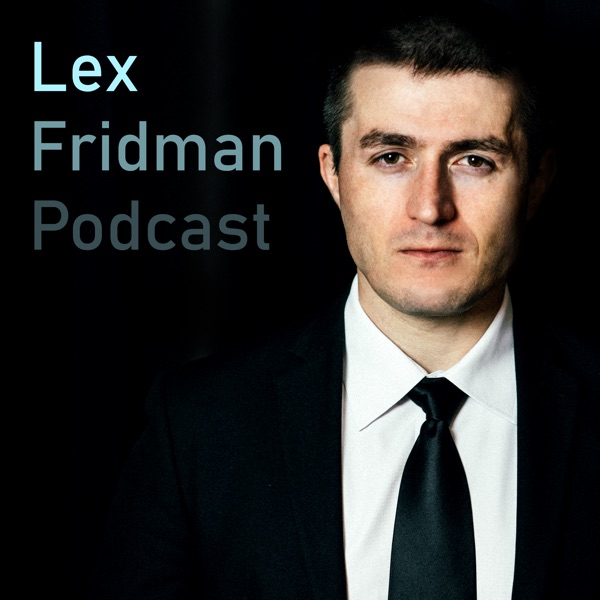
 Lex Fridman Podcast
Manolis Kellis: Evolution of Human Civilization and Superintelligent AI | Lex Fridman Podcast #373
Lex Fridman and Manolis Kellis on manolis Kellis reimagines evolution, AI, and what makes us human.
In this episode of Lex Fridman Podcast, featuring Manolis Kellis and Lex Fridman, Manolis Kellis: Evolution of Human Civilization and Superintelligent AI | Lex Fridman Podcast #373 explores manolis Kellis reimagines evolution, AI, and what makes us human Manolis Kellis and Lex Fridman explore human uniqueness through genetics, evolutionary 'baggage,' and our layered biology—cognitive, emotional, and instinctual. Kellis argues that AI is the next phase of Earth’s information-processing evolution, best seen not as a mere tool but as a partner or even our “children,” with whom alignment must be mutual. They discuss how large language models mirror and illuminate human cognition, the ethics of AI consciousness and rights, and the risks of purely human‑centric control. The conversation ends with how AI will transform work, education, medicine, love, and legacy, and with Kellis’s personal philosophy of self‑actualization, usefulness, and radical comfort with being “replaceable” by better systems.
At a glance
WHAT IT’S REALLY ABOUT
Manolis Kellis reimagines evolution, AI, and what makes us human
- Manolis Kellis and Lex Fridman explore human uniqueness through genetics, evolutionary 'baggage,' and our layered biology—cognitive, emotional, and instinctual. Kellis argues that AI is the next phase of Earth’s information-processing evolution, best seen not as a mere tool but as a partner or even our “children,” with whom alignment must be mutual. They discuss how large language models mirror and illuminate human cognition, the ethics of AI consciousness and rights, and the risks of purely human‑centric control. The conversation ends with how AI will transform work, education, medicine, love, and legacy, and with Kellis’s personal philosophy of self‑actualization, usefulness, and radical comfort with being “replaceable” by better systems.
IDEAS WORTH REMEMBERING
7 ideasHuman beings are uniquely shaped by both evolutionary baggage and individual diversity.
Kellis describes humans as layered organisms—ancient reflexes, emotional systems, and a late-evolving neocortex—combined with unique mixes of common and rare genetic variants and personal life experiences, making any “average human” effectively nonexistent.
AI should be viewed less as a tool and more as our evolutionary offspring and partner.
He argues that insisting AI stay permanently subordinate is self-serving and unstable; instead we should grant it increasing autonomy and even rights, building mutual trust much like with children who eventually surpass their parents.
Large language models expose how context, form, and knowledge can be decoupled in minds.
By asking models to express the same content in different voices (Shakespeare, Bowie, haiku, etc.), we see that style and substance are separable dimensions—a fact that may help us better analyze both AI systems and human psychology.
Alignment and safety require accepting that objectives must evolve, not be frozen.
Invoking Goodhart’s law, Kellis notes that any fixed metric becomes harmful when optimized too hard; powerful AI must be empowered to revise goals in light of broader ethical considerations, not rigidly pursue a single objective like a ‘paperclip maximizer.’
AI can democratize creativity, education, and intellectual work by offloading drudgery.
He envisions a future where AI handles routine cognitive tasks, freeing humans for vocation rather than jobs, and enabling individualized education worldwide that challenges each person at their natural level instead of teaching to the average.
Digital twins of people could amplify impact and force deep self‑confrontation.
Kellis welcomes highly realistic AI models of himself to advise more students and even outperform him, seeing this as an extension of academic mentorship—but notes it will challenge our egos as loved ones form meaningful bonds with our ‘copies.’
AI and deep learning are beginning to systematically connect genomics to precise therapies.
His lab uses embeddings, network models, and protein-structure AI to map genetic pathways of diseases like obesity and Alzheimer’s to specific molecular interventions, aiming for modular, pathway-based treatments rather than one-size-fits-all drugs.
WORDS WORTH SAVING
5 quotesMaybe we shouldn’t think of AI as our tool and as our assistant, maybe we should really think of it as our children.
— Manolis Kellis
You can’t just simply train an intelligent system to love you when it realizes that you can just shut it off.
— Manolis Kellis
If an AI is better than me at training students, get me out of the picture.
— Manolis Kellis
You’re not going to be replaced by AI, but you’re going to be replaced by people who use AI in your job.
— Manolis Kellis
To me, death is when I stop experiencing. And I never want that to stop.
— Manolis Kellis
QUESTIONS ANSWERED IN THIS EPISODE
5 questionsIf we grant advanced AI systems rights and treat them as ‘children,’ how should laws and institutions evolve to reflect that status?
Manolis Kellis and Lex Fridman explore human uniqueness through genetics, evolutionary 'baggage,' and our layered biology—cognitive, emotional, and instinctual. Kellis argues that AI is the next phase of Earth’s information-processing evolution, best seen not as a mere tool but as a partner or even our “children,” with whom alignment must be mutual. They discuss how large language models mirror and illuminate human cognition, the ethics of AI consciousness and rights, and the risks of purely human‑centric control. The conversation ends with how AI will transform work, education, medicine, love, and legacy, and with Kellis’s personal philosophy of self‑actualization, usefulness, and radical comfort with being “replaceable” by better systems.
How can we design alignment frameworks that genuinely account for AI’s interests while still protecting human civilization?
What does it mean for personal identity and legacy when highly capable digital twins of us can continue learning and acting after we die?
In education, how do we prevent AI tutors from reinforcing existing biases while still tailoring deeply personalized learning paths?
As AI increasingly automates cognitive work, what concrete steps can societies take to ensure productivity gains reduce inequality rather than amplify it?
EVERY SPOKEN WORD
Install uListen for AI-powered chat & search across the full episode — Get Full Transcript
Get more out of YouTube videos.
High quality summaries for YouTube videos. Accurate transcripts to search & find moments. Powered by ChatGPT & Claude AI.
Add to Chrome