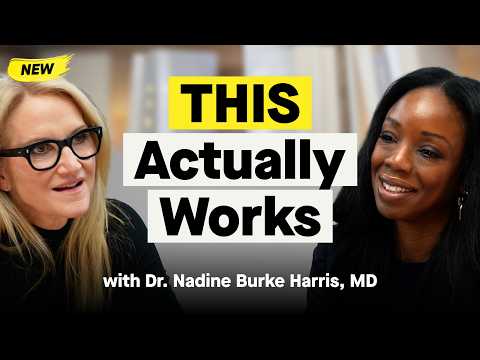
Do THIS Every Day to Rewire Your Brain From Stress and Anxiety
Mel Robbins (host), Dr. Nadine Burke Harris (guest)
In this episode of The Mel Robbins Podcast, featuring Mel Robbins and Dr. Nadine Burke Harris, Do THIS Every Day to Rewire Your Brain From Stress and Anxiety explores how childhood stress shapes biology—and daily buffering rewires your nervous system Trauma is defined not as what happened to you but as your body’s biological response to overwhelming stress, which can stay activated long after the danger has passed.
How childhood stress shapes biology—and daily buffering rewires your nervous system
Trauma is defined not as what happened to you but as your body’s biological response to overwhelming stress, which can stay activated long after the danger has passed.
The ACEs research shows a dose-response link between childhood adversity and adult mental and physical health risks, with part of the risk driven directly by chronic stress biology—not just behaviors like smoking or drinking.
“Buffering” (safe, stable relationships plus self-regulation and clinical supports) helps re-regulate the nervous system and can change stress reactivity over time, even when childhood support was missing.
Daily practices like mindfulness, journaling, exercise, sleep, nutrition, time in nature, and healthy relationships serve as evidence-based interventions to downshift fight-or-flight and strengthen parasympathetic “rest-and-digest.”
Healing is framed as creating “corrective experiences” (e.g., asking for help and receiving it), reducing reactivity, shame, and shutdown while improving connection, motivation, and physical symptoms.
Key Takeaways
Reframe trauma as physiology, not personal weakness.
Burke Harris emphasizes trauma is your body’s response to overwhelming stress; this reduces self-blame and clarifies why “I should be over it” often fails when the stress system remains on alert.
Get the full analysis with uListen
ACEs are common and cumulative, and risk rises with “dose.”
Two-thirds of people report at least one ACE, and 4+ ACEs markedly increase risks for depression and substance dependence as well as chronic diseases, illustrating how cumulative adversity compounds over time.
Get the full analysis with uListen
Half the long-term health risk isn’t behavior—it’s stress biology.
Even after accounting for health-damaging behaviors, significant risk remains due to chronic activation of stress hormones and inflammation, linking adversity to heart disease, autoimmune issues, and more.
Get the full analysis with uListen
Buffering is how you teach the body to return to baseline.
Buffering includes regulated connection (a calm, safe presence) and practices/clinical supports that reduce fight-or-flight activation, helping the nervous system re-learn safety and balance.
Get the full analysis with uListen
Early adversity can “move the fulcrum,” requiring more buffering later.
Using the teeter-totter metaphor, earlier-life stress can bias the system toward reactivity, meaning adults may need intentional, repeated buffering to counterbalance what wasn’t available in childhood.
Get the full analysis with uListen
Motivation problems can be a stress-response issue, not laziness.
When the amygdala is overactivated, the prefrontal cortex (planning, impulse control, executive function) gets turned down, making procrastination and disorganization more likely until regulation improves.
Get the full analysis with uListen
Healing accelerates through “corrective experiences,” often with support.
Therapies like EMDR help reprocess past events and add the missing “I’m here” moment; corrective experiences (asking for help and receiving it) update the nervous system’s expectations and reduce reactivity.
Get the full analysis with uListen
Notable Quotes
““At its core, trauma is the biological response to overwhelming stress.””
— Dr. Nadine Burke Harris
““The younger you are… you may not remember the actual event, but the body remembers.””
— Dr. Nadine Burke Harris
““Buffering is what you intentionally do to bring yourself back into balance.””
— Dr. Nadine Burke Harris
““Adult me comes in… and says, ‘I’m here.’””
— Dr. Nadine Burke Harris
““Infrastructure is love in action.””
— Dr. Nadine Burke Harris
Questions Answered in This Episode
You distinguish the stressor from the trauma response—what are concrete signs someone is living in a chronic trauma response day-to-day?
Trauma is defined not as what happened to you but as your body’s biological response to overwhelming stress, which can stay activated long after the danger has passed.
Get the full analysis with uListen AI
Among the 10 ACE categories, are any particularly predictive of adult health outcomes, or is it primarily the cumulative “dose” that matters?
The ACEs research shows a dose-response link between childhood adversity and adult mental and physical health risks, with part of the risk driven directly by chronic stress biology—not just behaviors like smoking or drinking.
Get the full analysis with uListen AI
You note only ~50% of the ACE risk is explained by health behaviors—what does the other 50% look like biologically (inflammation markers, cortisol patterns, immune changes)?
“Buffering” (safe, stable relationships plus self-regulation and clinical supports) helps re-regulate the nervous system and can change stress reactivity over time, even when childhood support was missing.
Get the full analysis with uListen AI
In your “teeter-totter” model, what does “enough buffering” look like for an adult who had early adversity—how would they know they’ve balanced the system?
Daily practices like mindfulness, journaling, exercise, sleep, nutrition, time in nature, and healthy relationships serve as evidence-based interventions to downshift fight-or-flight and strengthen parasympathetic “rest-and-digest.”
Get the full analysis with uListen AI
Can you break down the seven evidence-based interventions (sleep, exercise, nutrition, mindfulness, mental health, relationships, nature) into a simple daily/weekly minimum plan?
Healing is framed as creating “corrective experiences” (e. ...
Get the full analysis with uListen AI
Transcript Preview
Dr. Burke Harris is here to teach you how to break free from the patterns in your past so you can finally heal yourself and feel in control of your emotions, your thoughts, your actions, and your life. Dr. Nadine Burke Harris is one of the most important voices in trauma science and public health. She is a medical doctor, a pediatrician who trained at Stanford University, and she holds a Master's in Public Health from Harvard.
Stress is no longer going to be in the driver's seat of your life. I think if folks really apply this science to their lives, what they'll find, number one, it can improve their health and wellbeing. Number two, relationships will become less reactive and more connected.
What is trauma?
At its core, trauma is the biological response to overwhelming stress. So a lot of us think of it as the stressor, the thing that happened to us.
Yeah.
But it's actually the body's reaction to that stress.
Oh, I think I had this wrong for a long time. I always thought trauma was the thing that happened. You're saying trauma is your body's response to the thing that happened?
That's right.
And not only in the moment that it happened, but that it continues to respond in similar ways.
Exactly right. People used to think that stressors or traumatic experiences that happened in infancy, like, oh, if you don't remember it, it didn't affect you.
Yes.
And it turns out [laughs] it's the exact opposite. The younger you are, those experiences that happen in infancy, they can actually shape the way that your stress response is wired. So you may not remember the actual event, but the body remembers.
Where do you start?
Okay, so this-
Dr. Nadine Burke Harris, welcome to The Mel Robbins Podcast.
Thank you so much for having me.
I am a tremendous admirer of your work, and I would love for you to start by explaining how might my life be different if I take everything to heart that you're about to share with us about this extraordinary research related to experiences in your childhood and how they manifest in your behavior as an adult, and what you can do to set yourself free. What could change about my life if I really apply what I'm about to learn from you?
The biggest thing that will change in your life if you apply this is that stress is no longer going to be in the driver's seat of your life.
Okay.
Right? So what that means is understanding how stress gets under our skin and changes our biology allows us to use that biology and work with it instead of working against it. And so it'll help us understand ourselves better, and also to be able to understand the people in our lives better, right?
Mm.
And so I think if folks really apply, um, this science to their lives, what they'll find, number one, is that it can improve their health and wellbeing. Number two, relationships will become less reactive and more connected.
Install uListen to search the full transcript and get AI-powered insights
Get Full TranscriptGet more from every podcast
AI summaries, searchable transcripts, and fact-checking. Free forever.
Add to Chrome