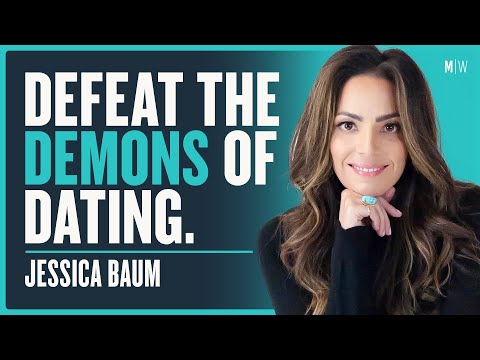
How To Deal With Being Anxiously Attached - Jessica Baum
Jessica Baum (guest), Chris Williamson (host)
In this episode of Modern Wisdom, featuring Jessica Baum and Chris Williamson, How To Deal With Being Anxiously Attached - Jessica Baum explores healing Anxious Attachment: Why Relationships Are Essential, Not Optional Psychotherapist Jessica Baum explains attachment theory, focusing on how early caregiver relationships wire our nervous system and later shape anxious and avoidant attachment in adult romance.
Healing Anxious Attachment: Why Relationships Are Essential, Not Optional
Psychotherapist Jessica Baum explains attachment theory, focusing on how early caregiver relationships wire our nervous system and later shape anxious and avoidant attachment in adult romance.
She details the biology behind attachment, including co-regulation, neuroception, and nervous system states (fight/flight/freeze vs. calm connection), and how these create recurring relational patterns.
Baum breaks down the anxious–avoidant dynamic, why it’s so magnetically attractive yet painful, and how partners can communicate and regulate better in conflict.
She argues that real healing from anxious attachment requires safe relationships and community—not radical self-reliance or one-off “trauma healing” experiences—but slow, repeated co-regulation and new relational experiences.
Key Takeaways
Your attachment style is largely shaped before you can remember it.
In-utero through roughly 18 months, a baby’s nervous system is built in response to the caregiver’s regulation and attunement. ...
Get the full analysis with uListen
Anxious attachment is driven by a nervous system primed for abandonment.
Anxiously attached people become hypervigilant to signs of disconnection; minor cues (a blank stare, checking a phone) can trigger intense fight-or-flight responses. ...
Get the full analysis with uListen
Anxious and avoidant partners are often powerfully attracted—but mismatched in regulation.
Anxious partners crave closeness and co-regulation, while avoidant partners regulate by withdrawing. ...
Get the full analysis with uListen
You can’t think your way out of an attachment style, but you can earn security.
Changing attachment is less about cognitive insight and more about repeated nervous-system experiences of safety. ...
Get the full analysis with uListen
In conflict, regulating your body comes before solving the problem.
When triggered, the body reacts faster than the thinking brain. ...
Get the full analysis with uListen
True healing requires other people; radical independence is often a protector.
The ‘I don’t need anyone’ or monk-mode narratives can be defenses after relational hurt. ...
Get the full analysis with uListen
One-off peak experiences don’t erase trauma; they may just show new paths.
Psychedelics or intense spiritual practices can reveal that other ways of being are possible, but they don’t rewrite old neural pathways overnight. ...
Get the full analysis with uListen
Notable Quotes
“When you've been wounded or when you've been hurt, the natural defense is, 'I don't wanna go there anymore. That is painful.' And so the narrative that comes out is, 'I don't need anyone.'”
— Jessica Baum
“Our biological imperative is to be in connection. When we're in disconnection, we sense it in our bodies.”
— Jessica Baum
“You can't think your way out of an attachment style, but you can earn your way to earned security.”
— Jessica Baum
“It's not that the sensations stop. It's that people have more tenderness toward what's going on with them, more understanding, and more choices.”
— Jessica Baum
“Life is about heartfelt connections, and the meaning in life and the quality of your life comes down to the relationships in your life.”
— Jessica Baum
Questions Answered in This Episode
How can someone reliably distinguish between legitimate relational problems with a partner and their own anxious attachment patterns being activated?
Psychotherapist Jessica Baum explains attachment theory, focusing on how early caregiver relationships wire our nervous system and later shape anxious and avoidant attachment in adult romance.
Get the full analysis with uListen AI
What are concrete signs that an anxiously attached person is beginning to move toward earned security in their day-to-day life?
She details the biology behind attachment, including co-regulation, neuroception, and nervous system states (fight/flight/freeze vs. ...
Get the full analysis with uListen AI
If you’re deeply avoidant and proud of your independence, what’s a realistic first step toward allowing co-regulation without feeling overwhelmed?
Baum breaks down the anxious–avoidant dynamic, why it’s so magnetically attractive yet painful, and how partners can communicate and regulate better in conflict.
Get the full analysis with uListen AI
How can men specifically navigate the tension between cultural expectations of emotional control and the vulnerability required to heal anxious attachment?
She argues that real healing from anxious attachment requires safe relationships and community—not radical self-reliance or one-off “trauma healing” experiences—but slow, repeated co-regulation and new relational experiences.
Get the full analysis with uListen AI
What responsibilities do therapists and coaches have to avoid ‘quick-fix’ trauma narratives and instead educate clients about the slow, relational nature of real healing?
Get the full analysis with uListen AI
Transcript Preview
When you've been wounded or when you've been hurt, the natural defense is, "I don't wanna go there anymore. That is painful." And so the narrative that comes out is, "I don't need anyone." And that is a form of protection. It is very lonely on that side of the coin.
(wind blowing) Jessica Palm, welcome to the show.
Thank you for having me.
You are a relationship expert, so given that this is the week that Love Island is restarting in the UK, I wanted to speak to you about something that I noticed online I thought was quite interesting. So there's a student news publication called The Tab, and they've got a trash page which is kind of celebrity gossip and, and sort of trashy news and stuff like that. They put a tweet out the other day that said, "The Love Island promo pics are always so bad, so here's actually what the Love Islanders from 2022 look like in real life." So what they were saying is that the promo pictures that are done by an entire team, (clicking sound) a huge team, right? There's a hair and makeup army, there's stylists, there's professional lighting, there's a guy with a huge long-lens DSLR, and it's not like they just take one. They take tons and tons of photos on this photo shoot. And they had a problem with the fact that those were unrepresentative, and what they were using as the benchmark for why it was unrepresentative were their Instagram photos. So they went on and said, "Look at them on Instagram, and then look at what they're doing." So if you dig into the actual article it says, "There is one simple fact on this earth, and that is that the Love Island photographer always does everyone so dirty year after year. It never changes and the promo pics get, if anything, worse. So ahead of the launch next week of Love Island 2022, here's everything you need to know about the new Islanders, their Instagram handles, age-s jobs, and what they actually look like in real life." So what we've done now is we've entered a world where the hyperreal has become more real than reality. So photos from Instagram, which is a social media platform known for enhanced and airbrushed images, is being used as the benchmark against which everything else should be measured. Instagram is what the cast actually look like in real life, despite the fact it's taken by this huge army of, of people that are behind the UK's biggest reality TV show. They're doing them so dirty. So I think it's ... It was just really interesting to me that kind of the bastille's been turned upside-down, that people are so used to spending time online with others that they see the online world as more accurate than the physical one. And the closer that we can fit real life to a digital existence, the more comfortable people feel.
Install uListen to search the full transcript and get AI-powered insights
Get Full TranscriptGet more from every podcast
AI summaries, searchable transcripts, and fact-checking. Free forever.
Add to Chrome