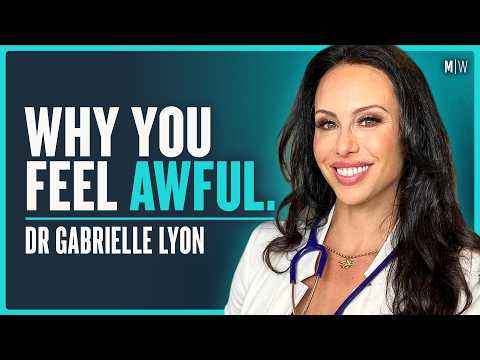
Why “Your Labs Are Normal” But You Still Feel Awful - Dr Gabrielle Lyon
Chris Williamson (host), Dr Gabrielle Lyon (guest)
In this episode of Modern Wisdom, featuring Chris Williamson and Dr Gabrielle Lyon, Why “Your Labs Are Normal” But You Still Feel Awful - Dr Gabrielle Lyon explores why Normal Lab Results Can Hide Serious Environmental Health Problems Dr. Gabrielle Lyon explains how many people feel unwell despite "normal" lab results because modern medicine underestimates environmental factors like mold, parasites, Lyme, heavy metals, microplastics, and VOCs. She argues that diet and exercise alone are no longer sufficient pillars of health; environment must be treated as a third, equally important pillar. The conversation covers diagnostic blind spots, why standard tests often miss complex illnesses, and how genetic differences make some people far more sensitive to exposures than others. Lyon emphasizes a balanced, evidence-informed yet open-minded medical approach, practical detox strategies (e.g., sauna, removal from exposure), and the critical role of patient belief and mindset in recovery.
Why Normal Lab Results Can Hide Serious Environmental Health Problems
Dr. Gabrielle Lyon explains how many people feel unwell despite "normal" lab results because modern medicine underestimates environmental factors like mold, parasites, Lyme, heavy metals, microplastics, and VOCs. She argues that diet and exercise alone are no longer sufficient pillars of health; environment must be treated as a third, equally important pillar. The conversation covers diagnostic blind spots, why standard tests often miss complex illnesses, and how genetic differences make some people far more sensitive to exposures than others. Lyon emphasizes a balanced, evidence-informed yet open-minded medical approach, practical detox strategies (e.g., sauna, removal from exposure), and the critical role of patient belief and mindset in recovery.
Key Takeaways
Include environment as a core health pillar, not an afterthought.
Diet and exercise are necessary but insufficient; exposures to mold, parasites, chemicals, and pollutants can independently undermine energy, mood, and metabolism even when lifestyle is optimized.
Get the full analysis with uListen
Normal lab results do not guarantee you’re healthy.
Standard panels track a limited set of biomarkers (e. ...
Get the full analysis with uListen
Parasites and gut issues are far more common and contagious than assumed.
Globalized food, raw fish, undercooked meat, pets, and household transmission make parasitic infections widespread; PCR stool tests can miss them, and microscopy plus symptom context are often required.
Get the full analysis with uListen
Mold illness is real but poorly defined and hotly debated in medicine.
There’s no universally accepted diagnostic criterion for mold, yet clinicians see clear patterns of brain fog, rashes, fatigue, and reactivity to specific buildings, especially in genetically susceptible people.
Get the full analysis with uListen
Removal from exposure and sauna use are foundational interventions.
Leaving contaminated environments is non-negotiable, and regular sauna (within safe temperature and duration ranges) can help excrete fat-soluble toxins and reduce systemic inflammation.
Get the full analysis with uListen
Effective care for complex illness requires a team-based, open-minded clinician.
Environmental illness patients often become “medical nomads” because specialists stay in narrow lanes; a good quarterback doctor coordinates multiple experts and balances evidence with clinical intuition.
Get the full analysis with uListen
Mindset and belief in recovery materially influence outcomes.
Patients who genuinely believe they can heal and commit to a stepwise plan tend to improve more; persistent hopelessness and fixation on illness can amplify stress and physiologic burden.
Get the full analysis with uListen
Notable Quotes
“People go to their doctor and get all of these blood panels done and everything looks, quote, 'perfect.' And the reality is these are just a series of biomarkers that we're aware of.”
— Dr. Gabrielle Lyon
“Environmental illness is kind of like the new hysteria. It's real but misunderstood.”
— Chris Williamson
“You can't answer and solve for questions that you're unwilling to face, or that you don't even know exist.”
— Dr. Gabrielle Lyon
“The two things that you never want to hear as a patient: the first one is from a doctor saying, 'We don't know what's wrong with you,' and the second one is from a friend saying, 'It's all in your head.'”
— Chris Williamson
“If they do not believe that they will get better, it's nearly impossible, because now what's happening is you are fighting against your own physiology.”
— Dr. Gabrielle Lyon
Questions Answered in This Episode
If my labs are normal but I feel chronically unwell, what specific environmental and infectious tests should I ask my doctor to consider?
Dr. ...
Get the full analysis with uListen AI
How can someone practically assess whether their home or workplace might be making them sick through mold, VOCs, or other exposures?
Get the full analysis with uListen AI
What is a realistic, evidence-informed protocol for mitigating mold or chemical exposure without falling into extreme or unproven detox fads?
Get the full analysis with uListen AI
How can patients find and evaluate clinicians who are both scientifically rigorous and genuinely open-minded about environmental illness?
Get the full analysis with uListen AI
Where is the line between healthy vigilance about environmental factors and anxiety-driven hypervigilance that may worsen overall wellbeing?
Get the full analysis with uListen AI
Transcript Preview
You had two original pillars of health, which were eat and exercise, but then you had to add a third one. How come-
I did. The third one, uh, was environment and is environment. I... Do you have time for a quick story?
Yeah, yeah.
I graduated medical school obviously, and then did my fellowship, and when you finish your fellowship and go into private practice, you kind of think you know everything. And I was convinced the key to health was diet and exercise. It was all lifestyle. And I was wrong. I had this patient, very successful patient, CEO of a major company. She was female, uh, she was doing everything she was supposed to, diet and exercise-wise, and she was feeling terrible and also gaining weight. I said, "No, no, no, it's definitely diet and exercise." And in fact, a handful of years later, I had to call and apologize because it wasn't just diet and exercise. She had significant exposures that really affected her health and wellness, and I think these exposures affect a lot of people and, um, you know, at the time when I was beginning my practice, it wasn't common, and we weren't even thinking about it.
So, is it getting more common? It- it- the w- talk of complex illness caused by mold, gut health, BPAs, heavy metals, Lyme, parasites, like, this-
No, microplastics.
... whatever this world is seems to be kind of gaining speed. Is this because more people are getting it or because we are detecting it more, uh, effectively? What- what do you think is going on there?
It's both. We have more exposures than arguably we've ever had now with microplastics and we are getting better at acknowledging and detecting it, but we're still not there. So for example, mold. Mold exposure, this is, we hear a lot about it now in terms of buildings with mold or locations and this musty smell, and oftentimes we think that it, it really doesn't affect people. However, there are certain people that will move into these buildings, walk in there, break out in a rash, have brain fog, fatigue, feel terrible, and it's this exposure to mold mycotoxins. But the reality is, for a testing perspective, we don't have validated tests for mold. However, I- I think it's really important that we test for it, but it's not like you walk in and you do a- a blood glucose test and there's this diagnosis of diabetes.
Mm.
Cut and dry. We don't have that.
Well, no we don't. Well, you do get stuff like the total tox test. Now obviously, um, sort of peering under the skirt of what my last two years has been like, this is a- a topic of particular interest to me because this is what I've been battling through, but since releasing the health log thing that I did a couple of weeks ago, or a couple of months ago now I guess, the number of people that reach out and say, "I lived in a house that had mold," or, "I had parasites," or, "I had, I'm dealing with Lyme," or, "I'm dealing with leaky gut," or, "I had, you know, fucking H. pylori," whatever, um, this, yeah, like multisystem challenge, um, it really is kind of like a silent epidemic, and it doesn't matter which angle you come into it at. Um, but yeah, as you say, uh, uh, d- you can say you are a m- mold person, like you have been in a house with mold, but you can do stuff like a total tox test, right, which comes back and you can see, wow, those numbers were right off the chart. Um, but yeah, I- I, the main sort of takeaway, I think, that I've learned from the last couple of years is how many people are living a life that they thought was just getting older or-
Install uListen to search the full transcript and get AI-powered insights
Get Full TranscriptGet more from every podcast
AI summaries, searchable transcripts, and fact-checking. Free forever.
Add to Chrome