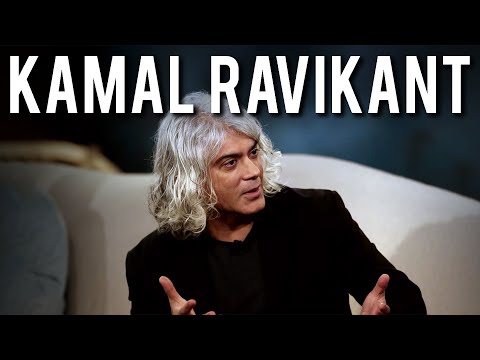
KAMAL RAVIKANT | How Loving Yourself Can Save Your Life | Modern Wisdom Podcast 135
Kamal Ravikant (guest), Chris Williamson (host)
In this episode of Modern Wisdom, featuring Kamal Ravikant and Chris Williamson, KAMAL RAVIKANT | How Loving Yourself Can Save Your Life | Modern Wisdom Podcast 135 explores near-Death, Radical Self-Love, And Becoming Hero Of Your Story Kamal Ravikant recounts a recent near-death experience following surgery, and how the obligation to finish and launch his book, *Love Yourself Like Your Life Depends On It*, pulled him through recovery and off heavy narcotics. He and Chris Williamson explore why self-love is a practical, disciplined inner practice rather than a vague feel-good idea, and how commitment and repetition literally retrain the mind. Kamal describes the book’s structure—story, step-by-step method, and an uncomfortably honest diary of a breakup—to show how self-love works under real emotional stress. The conversation returns repeatedly to personal responsibility: choosing to be the hero, not the victim, using commitments to yourself, self-forgiveness, and consistent practice as the foundations for a better inner and outer life.
Near-Death, Radical Self-Love, And Becoming Hero Of Your Story
Kamal Ravikant recounts a recent near-death experience following surgery, and how the obligation to finish and launch his book, *Love Yourself Like Your Life Depends On It*, pulled him through recovery and off heavy narcotics. He and Chris Williamson explore why self-love is a practical, disciplined inner practice rather than a vague feel-good idea, and how commitment and repetition literally retrain the mind. Kamal describes the book’s structure—story, step-by-step method, and an uncomfortably honest diary of a breakup—to show how self-love works under real emotional stress. The conversation returns repeatedly to personal responsibility: choosing to be the hero, not the victim, using commitments to yourself, self-forgiveness, and consistent practice as the foundations for a better inner and outer life.
Key Takeaways
Purpose can outweigh pain and even addiction.
Kamal came off strong opioids cold turkey—not because the pain stopped, but because he had to edit the final proofs of his book and needed a clear mind. ...
Get the full analysis with uListen
Self-love is a practice, not a concept.
He frames self-love as a trainable mental habit: you forgive yourself, make a solemn vow to love yourself, and then follow simple, repeated practices (like breath-based affirmations and visualizing light) until new thought-patterns become the default.
Get the full analysis with uListen
Radical honesty accelerates learning—for both writer and reader.
The most confronting part of Kamal’s book is a raw, unedited diary of a breakup where he repeatedly fails, clings, and falls apart, while applying his own method. ...
Get the full analysis with uListen
You must choose to be the hero, not the victim, of your story.
They argue that memories are stories, not fixed facts, and as adults we face a simple choice: use our circumstances to justify victimhood, or to step up, make a stand, and turn adversity into a hero’s journey. ...
Get the full analysis with uListen
Keeping promises to yourself builds unshakable self-trust.
Most people constantly break self-promises—about habits, health, or behavior—and erode their own credibility. ...
Get the full analysis with uListen
Inner work quietly transforms your outer life and relationships.
As people deepen self-love, Kamal notes they experience life shifting from “happening to me” to “happening for me” and eventually “through me. ...
Get the full analysis with uListen
Falling off the path is human; recommitment is the real skill.
Kamal admits he stopped practicing his own method, coasted, and then collapsed when life hit hard—despite being “the guy who wrote the book. ...
Get the full analysis with uListen
Notable Quotes
“When you're on fire, you don't need a lecture on the nature of combustion. You just want water.”
— Kamal Ravikant
“Love yourself like your life depends on it is really about one thing: commit and go all in, and watch transformation happen.”
— Kamal Ravikant
“We only have one simple choice: am I going to be a hero or am I going to be a victim of this story?”
— Kamal Ravikant
“It is both a blessing and a curse to feel everything so very deeply.”
— Chris Williamson
“Fear will push you and you'll run out of energy. Commitment pulls you forward.”
— Kamal Ravikant
Questions Answered in This Episode
How would my daily behavior change if I genuinely treated myself as someone I am responsible for helping?
Kamal Ravikant recounts a recent near-death experience following surgery, and how the obligation to finish and launch his book, *Love Yourself Like Your Life Depends On It*, pulled him through recovery and off heavy narcotics. ...
Get the full analysis with uListen AI
Where in my life am I still choosing to be the victim of my story instead of the hero, and what specific commitment could flip that?
Get the full analysis with uListen AI
What practices could I adopt—analogous to Kamal’s self-love routine—that would systematically retrain my thinking patterns?
Get the full analysis with uListen AI
Which broken promises to myself most undermine my self-trust, and what is one small promise I’m willing to keep starting today?
Get the full analysis with uListen AI
If purpose is bigger than pain, what project, responsibility, or mission could I cultivate that would be strong enough to pull me through my hardest days?
Get the full analysis with uListen AI
Transcript Preview
... look, you're not alone, you know? But, uh, I think, as you were to explain my depression, it feels so personal, and all of our stories feel so personal. I wanted to say, like, "Look, you're not alone. You reaching out to me for advice, I go through the same thing, and th- but this is what I do to get over it. This is what I do to get better. Again and again, I return to the same thing. And look, I'm the guy who came up with this, and look, I stopped doing it, I got lazy and, and then, you know, when something hard happened, I kind of fell apart." Right? And talk about embarrassing, talk about feeling shame, you know? Like, it's like-
(laughs) I'm supposed to be the guy.
Well, I never set out to be the guy. But, like, I wrote the book on it, right?
(laughs) Yeah. You're the guy that wrote the book, yeah.
Like, that was from my experience. And I had wrote it from my experience and, um, and so I wanted to share that as well, like, look, like, we will, there are times when we will, when we fall. What do we do? We step up again knowing what works and we do it again, and we go back at it. That's part of life.
(wind blowing) Ladies and gentlemen, welcome back. I'm joined by Kamal Ravikant. Kamal, welcome to the show.
Thanks for having me.
Absolute pleasure to have you on, man. Uh, I feel like we're gonna have something really special in front of us today, I hope.
I hope to, I hope so too, man.
Yeah.
Hope to live up to it.
Yeah, no. Um, so first things first, you had a bit of a turn recently, and you, you were dead for a bit. What, what-
Yeah, for a bit.
... what happened?
Uh, this was, uh, this was about two and a half months ago. I was, um, I went in for elective surgery, uh, just to fix an old, old injury. And that involved, like, moving some arteries around and, like, tweaking arteries. And, uh, right before I be- I was being discharged from the hospital, uh, the, the main artery they worked on, the, um, the, um, sutures came off so the whole thing burst and I basically bled to death. And, um, the only thing that saved me was I was still in the hospital and I was, and it bur- it burst so hard that it pooled up in my body and then burst out of my body. Uh, not out of the sutures, just from the force of the blood. And the only thing that saved me was I was spraying blood everywhere. And they did the-
So you were kind (laughs) a little bit like a garden sprinkler system but just with-
Install uListen to search the full transcript and get AI-powered insights
Get Full TranscriptGet more from every podcast
AI summaries, searchable transcripts, and fact-checking. Free forever.
Add to Chrome