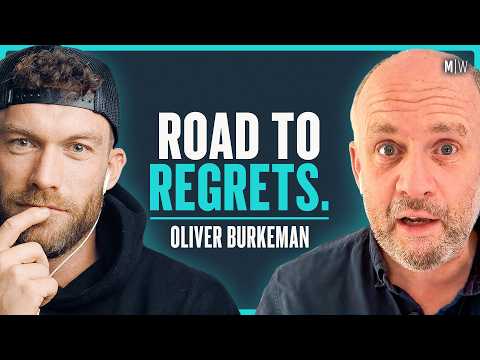
Why You Can’t Stop Your Productivity Addiction - Oliver Burkeman
Chris Williamson (host), Oliver Burkeman (guest)
In this episode of Modern Wisdom, featuring Chris Williamson and Oliver Burkeman, Why You Can’t Stop Your Productivity Addiction - Oliver Burkeman explores escaping productivity addiction by relinquishing control and embracing finitude now The conversation argues that many high achievers are “productivity addicted” because success is used to prop up self-worth, turning wins into mere relief and raising the minimum standard forever.
Escaping productivity addiction by relinquishing control and embracing finitude now
The conversation argues that many high achievers are “productivity addicted” because success is used to prop up self-worth, turning wins into mere relief and raising the minimum standard forever.
Burkeman reframes the drive for control as a way to avoid the vulnerability of being human—finite time, uncertainty, and inevitable failure to “do it all”—and suggests liberation comes from accepting those limits.
They distinguish agency from control: loosening the need to control outcomes often increases real power, creativity, flow, and the capacity to enjoy work and life.
Practical themes include “do it anyway,” navigating by interest (not rigid systems), the hidden costs of “best life” optimization, the inevitability of “settling” via trade-offs, and why AI can become a new control fantasy that undermines authenticity and relationships.
Key Takeaways
Relaxation can improve performance more than tightening control.
Burkeman notes that excellence often comes from “letting go into the action” (flow) rather than hyper-monitoring. ...
Get the full analysis with uListen
Goal pursuit becomes toxic when it’s a self-worth repair strategy.
The “insecure overachiever” achieves to fill a void, so any success instantly becomes the new baseline. ...
Get the full analysis with uListen
A simple diagnostic: do you feel joy or relief when things go well?
If your dominant feeling is relief, success is functioning as fear-reduction, not fulfillment. ...
Get the full analysis with uListen
Accepting finitude is not resignation; it’s a productivity-and-life unlock.
Because you can’t finish everything (the inbox will outlive you), you’re “already failed” by perfectionist standards. ...
Get the full analysis with uListen
Agency and control are different—less control can mean more agency.
Burkeman argues control is domination-based and fragile (dependent on outcomes), while agency is the capacity to act meaningfully amid uncertainty. ...
Get the full analysis with uListen
Rigid productivity systems can waste your best energy; interest is leverage.
Trying to force yourself to do pre-assigned tasks can fight natural motivation. ...
Get the full analysis with uListen
AI can become a control fantasy that erodes authenticity and intimacy.
Using an LLM to craft the “perfect” relationship message may prevent the real value of repair after imperfection, while also creating a private sense of fraudulence. ...
Get the full analysis with uListen
Optimization questions like ‘best life’ have no stopping rule—so they breed dissatisfaction.
“Best life” and “maximizing potential” are unfalsifiable ideals; you can’t ever prove you’ve reached them. ...
Get the full analysis with uListen
‘Settling’ is unavoidable; the real choice is which downside you accept.
Every commitment (and every non-commitment) has trade-offs. ...
Get the full analysis with uListen
Periods of ‘incongruence’ may be generative transition, not failure.
Letting old strategies fall away before mastering new ones can look like backsliding—especially next to highly “congruent” peers. ...
Get the full analysis with uListen
Notable Quotes
“It is very possible to be really, really good at what you do and relaxed.”
— Oliver Burkeman
“People who really excel… are more often in a flow state… It’s much better to lose yourself in the activity than to be trying to control it.”
— Oliver Burkeman
“There’s this really powerful and incredibly liberating… sense in which you’ve kind of already failed.”
— Oliver Burkeman
“[Krishnamurti’s secret:] ‘I don’t mind what happens.’”
— Oliver Burkeman
“You’re scared to let go… because you’re afraid of losing control, but you never had control. All you had was anxiety.”
— Oliver Burkeman (quoting Elizabeth Gilbert)
Questions Answered in This Episode
For someone who only feels “relief” after success, what’s the first practical step to re-train that response toward joy?
The conversation argues that many high achievers are “productivity addicted” because success is used to prop up self-worth, turning wins into mere relief and raising the minimum standard forever.
Get the full analysis with uListen AI
How do you tell the difference between ‘healthy ambition’ and ‘insecure overachiever’ ambition in real time, mid-project?
Burkeman reframes the drive for control as a way to avoid the vulnerability of being human—finite time, uncertainty, and inevitable failure to “do it all”—and suggests liberation comes from accepting those limits.
Get the full analysis with uListen AI
You say we’re “already failed” by certain standards—how do you use that idea without sliding into apathy or nihilism?
They distinguish agency from control: loosening the need to control outcomes often increases real power, creativity, flow, and the capacity to enjoy work and life.
Get the full analysis with uListen AI
What does ‘agency without control’ look like as a daily practice (especially for planners and optimizers)?
Practical themes include “do it anyway,” navigating by interest (not rigid systems), the hidden costs of “best life” optimization, the inevitability of “settling” via trade-offs, and why AI can become a new control fantasy that undermines authenticity and relationships.
Get the full analysis with uListen AI
If interest is a compass, how should people with rigid jobs (shift work, caretaking, junior roles) apply it realistically?
Get the full analysis with uListen AI
Transcript Preview
Is it possible to be the best in the world and relaxed at the same time?
[laughing] Um, the best in the world? I don't know. I, um, I- what I do think is that it is very possible to be really, really good at what you do and relaxed. And actually, my experience is that the more relaxed I can be, the better I am at things. I'm not gonna claim to be the best in the world at anything. But, um, I, I think that notion that you've either got to choose a relaxing life or a, an accomplished one, this is, uh, uh, this is the thing I'm on a mission, very personally motivated [chuckles] mission to prove is not, uh, not how it works.
I think there's a tension between having high standards, which is hypervigilance, and obsession, and focus, and really paying attention to stuff, and that just tends to bleed into the personality and the ambient anxiety. And, uh, I can see, uh, for instance, if you were to say, um: "Is it possible to be the best in the world and never relax at the same time?" That question would seem pretty obvious to answer.
Hmm.
Yes, of course, because the exact same level of resolution that you're obsessing over your pursuit with is the thing that kind of destroys the rest of your life. The interesting question is to work out whether you can kind of be on and off, or if you can hold things a little bit more loosely whilst still getting the right level of output you want.
Yeah, it's really interesting. I think that, um, there's, there's something... I mean, this runs through a lot of what I try to write about, but there's something about wanting to feel in control of the process of getting better at things or being good at things, which is kind of completely different from the actual process of getting better at them or, or being good at them. So I think there's, you know, this is, on some level, just the banal observation that people who really excel in what they do are very often, or perhaps more often, in a flow state while they're doing it. They're kind of- they sort of let go into the action. They're not sort of sitting back inside their minds, controlling it all in a very, um, sort of, mmm, uh, conscious, uh, controlly, controlly way. So yeah, for me, and of course, I'm talking about things like writing or speaking. I mean, I'm not talking about, um, uh, it may work differently in, to different degrees for kinda sports performance and things, but you find that the more I'm trying to make sure that things go well, that- that's just like a... And, and therefore, I'm sort of unrelaxed and clenched, and m- muscles tensed and everything. The, the more, um, you sort of pop into this awful self-conscious space where nothing, nothing works, and it's much better to lose yourself in the activity than to be trying to control it.
Install uListen to search the full transcript and get AI-powered insights
Get Full TranscriptGet more from every podcast
AI summaries, searchable transcripts, and fact-checking. Free forever.
Add to Chrome