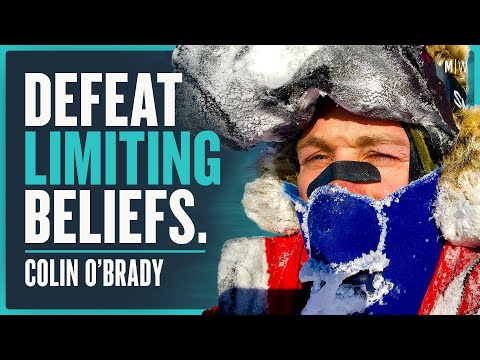
The Man Who Walked Across Antarctica - Colin O’Brady
Colin O'Brady (guest), Chris Williamson (host)
In this episode of Modern Wisdom, featuring Colin O'Brady and Chris Williamson, The Man Who Walked Across Antarctica - Colin O’Brady explores antarctic explorer’s 12-hour walk breaks comfort, shatters limiting beliefs Colin O’Brady recounts his solo, unsupported crossing of Antarctica, using the brutal physical and mental demands as a lens on human potential and mindset. He contrasts modern, comfortable lives with the extreme adversity faced by historical explorers like Shackleton and contemporary climbers like Nims Purja, arguing that suffering and risk are prerequisites for life’s highest highs. O’Brady explains his concept of “possible mindset” born from recovering from severe burn injuries and later refined in Antarctica, emphasizing how limiting beliefs—not true constraints—cap our potential. He introduces his book and the practice of a solitary 12-hour walk as a practical, one-day intervention to confront those beliefs, escape “comfortable complacency,” and reorient life toward personally meaningful “Everests.”
Antarctic explorer’s 12-hour walk breaks comfort, shatters limiting beliefs
Colin O’Brady recounts his solo, unsupported crossing of Antarctica, using the brutal physical and mental demands as a lens on human potential and mindset. He contrasts modern, comfortable lives with the extreme adversity faced by historical explorers like Shackleton and contemporary climbers like Nims Purja, arguing that suffering and risk are prerequisites for life’s highest highs. O’Brady explains his concept of “possible mindset” born from recovering from severe burn injuries and later refined in Antarctica, emphasizing how limiting beliefs—not true constraints—cap our potential. He introduces his book and the practice of a solitary 12-hour walk as a practical, one-day intervention to confront those beliefs, escape “comfortable complacency,” and reorient life toward personally meaningful “Everests.”
Key Takeaways
Life’s peak experiences are earned by accepting real risk and discomfort.
O’Brady argues that 9s and 10s on the “life scale” only arise because we’re willing to face the “1s”—pain, fear, failure—rather than insulating ourselves in safe but numb routines.
Get the full analysis with uListen
Most people are stuck in a ‘zone of comfortable complacency.’
He links Thoreau’s ‘quiet desperation’ and concepts like the Region Beta Paradox to modern lives lived between 4 and 6 out of 10—jobs, relationships, and lifestyles that are ‘fine’ but never demand real change, so nothing truly great ever happens.
Get the full analysis with uListen
Limiting beliefs—not hard constraints—usually cap our potential.
What we treat as hard limits (“I can only walk 10 hours,” “I’ll never be fit,” “I don’t have time”) are beliefs, not facts; O’Brady’s own shift from 10 to 12-hour Antarctic days illustrates how questioning these stories unlocks new capacity.
Get the full analysis with uListen
Adversity can become a powerful catalyst if paired with a clear goal.
After doctors said he might never walk normally, O’Brady’s mother pushed him to visualize and train for a triathlon; that focus transformed a catastrophic burn injury into the foundation for a world-record athletic career.
Get the full analysis with uListen
Competition and external pressure can raise your internal ceiling.
Racing Captain Lou Rudd across Antarctica forced O’Brady to recalibrate what he thought was physically possible and maintain a punishing 12-hour daily pace he admits he’d likely never have reached alone.
Get the full analysis with uListen
A solitary 12-hour walk is a simple, powerful tool to reset your mind.
Walking alone in silence with your phone on airplane mode confronts you with your own thoughts and limiting beliefs; participants consistently report returning more energized, clear, and creatively engaged with their lives.
Get the full analysis with uListen
Massive goals are just millions of small, consistent actions stacked together.
O’Brady’s “Everest pebble” metaphor and his wheelchair-to-chair first step illustrate that what looks impossible from afar becomes achievable when broken into tiny, daily commitments executed with discipline.
Get the full analysis with uListen
Notable Quotes
“Every time that I experience a 10, it’s not in spite of my ones, but it’s because of my ones.”
— Colin O’Brady
“Most people are stuck in what I call the zone of comfortable complacency, between four and six.”
— Colin O’Brady
“They’re not limiting truths. These are not limiting facts. They’re beliefs. And beliefs can be rewritten.”
— Colin O’Brady
“What’s your Everest? Even Mount Everest is just a bunch of tiny pebbles stacked on top of each other.”
— Colin O’Brady
“You don’t have to live this life of quiet desperation. Wake up.”
— Colin O’Brady
Questions Answered in This Episode
Which areas of my life are sitting in that ‘4–6’ zone of comfortable complacency, and what would it actually take to risk dropping to a ‘1’ in order to reach a ‘10’?
Colin O’Brady recounts his solo, unsupported crossing of Antarctica, using the brutal physical and mental demands as a lens on human potential and mindset. ...
Get the full analysis with uListen AI
What are the three most persistent limiting beliefs in my internal dialogue, and how would my decisions change if I treated them as stories rather than facts?
Get the full analysis with uListen AI
If I defined my own ‘Everest’—the thing I’d regret not attempting by age 80—what is the smallest concrete step I could take toward it this week?
Get the full analysis with uListen AI
How might a deliberate dose of ‘Type 2 Fun’—a challenging, uncomfortable experience—change how alive and fulfilled I feel six months from now?
Get the full analysis with uListen AI
If I committed to a 12-hour walk, what excuses arise immediately, and what do those excuses reveal about how I’m currently running my life?
Get the full analysis with uListen AI
Transcript Preview
When I was walking across Antarctica on my solo crossing, the first day I started crying, man. I started crying because I could barely pull my sled. I had a thousand miles to go and I couldn't even, like, literally cross the first quarter mile, and when you're crying, it's minus 30, minus 40 degrees outside. Antarctica doesn't take it easy on you. Just freezes the tears to your face. You feel like a real pathetic loser.
(wind blowing) Colleen O'Brady, welcome to the show.
Great to be here with you, Chris. Thanks for having me.
How connected did you feel to the discovery of Shackleton's ship, Endurance, when they found it a few months ago?
Oh, man, it was, uh, that was like, uh, it's like a kid on Christmas, waking up to that news. I remember, uh, I got the New York Times alert and then my phone started blowing up 'cause so many people know how, um, you know, fondly I, I think of, uh, Antarctica, but specifically Shackleton. Shackleton has been, um, a, a hero among heroes i- in my mind and consciousness. Um, I, you know, the, Endurance is his story of, of that survival. It's one of my all-time favorite books. I've read, you know, like, obscure texts of his journals (laughs) and things like that. So, um, I honestly, I will say this though, I, I'm not generally a huge skeptic, but when they said they were going on this expedition to find that, I was like, "How could they possibly find?" (laughs) Like, they're, how are they gonna find this, you know? Like, I've, I've, I've rowed a boat across Drake Passage, I've been in these waters, I've been in there and I'm like, I'm like, uh, "No." But honestly, I was happy to be proven wrong 'cause it was unbelievable to see those photos, um, and, and how preserved the boat was. I mean, oh my gosh.
Have you got any idea how they actually managed to find it? Because the Antarctic is pretty big-
(laughs) .
Presumably the GPS coordinates that they had from whatever it was, 1914, 1915 or something-
Yeah.
... when they departed, they wouldn't have been particularly sophisticated. So, have you got any idea how they knew where to look?
I, honestly, that, that is the part that I, I, I should probably look deeper into it, 'cause I'm fascinated to know the answer to that question. Um, I have no idea, particularly because, uh, the Weddell Sea, um, and then that section over there, I mean, they were on sea ice and it melted and it shrank and you, I mean, I've literally been in a rowboat i- in these waters with 40-foot swells. And so I've been bashed around just, uh, in the course of a couple of weeks. And then, you know, hundred years you think it's gonna move around at the bottom of the ocean. Um, and I think even they were, from the, the reports I read, pretty, uh, surprised to see, I mean, for one thing they found it, but how well preserved it was. Like, there, it's just the water is so cold that there was not as many sort of natural predators and things that they would have in a warmer environment of, of co- corals and barnacles and things that, um, would normally kind of decay. So like, I mean, it was like, uh, practically frozen in time. I mean, it was wild.
Install uListen to search the full transcript and get AI-powered insights
Get Full TranscriptGet more from every podcast
AI summaries, searchable transcripts, and fact-checking. Free forever.
Add to Chrome