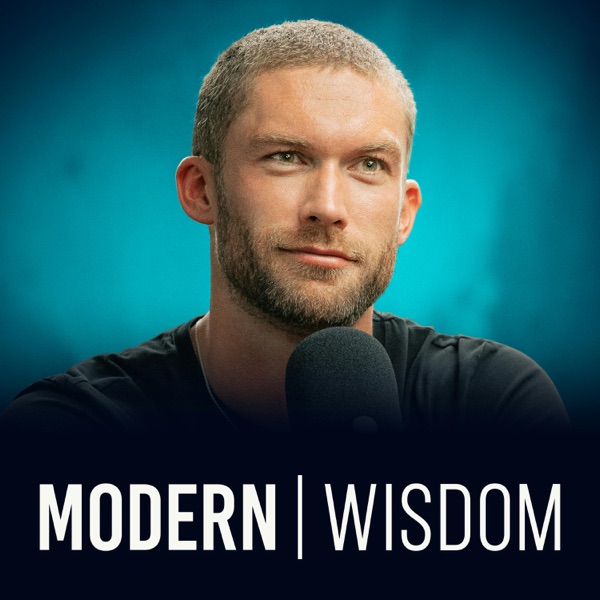
 Modern Wisdom
The Uber Eats to OnlyFans Pipeline
Chris Williamson and George Mack on wild riff session on trends, truth, addiction, and modern incentives.
In this episode of Modern Wisdom, featuring Chris Williamson and George Mack, The Uber Eats to OnlyFans Pipeline explores wild riff session on trends, truth, addiction, and modern incentives The hosts bounce from humorous internet curiosities (peanuts in Coke, Uber Eats tipping via feet photos) to a broader critique of how attention and money create “pipelines” that reshape behavior.
At a glance
WHAT IT’S REALLY ABOUT
Wild riff session on trends, truth, addiction, and modern incentives
- The hosts bounce from humorous internet curiosities (peanuts in Coke, Uber Eats tipping via feet photos) to a broader critique of how attention and money create “pipelines” that reshape behavior.
- They argue mainstream media is still influential on elite decision-making despite low public trust, because prestige and agenda-setting affect politicians and institutions.
- The group discusses mental health language inflation and self-diagnosis, claiming it can both help and harm by turning diagnoses into identity and reducing personal agency.
- A major segment warns about kratom—especially potent 7-OH products—describing how OTC availability, subtle intoxication, and harsh withdrawals may be fueling a quiet addiction wave.
- They explore epistemic decay: replication issues in social science, “studies say” as a social-authority hack, and AI/deepfakes worsening a post-truth environment while also offering real personal utility (e.g., health troubleshooting, personalized genetics insights).
IDEAS WORTH REMEMBERING
5 ideasPrestige can matter more than audience size in shaping power.
They suggest mainstream outlets (BBC, major papers) influence politicians and policy agendas even when “nobody reads it,” because elite actors monitor and react to headline narratives.
Mental health is simultaneously under- and over-diagnosed.
The conversation highlights a real need for care while criticizing how broad labels and DSM-style expansion can become identity, excuse-making, or social signaling—reducing nuance and agency.
OTC availability does not imply a substance is “mild.”
Kratom (especially 7-OH–fortified products) is portrayed as deceptively strong: users may not realize how impaired they are, can develop dependence, and face severe withdrawals despite gas-station retail placement.
Personalized biology can legitimize preferences—but can also become destiny.
Genetic testing (e.g., caffeine metabolism, magnesium absorption, morphine sensitivity, COMT traits) can guide practical choices and offer psychological “permission,” but risks over-identification or fatalism if treated as fixed fate.
“Studies say” often functions as social authority, not truth.
They argue many viral psych findings are small-sample, non-replicable, or poorly explained; a better default is skepticism and demand for mechanisms, variables, and quality of explanation, not just citations.
WORDS WORTH SAVING
5 quotesMental health is both under-diagnosed and over-diagnosed.
— Chris Williamson
I think the insults that hurt the most are the ones that you know are untrue, but that you fear other people might believe.
— Chris Williamson
We pity the moth for confusing the lamp for the moon, yet here you are confusing a screen for the world.
— Shaan Puri
This is not a calm, content temperament. It is a perform or perish nervous system.
— Chris Williamson
This is the fucking Only- Uber Eats to OnlyFans pipeline that no one is talking about.
— Chris Williamson
QUESTIONS ANSWERED IN THIS EPISODE
5 questionsOn mainstream media: what specific examples show policymakers reacting to headlines rather than voter sentiment or internal analysis?
The hosts bounce from humorous internet curiosities (peanuts in Coke, Uber Eats tipping via feet photos) to a broader critique of how attention and money create “pipelines” that reshape behavior.
On mental health: where’s the line between helpful diagnosis and identity-as-crutch, and how would you redesign the language to preserve nuance?
They argue mainstream media is still influential on elite decision-making despite low public trust, because prestige and agenda-setting affect politicians and institutions.
On kratom: what evidence distinguishes risks of plain leaf powder versus 7-OH concentrates, and what would sensible regulation look like without banning everything?
The group discusses mental health language inflation and self-diagnosis, claiming it can both help and harm by turning diagnoses into identity and reducing personal agency.
On platform incentives: if you could remove all engagement metrics for a week, how would you expect your own consumption and mood to change?
A major segment warns about kratom—especially potent 7-OH products—describing how OTC availability, subtle intoxication, and harsh withdrawals may be fueling a quiet addiction wave.
On “golden likes”: what scarcity design (one per week, paid, reputation-based) would best surface depth without creating a new status game?
They explore epistemic decay: replication issues in social science, “studies say” as a social-authority hack, and AI/deepfakes worsening a post-truth environment while also offering real personal utility (e.g., health troubleshooting, personalized genetics insights).
Chapter Breakdown
Peanuts in Coke taste test (and the science behind sweet-salty combos)
The episode opens with a viral food pairing: salted peanuts dropped into full-fat Coke. They try it, react in real time, and riff on why it might work chemically—even if the first sip mostly just tastes like Coke.
The highest-paid athlete ever: the Roman chariot racer who dwarfs Jordan
A sports-pay tangent turns into a history flex: Gaius Appuleius Diocles, a Roman charioteer, allegedly earned the modern equivalent of ~$15B. This leads into a comparison of how 'capitalist' modern US sports really are versus the UK/Europe.
Why mainstream media might be underpriced (despite no one admitting they watch it)
George argues that mainstream media is oddly powerful precisely because the visible cultural conversation has moved elsewhere. Even if everyday people don’t read it, politicians and institutions often still respond to it, making it influential in agenda-setting.
Anxiety bags, over-medicalization, and why mental health feels less credible now
A story about Gen Z ‘grab-and-go’ anxiety kits sparks a deeper conversation about mental health language, identity, and the DSM’s expanding taxonomy. They argue mental health is simultaneously under- and over-diagnosed, eroding seriousness while genuine sufferers go unnoticed.
Kratom and 7-OH: the gas-station opioid problem (and withdrawal horror stories)
Gary lays out his developing investigation into kratom—especially 7-hydroxymitragynine products sold over the counter—and claims withdrawals can be worse than heroin. The group discusses sneaky intoxication, dose-dependent effects (stimulant to sedative), and how legal availability masks risk.
DNA testing as a personalization layer: risks, permissions, and “no one is average”
They discuss Intelix DNA testing and how genetic profiles can guide supplementation, medication safety, and lifestyle choices. Beyond new facts, the bigger effect is psychological: it legitimizes preferences and reduces self-doubt—while also risking genetic determinism.
Porn memory, American bathroom stalls, and the case for compartmentalization
A private-dinner comment about remembering explicit imagery becomes a comedic rant about US bathroom stall gaps. The larger point: humans rely on psychological ‘walls’—compartmentalization—to function, and certain environments (like US stalls) violate that boundary.
The Uber Eats-to-OnlyFans pipeline: feet pics, tipping hacks, and incentive escalation
A viral example shows a delivery driver boosting tips by including her feet in drop-off photos. They frame it as a micro-incentive system: small monetized boundary pushes can quickly lead to larger content escalation—an ‘OnlyFans pipeline’ driven by rewards.
Peak bachelor aesthetics: Male Living Spaces and the ‘Norwegian prison’ meme
They tour the ‘Male Living Spaces’ subreddit—minimalist, chaotic, and hilarious bachelor setups. This segues into a comparison meme: some Norwegian prisons look better than many young men’s apartments, sparking commentary on incentives and conditions.
High-agency field intel: ‘Analyst #3’ goes to Hormuz to count ships
Shaan recounts an extraordinary ‘high agency’ story: a research analyst travels to the Strait of Hormuz to verify shipping flow when markets are volatile and data is unreliable. The tale highlights first-principles verification, opsec mistakes, and how narratives diverge from reality.
Life hacks that aren’t productivity: Flighty, ‘studies say’ skepticism, and metric traps
They swap ‘life hacks’ ranging from practical (Flighty app for travel) to epistemic (default skepticism toward research claims). The conversation pivots into the replication crisis and how ‘science-backed’ language often functions as social authority rather than understanding.
Investigative journalism vs legislation: the ‘Stop Nick Shirley Act’ and Puerto Rico transparency
They discuss a proposed California bill framed as preventing harm but potentially chilling investigative exposure of fraud. Gary connects it to his Puerto Rico reporting, describing structural corruption incentives and how transparency mechanisms can be quietly weakened.
Choosing the right game: views, ‘golden likes,’ and how scoreboards rewire identity
A philosophical segment explores how platforms’ metrics (views/likes) reshape creators’ behavior and values. They propose mechanisms to restore depth—scarce ‘golden likes,’ alternate success metrics (book sales), and personal strategies to avoid being captured by the scoreboard.
Supernormal stimuli: how modern life hacks your brain (and how to reset)
Shaan introduces supernormal stimuli—oversized, intensified signals that hijack evolved preferences—then they connect it to food, porn, cosmetic surgery, and social media. They argue the antidote is partially a reset: short detoxes reduce tolerance and restore sensitivity to normal rewards.
AI doom vs AI benefits: medical wins, deepfakes, manias, and robot training data
The final stretch swings between optimism and dread: AI helps solve real personal problems (like George’s dermatitis) yet deepfakes and post-truth dynamics could destabilize trust. They also cover AI mania behavior (Allbirds pivot), training-data labor in Indian factories, and Tesla-style robot ‘self-play’ fantasies.
Closing riffs: Phil Collins’ Rock Hall news and final banter
They wrap with a light note: Phil Collins’ induction and a joke about him being George’s dad. The episode ends as it began—chaotic camaraderie and quick-hit tangents.
EVERY SPOKEN WORD
Install uListen for AI-powered chat & search across the full episode — Get Full Transcript
Get more out of YouTube videos.
High quality summaries for YouTube videos. Accurate transcripts to search & find moments. Powered by ChatGPT & Claude AI.
Add to Chrome