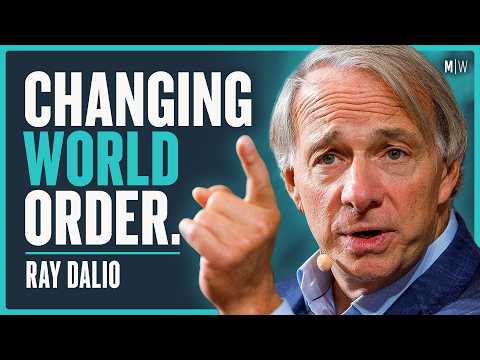
The Economic Collapse You’ve Been Told Won’t Happen - Ray Dalio
Chris Williamson (host), Ray Dalio (guest), Narrator, Narrator
In this episode of Modern Wisdom, featuring Chris Williamson and Ray Dalio, The Economic Collapse You’ve Been Told Won’t Happen - Ray Dalio explores ray Dalio Warns: Debt Cycles, Power Shifts, and AI Collisions Ahead Ray Dalio explains how today’s economic, political, and geopolitical tensions fit into long-running historical cycles that have repeated for centuries. Drawing on 500 years of data, he outlines five major forces—debt, internal conflict, world order shifts, acts of nature, and technology—and argues that all prior monetary, political, and global systems have eventually broken down and been replaced. He details the mechanics of the current U.S. debt situation, why reserve currencies ultimately fail, and how rising inequality fuels populism and polarization. Dalio also discusses AI as the most powerful technology yet, likely to bring huge productivity gains but also deep social disruption he doubts we will manage wisely.
Ray Dalio Warns: Debt Cycles, Power Shifts, and AI Collisions Ahead
Ray Dalio explains how today’s economic, political, and geopolitical tensions fit into long-running historical cycles that have repeated for centuries. Drawing on 500 years of data, he outlines five major forces—debt, internal conflict, world order shifts, acts of nature, and technology—and argues that all prior monetary, political, and global systems have eventually broken down and been replaced. He details the mechanics of the current U.S. debt situation, why reserve currencies ultimately fail, and how rising inequality fuels populism and polarization. Dalio also discusses AI as the most powerful technology yet, likely to bring huge productivity gains but also deep social disruption he doubts we will manage wisely.
Key Takeaways
Long-term historical cycles are essential to understanding today’s crises.
Dalio argues that major economic and political events now unfolding closely mirror past episodes (e. ...
Get the full analysis with uListen
The debt-money system has become structurally unsustainable in the U.S.
With the U. ...
Get the full analysis with uListen
Reserve currencies and monetary orders always break down eventually.
All historical reserve currencies and monetary systems have failed as debt and claims on money outgrow real economic capacity; governments then resort to devaluation, monetization, or coercive policies, undermining money as a store of wealth and shifting global power.
Get the full analysis with uListen
Rising inequality and cultural divides fuel populism and political extremism.
Capitalism’s success creates large wealth and values gaps; a booming tech/AI elite coexists with a bottom 60% struggling with weak education and stagnant incomes, driving resentment, ‘us vs. ...
Get the full analysis with uListen
Geopolitical order is moving from U.S. dominance to multipolar rivalry.
Post‑1945 multilateral structures (UN, IMF, WTO) are less effective as power diffuses; China’s rise as a comparable power, along with other emerging economies, reduces U. ...
Get the full analysis with uListen
Acts of nature and climate change will impose enormous economic costs.
Dalio cites estimates of around $8T per year in global costs from climate-related mitigation, adaptation, and damage in a ~$100T world economy, arguing that environmental shocks have historically killed more people and toppled more orders than wars.
Get the full analysis with uListen
AI will supercharge productivity but likely worsen inequality and instability.
AI is, in Dalio’s view, the most powerful general-purpose technology ever, but its gains will heavily favor some while displacing many workers and enhancing warfare capabilities; he doubts societies will manage the distributional and social disruptions wisely.
Get the full analysis with uListen
Notable Quotes
“All monetary orders, all political orders, and all geopolitical orders have broken down throughout history.”
— Ray Dalio
“Debt service payments build up like plaque in the arteries of your system that will squeeze out other spending.”
— Ray Dalio
“It’s like being on a boat headed to rocks, and the politicians know it, but they’re arguing about how to turn.”
— Ray Dalio
“We have a human nature problem… I don’t think we’re going to navigate this wisely.”
— Ray Dalio
“You’re only looking at this much. You turn on the news, and there’s today’s news. There’s not seeing the cycle.”
— Ray Dalio
Questions Answered in This Episode
If all prior monetary and political systems have broken down, what specific indicators should ordinary people watch for to know when ours is nearing that point?
Ray Dalio explains how today’s economic, political, and geopolitical tensions fit into long-running historical cycles that have repeated for centuries. ...
Get the full analysis with uListen AI
Given the current U.S. debt trajectory, what practical steps can individuals and institutions take to protect their savings and investments?
Get the full analysis with uListen AI
How could policymakers realistically build the ‘strong middle’ Dalio says is needed to reduce polarization and implement shared sacrifices?
Get the full analysis with uListen AI
What kinds of governance or international agreements might reduce the odds that AI becomes primarily a tool for warfare and destabilization?
Get the full analysis with uListen AI
Are there historical examples of countries successfully navigating a similar stage of the cycle without major war or systemic collapse, and what did they do differently?
Get the full analysis with uListen AI
Transcript Preview
60 years of global macro investing. Congratulations.
Thank you. Yeah. Bi- Bridgewater just cele- celebrated its 50th year, and I just, uh, celebrated passing it along. So yeah, thank you.
Yeah. Why, after all that time, why did you get interested in a changing world order and how countries go broke? Like, why does-
Oh, okay.
... a global macro investor do that?
Well, I'll, uh, I, I'll tell you a s- a story. Um, when I was (clears throat) between, uh, college and Harvard Business School in 1971, I was clerking on the floor of the New York Stock Exchange, and on August 15th, 1971, President Nixon gets on the television and he says, "You know our promises to allow you to turn in those dollars for gold? Well, we're not gonna s- stick to them," and that wasn't his wording exactly (laughs) , uh, but, um, money as we knew it, which was gold, and the money, uh, as we now know it, which is fiat money, was like checks, uh, he di- he didn't, uh, we weren't gonna get our money. And so I walked on the floor of the New York Stock Exchange the next morning, clerking, and I figured the market would be down a lot, and it turned out it was up a lot and I hadn't been through a devaluation before, so I studied history then I found out that on, um, March 15th, or on S- I think it was March 3rd, 1933, Roosevelt did the exact same thing on the radio and I studied it. And as a result of studying that, I understood the mechanics of that, why the devaluation had that kind of effect, and I studied the Great Depression because I, what I learned was that, uh, it may not have happened in my lifetime before, these important things, but I need to understand them. So, I studied the Great Depression and that allowed me to, uh, make a lot of money and do very well in anticipating the 2008 financial crisis and then, um, to also, uh, the European debt crisis from 2010 to 2015. So, I knew that, uh, things may have happened before, so I then needed to study. So, there are things that are going on now that happened to happen in our lifetime before, and I figured, uh, that I needed to study that. Um, what causes the rise and decline of a reserve currency? Or what causes the rise and decline of a great power? And so I needed to study the last 500 years, you know, 'cause a rise and decline of a reserve currency or a great power c- takes arcs. You know, there's the British power, before that there was the Dutch, and so on, and I needed to study that. I studied that 500 years, and then I saw that the same things happen over and over again for the same reasons, um, and now I'm at a stage in my life where what I wanna do is pass along whatever I know to make it available to other people. I'm no longer, you know, um, focused in and keeping it quiet, um, and so that's why I studied that 500 year and that's why I, uh, wrote the, uh, book before the last one, the book before the last one is called Principles for Dealing With the Changing World Order, and if you read it you see the pattern. And by the way, I also put out a free video for anybody, it's called the, on YouTube, Changing World Order. It's free. You can, um, you, you can listen to it. So anyway, that's how I came about all this. And, and need to study, you need to study the mechanics of things that have happened before because a lot of what's happening now is most similar to what has happened before our lifetimes.
Install uListen to search the full transcript and get AI-powered insights
Get Full TranscriptGet more from every podcast
AI summaries, searchable transcripts, and fact-checking. Free forever.
Add to Chrome