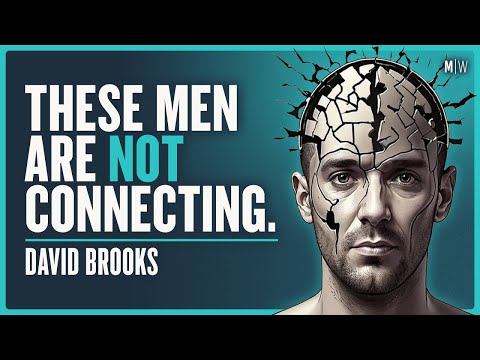
Why Is Everyone So Emotionally Detached? - David Brooks
Chris Williamson (host), David Brooks (guest)
In this episode of Modern Wisdom, featuring Chris Williamson and David Brooks, Why Is Everyone So Emotionally Detached? - David Brooks explores david Brooks On Trading Stoic Armor For Fully Felt Human Life David Brooks and Chris Williamson explore why so many people—especially high‑functioning, rational achievers—live emotionally detached lives and how that detachment quietly impoverishes them. Brooks shares his own journey from hyper‑controlled, aloof “emotional idiot” to someone more open, vulnerable, and relationally focused. They unpack the fears behind emotional suppression, the cultural forces that reward stoicism and banter, and the research showing emotions are essential for rational decision‑making. The conversation then turns practical, covering how to deepen relationships, listen better, ask richer questions, support people in pain, and gradually expand one’s emotional range without losing a valued sense of competence and control.
David Brooks On Trading Stoic Armor For Fully Felt Human Life
David Brooks and Chris Williamson explore why so many people—especially high‑functioning, rational achievers—live emotionally detached lives and how that detachment quietly impoverishes them. Brooks shares his own journey from hyper‑controlled, aloof “emotional idiot” to someone more open, vulnerable, and relationally focused. They unpack the fears behind emotional suppression, the cultural forces that reward stoicism and banter, and the research showing emotions are essential for rational decision‑making. The conversation then turns practical, covering how to deepen relationships, listen better, ask richer questions, support people in pain, and gradually expand one’s emotional range without losing a valued sense of competence and control.
Key Takeaways
Emotional control often hides fear, not strength.
Many people (especially men) cling to stoicism, mastery, and hyper-rationality because feelings feel unsafe and unpredictable, but this armor also blocks intimacy, joy, and genuine connection.
Get the full analysis with uListen
You cannot think well without feeling well enough.
Neuroscience research (e. ...
Get the full analysis with uListen
Name and refine your emotions to navigate life better.
Building “emotional granularity” (distinguishing stress from anxiety, frustration from impatience, etc. ...
Get the full analysis with uListen
Deep relationships require a willingness to lose control.
Every close bond—friendship, marriage, therapy—involves putting your heart in someone else’s hands, accepting the real risk of hurt in exchange for the possibility of profound joy and being fully known.
Get the full analysis with uListen
Good conversations are a learnable craft, not a personality trait.
Skills like giving undivided attention, avoiding “topping” others’ stories, listening loudly (verbally and non‑verbally), and asking story-based, open questions can transform everyday interactions into memorable, connecting moments.
Get the full analysis with uListen
To support someone in deep pain, validate and stay present, not fix.
With depression or grief, advice-giving and “look on the bright side” reframes usually backfire; what helps more is acknowledging how bad it is, expressing “I want more for you,” offering small, consistent check-ins, and practical help.
Get the full analysis with uListen
Vulnerability tends to increase, not decrease, real connection and respect.
Contrary to fears that openness signals weakness or lowers status—especially for men—Brooks argues that most people crave partners and friends who communicate honestly, and that careful, gradual vulnerability strengthens rather than erodes bonds.
Get the full analysis with uListen
Notable Quotes
“The thing we want most in the world is to be seen in our fullness. The thing we fear most in the world is to be seen in our fullness.”
— David Brooks
“If you close yourself off from the hazards of the world, you’re closing yourself off from the holy sources of life itself.”
— David Brooks (via Frederick Buechner)
“Mr. Spock is a myth. Humans need emotions—intelligent emotions—on which to think rationally.”
— David Brooks
“If the same problems continue to show up in your life, the problems aren’t the problem. You are the problem.”
— Chris Williamson
“I used to think wisdom was being like Yoda, saying smart maxims. Now I think it’s the ability to receive the stories that people are telling you in a way that holds space for them.”
— David Brooks
Questions Answered in This Episode
Where in my own life am I using competence and control to avoid feeling vulnerable or being fully seen?
David Brooks and Chris Williamson explore why so many people—especially high‑functioning, rational achievers—live emotionally detached lives and how that detachment quietly impoverishes them. ...
Get the full analysis with uListen AI
What specific emotions do I tend to lump together, and how might developing more emotional granularity change my decisions and relationships?
Get the full analysis with uListen AI
How could I experiment with asking one or two of Brooks’s story-based questions to deepen an existing friendship without it feeling forced?
Get the full analysis with uListen AI
In what ways might my culture, gender norms, or peer group (e.g., “banter”) be quietly training me away from earnestness and emotional openness?
Get the full analysis with uListen AI
How can I become better at simply holding space—through silence, presence, and practical help—for someone who is suffering, instead of trying to fix or reframe their pain?
Get the full analysis with uListen AI
Transcript Preview
There's a lot of people in the world who find something, I think, attractive about being stoic, or aloof, or rational, or cynical. Emotions don't really get much room or honor.
Yeah, I used to be that guy. (laughs) Uh, and so I'm gonna tell you a quick story. I love baseball, and I've been to a th- thousand baseball games, and I've never caught a foul ball. So about 10 years ago, I'm at Camden Yards, uh, with my son, and the batter loses control of the bat, it flies into the air, lands in my lap in the stands. So I've got a bat, and getting a bat is a thousand times better than getting a ball. And so any normal human being is holding th- his trophy up in the air, high-fiving everybody, hugging, getting on the jumbotron. I put the bat at my feet and stare straight ahead, like I have the emotional reaction of the turtle.
(laughs)
(laughs) And I, I look back on that guy and I think, "Show a little joy." And I, I was, uh, through the early part of my life, even w- when I was four, my nursery school teacher apparently told my parents, "David doesn't really play with the other kids. He just watches them," which I guess is good for a career in journalism, but it's just an emotionally detached way of living, and I found it, um, that I was a s- I had emotions, but they were, I, I was a little str- they were strangers to me, and there was certainly no highway between my heart and my mouth, so I couldn't express them. Uh, and I just found it a cold, uh, lonely, uh, and detached way of living, uh, and so, uh, I've set out on a journey for 10 years to become a, a little more emotionally vulnerable, a little more emotionally available, and a little less of a complete emotional idiot.
What do you think compels people to not feel feelings?
I think, A, uh, grew up in a certain culture where feel- feelings are not acceptable, especially if they're guys. Two, fear. Feelings are sort of hard to control. Fear of vulnerability, uh, desire for mastery. Uh, if you can reduce the world to systems and logical systems, then it's a world you can control. And people are just afraid of intimacy. I mean, the thing we want most in the world is to be seen in our fullness. The thing we fear most in the world is to be seen in our fullness, and so it's terrifying to open yourself up, uh, to people, and I've found moments of real, you know, scariness 'cause, you know, who knows how much to reveal? Who knows... It's scary to face yourself, but, you know, over the years, I've become better at it, I think, and I, I've come to just totally appreciate this way of life. I was at a conference about two years ago in Nantucket, and, um, we're at some venue, and the speaker passes out these sheets of paper, uh, and on each sheet of paper is a s- lyrics to a love song, and the speaker tells us, "Find a stranger, stare into their eyes, and sing the love song into their eyes." And if you had asked me to do that 10 years ago, I would have spontaneously combusted, but, uh, but I did it, and I, uh, you, um, I wouldn't wanna do that every day, but, um, I'm glad to be a little more loose (laughs) than I used to be.
Install uListen to search the full transcript and get AI-powered insights
Get Full TranscriptGet more out of YouTube videos.
High quality summaries for YouTube videos. Accurate transcripts to search & find moments. Powered by ChatGPT & Claude AI.
Add to Chrome