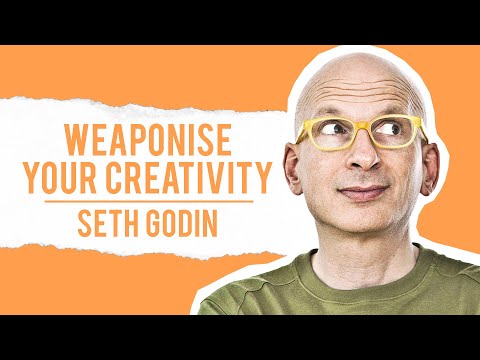
Seth Godin - The Practice Of Shipping Creative Work | Modern Wisdom Podcast 241
Seth Godin (guest), Chris Williamson (host), Narrator
In this episode of Modern Wisdom, featuring Seth Godin and Chris Williamson, Seth Godin - The Practice Of Shipping Creative Work | Modern Wisdom Podcast 241 explores seth Godin Explains How Consistent Practice Beats Perfection in Creativity Seth Godin joins Chris Williamson to unpack the core ideas behind his book *The Practice*, arguing that creative success comes from consistent, intentional work rather than inspiration or talent. He reframes imposter syndrome as evidence that you are doing meaningful, future-oriented work and urges creators to see it as a positive signal. Godin contrasts hack work with true art, emphasizes defining ‘good enough’ and audience upfront, and explains why process and shipping matter more than moods or perfectionism. Throughout, they explore criticism, media incentives, identity-based habits, and the leverage individuals have to improve their work and the culture around them.
Seth Godin Explains How Consistent Practice Beats Perfection in Creativity
Seth Godin joins Chris Williamson to unpack the core ideas behind his book *The Practice*, arguing that creative success comes from consistent, intentional work rather than inspiration or talent. He reframes imposter syndrome as evidence that you are doing meaningful, future-oriented work and urges creators to see it as a positive signal. Godin contrasts hack work with true art, emphasizes defining ‘good enough’ and audience upfront, and explains why process and shipping matter more than moods or perfectionism. Throughout, they explore criticism, media incentives, identity-based habits, and the leverage individuals have to improve their work and the culture around them.
Key Takeaways
Treat imposter syndrome as proof you’re stretching into meaningful work.
Feeling like a fraud arises precisely when you are inventing a future you’ve never created before; instead of fighting it, use it as a signal that you’re working on something that matters and living at the edge of your competence.
Get the full analysis with uListen
Build a creative practice that ships work regardless of mood.
Relying on inspiration, ‘the muse’, or perfect conditions keeps creativity outside your control; committing to a process (like daily blogging) removes decision fatigue, normalizes effort, and ensures learnings from real-world feedback.
Get the full analysis with uListen
Define ‘good enough’ and your audience in advance, then ship.
Deciding up front who it’s for, what it’s for, and what quality means prevents endless tinkering and perfectionism; once work meets your predetermined spec, extra polishing is waste instead of value.
Get the full analysis with uListen
Focus on throwing well (process), not lunging for every catch (outcome).
Like learning to juggle, most people obsess over last-second saves instead of mastering the fundamentals; investing in repeatable process and deliberate practice makes good outcomes (the catches) far more reliable.
Get the full analysis with uListen
Reject hack work if you want to make art.
A ‘hack’ gives the market exactly what it already wants at an average level; art, by contrast, aims to change people, offer something extraordinary (though not for everyone), and often requires turning away from lowest-common-denominator expectations.
Get the full analysis with uListen
Curate criticism: not all feedback deserves your attention.
You should care about critique only from the audience you seek to serve; a one-star review usually just means the wrong person encountered your work, so protecting your process may mean turning off comments or ignoring mass reviews.
Get the full analysis with uListen
Use actions to shape identity: you become what you repeatedly do.
Rather than waiting to feel like a ‘real’ writer, runner, or honest person, act as one for long enough (e. ...
Get the full analysis with uListen
Notable Quotes
“Not only can't you get rid of [imposter syndrome], you shouldn't want to, because it's the sign that you're healthy.”
— Seth Godin
“Our work is about throwing. The catching takes care of itself.”
— Seth Godin
“Process saves us from the poverty of our intentions.”
— Elizabeth King (quoted by Chris Williamson and Seth Godin)
“Work that doesn't ship doesn't count.”
— Seth Godin
“Perfectionism and mediocrity are both the same thing: places to hide.”
— Seth Godin
Questions Answered in This Episode
How would my creative output change if I treated imposter syndrome as a positive signal instead of a problem to eliminate?
Seth Godin joins Chris Williamson to unpack the core ideas behind his book *The Practice*, arguing that creative success comes from consistent, intentional work rather than inspiration or talent. ...
Get the full analysis with uListen AI
What specific ‘good enough’ criteria and smallest viable audience could I define for my current project before I do more work on it?
Get the full analysis with uListen AI
Where am I acting like a hack—giving people what they already want—when I actually aspire to make art that changes people?
Get the full analysis with uListen AI
What daily or weekly practice could I commit to for 30 days that would start to reshape my identity as a creator?
Get the full analysis with uListen AI
Which sources of criticism genuinely help me serve my intended audience better, and which do I need to ignore or turn off entirely?
Get the full analysis with uListen AI
Transcript Preview
Imposter syndrome is the feeling of being a fraud, of being unprepared. Why did they pick me? Who am I to show up and do this? More and more people would come up to me and say, "How do I get rid of this?" And they're surprised at my answer, which is, "Not only can't you get rid of it, you shouldn't want to, because it's the sign that you're healthy. It's a sign that you're doing good work." Because if you're trying to invent the future, of course you're an imposter, because you haven't seen the future yet. It's not here. You are acting as if. You're putting something into the world that you cannot be as qualified to be as someone who's a street sweeper, 'cause the street sweeper swept that street yesterday. They know they can do it. There's no imposter going on at all. But if you're imagining that people are gonna be moved or changed or influenced by what you're about to do but you've never done it, you're an imposter. So when it shows up, the answer is, "Thank you. Thanks for letting me know I'm onto something. Here I am, doing this work and feeling it." The same way, you run a marathon, you better get tired, 'cause if you don't get tired, you're not trying hard enough.
(wind blowing) What is The Practice?
Well, there are only two kinds of successful people in the world. Um, what they have in common is that they've solved interesting problems, that they've shown up and made something better, that they did something original, something important. Maybe they did it by waiting for the muse to touch them, by getting picked, by somehow getting permission. But more likely, in my experience of talking to lots of people from every line of work, is that they have a practice, that they show up on the regular, that they have a way to see forward to produce this work even when they don't feel like it, especially when they don't. And so I wrote a book about this process of shipping creative work, and it counters so many of the myths that people have about, what does it mean to even be creative? What does it mean to do this work you're proud of?
What are the biggest misconceptions or the things that most people get wrong about creativity?
Well, they think that you need to be in the mood, that it happens when you find flow, that, uh, all criticism is the same, that writer's block is real, that the muse, uh, can be summoned. A whole bunch of things that put it outside of you, that turn it into some sort of gift or talent. No one talks that way about plumbing. No one talks that way about most of the things in our life. Why do we talk that way about this important thing? And it's 'cause we're afraid.
Yeah. Uh, I recently had your friend, Steven Pressfield, on the show, and I see a lot of parallels between The Practice and The War of Art and Turning Pro. Is that, w- were you influenced by him when writing this book?
Install uListen to search the full transcript and get AI-powered insights
Get Full TranscriptGet more from every podcast
AI summaries, searchable transcripts, and fact-checking. Free forever.
Add to Chrome