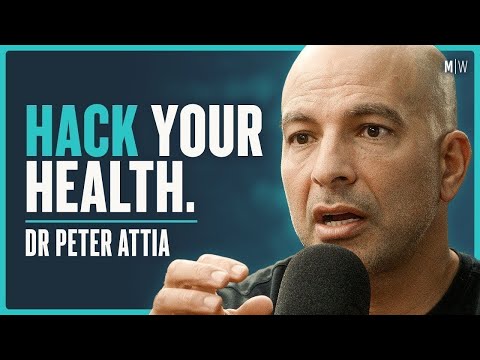
How To Improve Sleep Quality, Muscle Growth & Daily Mood - Dr Peter Attia (4K)
Chris Williamson (host), Dr Peter Attia (guest)
In this episode of Modern Wisdom, featuring Chris Williamson and Dr Peter Attia, How To Improve Sleep Quality, Muscle Growth & Daily Mood - Dr Peter Attia (4K) explores peter Attia on sleep, strength, emotions, and fixing modern health Peter Attia joins Chris Williamson to dissect why American healthcare is both world‑class and financially disastrous, contrasting acute, expensive "Medicine 2.0" with underused, preventative "Medicine 3.0". He details practical levers for better cognition, sleep, and long‑term brain health, emphasizing exercise, metabolic health, and deliberate deep-work routines over exotic drugs and gadgets. Attia then pivots into emotional health, describing intensive therapy, rewiring brutal self-talk, and how purpose, relationships, and distress tolerance define real happiness more than biomarkers do. The conversation closes with applied longevity: sane views on TRT, supplements, sleep protocols, gut health, processed food, and what it really means to age well as a man without becoming obsessive or nihilistic.
Peter Attia on sleep, strength, emotions, and fixing modern health
Peter Attia joins Chris Williamson to dissect why American healthcare is both world‑class and financially disastrous, contrasting acute, expensive "Medicine 2.0" with underused, preventative "Medicine 3.0". He details practical levers for better cognition, sleep, and long‑term brain health, emphasizing exercise, metabolic health, and deliberate deep-work routines over exotic drugs and gadgets. Attia then pivots into emotional health, describing intensive therapy, rewiring brutal self-talk, and how purpose, relationships, and distress tolerance define real happiness more than biomarkers do. The conversation closes with applied longevity: sane views on TRT, supplements, sleep protocols, gut health, processed food, and what it really means to age well as a man without becoming obsessive or nihilistic.
Key Takeaways
Preventative medicine doesn’t fit current healthcare economics, so you must self‑advocate.
Attia argues U. ...
Get the full analysis with uListen
Sleep, exercise, and nutrition are the primary drivers of cognitive performance.
He ranks sleep as the top lever for attention and clarity, with exercise second due to its metabolic, vascular, and BDNF benefits, and nutrition third—especially controlling big carbohydrate spikes that cause energy crashes. ...
Get the full analysis with uListen
Design your environment for deep work: remove notifications and time‑block mornings.
Attia keeps only phone call alerts on, schedules 2+ hour uninterrupted morning blocks, and decides in advance what gets done then. ...
Get the full analysis with uListen
Exercise is the single most powerful tool against cognitive decline and vascular dementia.
He emphasizes cardiorespiratory fitness (heavy dose of zone 2 plus some VO2 max), strength, and blood‑pressure control as the best‑supported ways to reduce dementia risk. ...
Get the full analysis with uListen
Brutal self‑talk can be rewired with deliberate, repeated behavioral practice.
To dismantle a 40‑year habit of vicious inner criticism, Attia recorded voice notes rephrasing each self‑attack as what he’d say to a friend in the same situation. ...
Get the full analysis with uListen
Testosterone therapy has narrow, specific use cases and real trade‑offs.
Within physiologic doses and appropriate ages, TRT doesn’t appear to raise prostate‑cancer or ASCVD risk, but supraphysiologic doses, fertility loss, erythrocytosis, and adjunct drugs (finasteride, aromatase inhibitors) add uncertain dangers. ...
Get the full analysis with uListen
Emotional health and relationships are as central to longevity as muscles and lab values.
Attia frames happiness as alignment with purpose, quality relationships, achievement, self‑regulation, and distress tolerance—not just pleasant feelings. ...
Get the full analysis with uListen
Notable Quotes
“Longevity itself and healthspan in particular doesn't really fit into the business model of our current healthcare system.”
— Peter Attia
“You never have the counterfactual for sleep. You don't know how much better that three‑hour‑a‑night person would perform if they slept eight.”
— Peter Attia
“If you have every single thing imaginable but you have no connection to other people, what do you have?”
— Peter Attia
“It is, in my life, the single greatest example of neuroplasticity that I have ever witnessed.”
— Peter Attia, on changing his inner self‑talk
“I really care what you can do when you're 90, not when you're 40.”
— Peter Attia
Questions Answered in This Episode
How should an average 30‑year‑old prioritize testing and interventions if they want to practice "Medicine 3.0" without unlimited money?
Peter Attia joins Chris Williamson to dissect why American healthcare is both world‑class and financially disastrous, contrasting acute, expensive "Medicine 2. ...
Get the full analysis with uListen AI
What concrete markers (labs, fitness tests, emotional metrics) best indicate that your current lifestyle will translate into a high‑quality final decade of life?
Get the full analysis with uListen AI
How can someone distinguish between healthy ambition and a perfectionism‑driven inner critic that’s actually sabotaging their well‑being?
Get the full analysis with uListen AI
Given the uncertain long‑term risks, in what specific scenarios would you consider TRT or Clomid truly justified for men under 35?
Get the full analysis with uListen AI
What would an ideal weekly "longevity routine" look like if you had to balance exercise, sleep, work, and emotional training for a busy knowledge worker?
Get the full analysis with uListen AI
Transcript Preview
What's this story about your son going to hospital and getting some insane medical charge for a tiny procedure?
Y- yeah, well it's- it's unfortunately a very common story, right, where anybody goes to the ER and, you know, they end up needing a bag of IV fluids or something like that, and then they- they get a bill for thousands of dollars. And you actually look through the line item and you realize this is comical, right? You literally charged me $1,400 for a bag of normal saline that costs, I don't know, somewhere between $2 and $3. Um, but it sort of speaks to a lot of the breaks in the, uh, specifically in the American healthcare system.
What is it... Why is it so broken? What... Is it because it's a commercial enterprise? Is it because it needs to be, uh... additional funds need to be brought in from places where they shouldn't? What's going on?
It has to do with the complexity of a multi-payer system, and basically the way contracts are negotiated between payers and hospitals. And you have to decide in those negotiations who is in network and who is out of network. Um, that's, like, one sliver of one problem. Uh, this- this exists on- on so many levels. Um, but in- in that case, I think the issue came down to, you know, some very high deductible that wasn't met coupled with, you know, some out of network thing. But the- the truth of it is, there's also ridiculous pricing. So- so there's a... sort of a false sense of how much things cost in hospitals. It's sort of funny money. Like, "We're gonna really, really mark up the price so that we can give you a big discount if you're in network."
Right.
Y- y- you know, so you- you see this across the board with all sorts of things in medicine.
And to rehydrate your son, it costs, like, six grand or something.
I can't remember the dollar amount. It was so egregious. Um, and again, I... It- it's infuriating to me when you keep in- in- in mind the fact that, you know, probably the average American would have a hard time on short notice producing $1,000. And yeah, I'm fortunate enough that I can produce $1,000 without, uh, too much difficulty. But for the average person, maybe 50% of the population, that's a really big deal and that's a huge inconvenience, right? That means... that changes your plans-
Yeah.
... dramatically. It means you're not taking a vacation that summer. It means you're not, you know, not able to go out with your family for a movie night.
How long are you paying off that-
Yeah, exactly, exactly.
... credit card debt for, et cetera.
And it totally... It's totally inexcusable.
I went to a ghost tour in New Orleans five years ago, and the guy that was taking the tour finished up afterward, and I was asking him about the American healthcare system, and he said this thing, it's really stuck with me. He said, "If you get hit by a car, you'd better walk it off." His point being that there are medical emergencies that can happen that can ruin your life by you having to fix them, not by you not fixing them.
Install uListen to search the full transcript and get AI-powered insights
Get Full TranscriptGet more from every podcast
AI summaries, searchable transcripts, and fact-checking. Free forever.
Add to Chrome