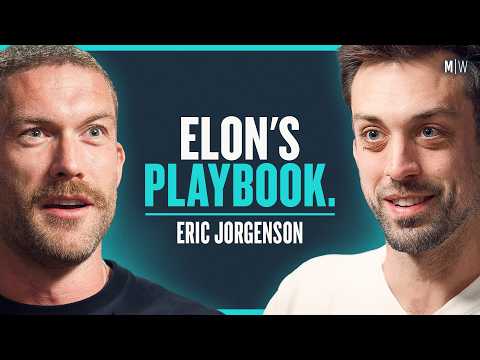
How Elon Achieves the Impossible - Eric Jorgenson
Chris Williamson (host), Eric Jorgenson (guest)
In this episode of Modern Wisdom, featuring Chris Williamson and Eric Jorgenson, How Elon Achieves the Impossible - Eric Jorgenson explores eric Jorgenson distills Elon Musk’s methods: purpose, urgency, first principles. Jorgenson argues Musk’s outlier output comes from compounding a few interacting traits—purpose, risk tolerance, first-principles thinking, and relentless urgency—rather than any single tactic.
Eric Jorgenson distills Elon Musk’s methods: purpose, urgency, first principles.
Jorgenson argues Musk’s outlier output comes from compounding a few interacting traits—purpose, risk tolerance, first-principles thinking, and relentless urgency—rather than any single tactic.
They explore Musk’s management style: attacking bottlenecks, setting 50/50 deadlines, physically going to problems, and creating “surges” to increase pace, along with the burnout and churn this can cause.
SpaceX is framed as initially philanthropic (Mars Oasis) and later a cost-reduction crusade aimed at making life multi-planetary and opening a future space economy via reusable launch and Starship.
Tesla is presented as stacked S-curves—EVs, autonomy, batteries/grid storage, and humanoid robots—backed by vertical integration and aggressive cost-down decisions.
Jorgenson explains his “usefulness-first” book method: distilling millions of words into a dialogue-style, reader-applicable set of principles, while avoiding partisan/personal projection about Musk.
Key Takeaways
Purpose sustains extreme effort when incentives and odds don’t.
Jorgenson’s core claim is that Musk’s missions (multi-planetary life, electrification, autonomy) make otherwise irrational risk and workload feel mandatory, enabling persistence through repeated near-failures.
Get the full analysis with uListen
Combine urgency + first principles + correct bottleneck focus for nonlinear gains.
The “two orders of magnitude” effect comes from stacking behaviors: work on the limiting factor, do it immediately, and rethink constraints from physics/economics rather than tradition.
Get the full analysis with uListen
Set deadlines to create learning and breakthroughs, not to preserve comfort.
Musk reportedly targets schedules with ~50% success probability, preferring misses over conservative planning because aggressive targets force invention and reveal true constraints faster.
Get the full analysis with uListen
Don’t insulate decision-makers from downstream pain.
Keeping designers/engineers close to manufacturing (and leaders close to failures) tightens feedback loops, reduces waste, and prevents elegant but impractical solutions from surviving.
Get the full analysis with uListen
Cost reduction is often an organizational detective story, not a technical miracle.
The “Idiot Index” (price vs. ...
Get the full analysis with uListen
Parallelization can compress timelines when tasks have long gestation periods.
While some work is serial, Musk-style parallel “planting seeds” (product, integrations, regulatory) can shrink total time-to-launch—at the expense of chaos and management load.
Get the full analysis with uListen
Extreme operators are informative but not always imitable.
Both hosts emphasize Musk as a “99. ...
Get the full analysis with uListen
Notable Quotes
““Failure is irrelevant unless it’s catastrophic.””
— Elon Musk (quoted by Eric Jorgenson)
““If we don’t make stuff, there is no stuff.””
— Elon Musk (quoted by Eric Jorgenson)
““I set a deadline that I think we have a 50/50 chance of making.””
— Elon Musk (paraphrased/quoted by Eric Jorgenson)
““Do not separate yourself from the pain of your decisions.””
— Elon Musk (quoted by Eric Jorgenson)
““It is a huge weakness to want to be liked and I do not have it.””
— Elon Musk (quoted by Eric Jorgenson)
Questions Answered in This Episode
What are the clearest examples where Musk’s “purpose” (not tactics) directly changed a major decision at Tesla or SpaceX?
Jorgenson argues Musk’s outlier output comes from compounding a few interacting traits—purpose, risk tolerance, first-principles thinking, and relentless urgency—rather than any single tactic.
Get the full analysis with uListen AI
Jorgenson says Musk sometimes creates urgency even without an objective emergency—how do you distinguish productive “pace-setting” from wasteful chaos?
They explore Musk’s management style: attacking bottlenecks, setting 50/50 deadlines, physically going to problems, and creating “surges” to increase pace, along with the burnout and churn this can cause.
Get the full analysis with uListen AI
The 50/50 deadline philosophy seems to normalize misses; where is the line between ambitious scheduling and corrosive credibility loss?
SpaceX is framed as initially philanthropic (Mars Oasis) and later a cost-reduction crusade aimed at making life multi-planetary and opening a future space economy via reusable launch and Starship.
Get the full analysis with uListen AI
How exactly would a reader apply the “Idiot Index” in a non-manufacturing job (software, services, content, healthcare) without forcing bad analogies?
Tesla is presented as stacked S-curves—EVs, autonomy, batteries/grid storage, and humanoid robots—backed by vertical integration and aggressive cost-down decisions.
Get the full analysis with uListen AI
SpaceX began as “Mars Oasis” philanthropy—what were the pivotal technical or market insights that converted it into a reusable-launch monopoly?
Jorgenson explains his “usefulness-first” book method: distilling millions of words into a dialogue-style, reader-applicable set of principles, while avoiding partisan/personal projection about Musk.
Get the full analysis with uListen AI
Transcript Preview
How many copies of The Navalmanac have you sold now?
It's tough to know, but I think we're coming up on 2 million.
How's that feel?
I'm still, uh, the word I like to use is gobsmacked. Like, I really thought I was doing fan service for a few thousand Naval nerds.
Mm.
And the fact that it's, like, 40 languages and millions of people and we've given away a few million more, right? Like, I don't even really know.
Oh, so that's how many were sold-
Sold
... 'cause it was available for free through the website.
Yeah, which is another, like, 5 million plus. Really hard to track.
I think it's my most suggested book. When people say, "Where should I start with personal development?" Essentialism by Greg McKeown or The Navalmanac.
That's incredible. And, and that's-- I mean, I had no idea how many people were gonna resonate with it and recommend it and, you know, I think the highest compliment a gift, uh, the highest compliment a book can receive is to be gifted.
Mm.
Um, and so much of what we read comes from what's recommended. Like, how often do you see an ad for a book and buy it? Like, almost never.
Yeah.
The bars are too high.
Yeah. And the subtitle of this new one is A Guide to Purpose and Success, about Elon. Why pick that? Why purpose specifically?
It was-- It's emergent. I mean, when I write these books, I start with millions and millions of words of source material, everything they've ever shared publicly, and I try to figure out, like, what is the essence of the person? What is the thing that is most special about them that anybody can learn from? And we all know that Elon is, like, massively productive. I feel like the question everybody's asking is kind of like, "How the hell did this happen?" Like, how does he get so much done?
Mm.
But what I didn't realize until way into the process was that purpose was the other pillar. So I knew I wanted to know, like, how does he win, but I didn't know to the extent that purpose was a big part of why he wins, and that is actually, he has some really incredible answers for what do I do? What's important? How do I choose what's important?
Mm. Yeah, I think everyone looks and just assumes tactics, raw tactics.
Yeah.
But if there's something bigger driving that. Uh, Thiel says about Elon, "He seems to know something that, the, about risk that the rest of us do not." What do you think that thing is?
Yeah. I mean, I think Elon is risk on. Like, he takes risks that he shouldn't take. He's inherently biased towards risk. But the number of times that that pays off, I think reveals and puts in Thiel's context, like, Thiel is a risk manager, and Elon is a risk taker. And when you combine that with purpose, the fact that, like, Elon is on these missions, he's trying to accomplish something, and he almost doesn't care how much risk it takes. He'll just keep taking chances and keep taking chances until he breaks through. And he's got this amazing quote, um, "Failure is irrelevant unless it's catastrophic."
Install uListen to search the full transcript and get AI-powered insights
Get Full TranscriptGet more from every podcast
AI summaries, searchable transcripts, and fact-checking. Free forever.
Add to Chrome