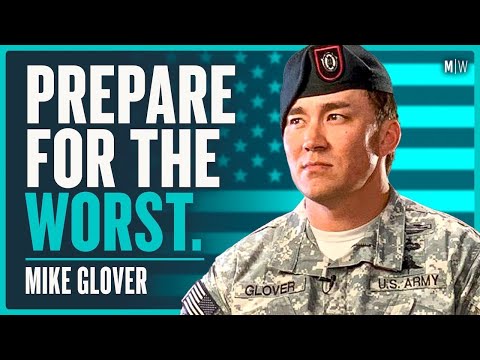
Green Beret Teaches You How to Survive Any Situation - Mike Glover
Mike Glover (guest), Chris Williamson (host), Narrator
In this episode of Modern Wisdom, featuring Mike Glover and Chris Williamson, Green Beret Teaches You How to Survive Any Situation - Mike Glover explores green Beret Mike Glover Explains Real-World Preparedness, Not Doomsday Prepping Mike Glover, former Green Beret and CIA contractor, argues that modern society has outsourced too much responsibility to institutions, leaving individuals fragile and unprepared for likely emergencies. Rather than focusing on doomsday scenarios, he emphasizes statistics-driven preparedness for everyday risks like car accidents, mental health crises, overdoses, and home incidents.
Green Beret Mike Glover Explains Real-World Preparedness, Not Doomsday Prepping
Mike Glover, former Green Beret and CIA contractor, argues that modern society has outsourced too much responsibility to institutions, leaving individuals fragile and unprepared for likely emergencies. Rather than focusing on doomsday scenarios, he emphasizes statistics-driven preparedness for everyday risks like car accidents, mental health crises, overdoses, and home incidents.
He explains how self-reliance threatens centralized systems, why governments may fear highly competent civilians, and how media skews our sense of risk by overemphasizing terrorism and mass shootings while underplaying vehicle deaths, fentanyl overdoses, and suicide.
Glover outlines practical steps for building resilience: improving situational awareness, hard skills (first aid, defensive driving, weapons handling), and mindset (stress inoculation, understanding freeze response, decision criteria for force).
The conversation also covers legal and moral complexities of self-defense, the cultural allure of ‘vigilante’ heroism, and how subtle behaviors, posture, and environmental awareness can deter threats and keep families safe.
Key Takeaways
Prepare for probabilities, not cinematic worst-case fantasies.
Glover stresses that you’re far more likely to face car crashes, medical emergencies, or supply disruptions than terrorism or a ‘zombie apocalypse,’ so your training and gear should be built around those statistical realities.
Get the full analysis with uListen
Basic medical and vehicle preparedness can literally be life-or-death.
Keeping a proper trauma kit, a quality tourniquet, burn treatments, blankets, and knowing defensive driving techniques can prevent deaths from bleeding out, exposure, or avoidable crashes long before first responders arrive.
Get the full analysis with uListen
Situational awareness and demeanor are more important than gear.
Head-up observation, reading anomalies in crowds, and projecting confident, organized posture deter opportunistic criminals and buy you critical reaction time; most people are dangerously distracted by phones and comfort.
Get the full analysis with uListen
Resilience requires stress inoculation, not just technical skills.
People who shoot well on a flat range often panic or overreact in force-on-force scenarios; training must include decision-making under pressure (when to shoot, when not to) and understanding fight–flight–freeze and dissociation.
Get the full analysis with uListen
Self-reliance can put you at odds with centralized systems.
When citizens reclaim competence in security, health, and education, they reduce dependence on institutions, which Glover argues can make them targets of political or bureaucratic suspicion, as he experienced with his group being flagged as ‘extremist-capable’.
Get the full analysis with uListen
Home defense starts with barriers and early warning, not gunfights.
Layered physical security (doors, locks, bushes, alarms), technical systems (cameras, sensors), and even dogs are meant to prevent or delay intrusion so you can avoid direct confrontation or set a defensive position with your family secured.
Get the full analysis with uListen
Using lethal force is legally, morally, and psychologically costly.
Glover highlights recent cases where seemingly justified shooters were imprisoned, cautioning against any romantic desire for a ‘kinetic incident’ and emphasizing avoidance, de-escalation, and a clear personal threshold for deadly force.
Get the full analysis with uListen
Notable Quotes
“A $29 piece of equipment and a little bit of training that you could literally get from YouTube could save your life. Why would you not pay attention to that?”
— Mike Glover
“We advocate for self-reliance, and taking back that reliance in your life that you normally outsource to institutions… because the efficiency and the optimization that you bought into isn’t necessarily beneficial nowadays.”
— Mike Glover
“A benefit, a proxy benefit of freedom is convenience. The problem with convenience is sometimes it gets so convenient, you’re complacent, and that complacency leads to risk.”
— Mike Glover
“Everybody wants to focus on the nuance of shooting the gun into the paper… but those endorphins have nothing to do with the actual events that are gonna take place suppressed under stress.”
— Mike Glover
“The best way to be on the up and up, to be a protector and a defender, is avoid conflict in the first place.”
— Mike Glover
Questions Answered in This Episode
How can an average person build a simple, statistically grounded preparedness plan for their specific city or environment?
Mike Glover, former Green Beret and CIA contractor, argues that modern society has outsourced too much responsibility to institutions, leaving individuals fragile and unprepared for likely emergencies. ...
Get the full analysis with uListen AI
What are the first three hard skills (beyond buying gear) you would recommend someone learn to meaningfully increase their family’s resilience?
He explains how self-reliance threatens centralized systems, why governments may fear highly competent civilians, and how media skews our sense of risk by overemphasizing terrorism and mass shootings while underplaying vehicle deaths, fentanyl overdoses, and suicide.
Get the full analysis with uListen AI
Where is the line between healthy self-reliance and the kind of behavior that might attract unwelcome attention from authorities or be mischaracterized as ‘extremism’?
Glover outlines practical steps for building resilience: improving situational awareness, hard skills (first aid, defensive driving, weapons handling), and mindset (stress inoculation, understanding freeze response, decision criteria for force).
Get the full analysis with uListen AI
How should a responsible gun owner practically work out—and rehearse—their personal criteria for when they would and would not use deadly force?
The conversation also covers legal and moral complexities of self-defense, the cultural allure of ‘vigilante’ heroism, and how subtle behaviors, posture, and environmental awareness can deter threats and keep families safe.
Get the full analysis with uListen AI
Given the legal uncertainty in self-defense cases, how should people balance the benefits of carrying weapons with the potential long-term consequences of using them?
Get the full analysis with uListen AI
Transcript Preview
Imagine you're in a situation where you have a compromised femoral artery, you're bleeding out, and you're waiting for the first responder who has an average response time of 12 minutes in most areas in the country, and you bleed out in three. A $29 piece of equipment and a little bit of training that you could literally get from YouTube could save your life? Why would you not pay attention to that? (whoosh)
What's your background? Why should anyone listen to you about how to be prepared for anything?
Yeah. I- I- I think, mostly my background is in the military and the CIA. That's what kind of I'm- I'm- I'm known for, but I don't think that's why I am the expert at preparedness. I think, kind of as a leader and as somebody who's managed a lot of people in the military, uh, I know how to connect people who are assets, subject matter experts, with people who are trying to get information to make themselves better. So, that's kinda how I came to the inclusion that, um, civilians needed preparedness in their life. So, nothing complex. I think my field of experience is very narrow, very specific, and- and its totality has a lot to do with preparedness, but not specifically. You need experts in all the fields, which I am not an expert in. I'm just a collaborator. I'm the conduit between experts and you and people.
I call it podcast smarts.
Hmm.
So, it's the ki- it's the level of knowledge that I've got on most topics. Like, I don't actually know it inside out.
(laughs)
I know it enough to be able to have a podcast about it and to hold a conversation. But if you want to go out and do it, if you want- if you wanna go build a bridge, you can't speak to me... I can have a conversation with you-
(laughs)
... about a bridge builder I once spoke to. But, like, you need to find the man that builds the bridges and then you can speak to him about how to build a bridge. So yeah, I think, um, podcast smarts or preparedness smarts perhaps is- is a good, uh, a good way to look at it. One- one of the questions I had, I actually asked, um, Shawn Ryan this and Andy Stumpf. Why do you think it is that members of the CIA, uh, people who are working for the CIA, are seen in such a different light to people who are in the Special Forces? Especially given that there is quite a regular conveyor belt of Special Forces to CIA. Um, it just seems to me that there's a branding or a marketing problem with regards to how the operatives working in three-letter agencies are perceived by the wider public.
Yeah. I think it's a lot to do with the idea of cloak and dagger and, you know, operating with certain privileges and all the things behind the curtain. You know, I- I had an idea until I started working with the CIA and I'm like, "Oh, they're j- just like me," you know? Super intelligent, highly capable human beings with endless budgets. But I- I think a lot of the perception is based in the, uh, I don't know, I- I think it's based in fantasy, it's based in Hollywood, um, it's based in books that I grew up reading on the Office of Strategic Services and the CIA. And so, I- I think that's a good thing, uh, partly for the culture. Um, but I have seen it be the bad thing in- in many instances because, you know, I've- I've rolled with case officers who thought they were Jason Bourne, and I'm like, "No, no, no, no. You're not Jason Bourne. You're capable. You're a case officer. You're intelligent. But you're not Jason Bourne. That doesn't exist." And so, I- I think that helps with recruitment. It's like kind of like the BUD/S program for the Navy. It's a genius marketing tactic. Why? Because everybody wants to be a SEAL, and then when you go in and the Navy knows 99% of everybody who comes in is gonna wash out, well then, you have the needs of the Navy. You get to fill the ranks and fill the positions that nobody else wants to do, um, with a very smart and sound marketing tactic. Um, so I think part of that is- is the reason why I wanted to be in the CIA. Um, but I think that's for a reason, specific reason.
Install uListen to search the full transcript and get AI-powered insights
Get Full TranscriptGet more from every podcast
AI summaries, searchable transcripts, and fact-checking. Free forever.
Add to Chrome