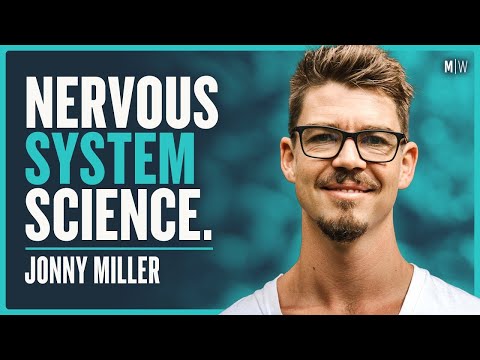
How To Stop Living Life In Your Head - Jonny Miller
Chris Williamson (host), Jonny Miller (guest)
In this episode of Modern Wisdom, featuring Chris Williamson and Jonny Miller, How To Stop Living Life In Your Head - Jonny Miller explores unlocking Emotional Intelligence: Nervous System Skills For High-Agency Living Chris Williamson and Jonny Miller explore why so many people, especially high-achieving, cerebral types, live disconnected from their emotions and bodies. They frame emotional numbness and reactivity as nervous system issues rooted in safety, capacity, and unprocessed stress rather than simple mindset problems.
Unlocking Emotional Intelligence: Nervous System Skills For High-Agency Living
Chris Williamson and Jonny Miller explore why so many people, especially high-achieving, cerebral types, live disconnected from their emotions and bodies. They frame emotional numbness and reactivity as nervous system issues rooted in safety, capacity, and unprocessed stress rather than simple mindset problems.
Jonny outlines three core skills—interoception, self‑regulation, and emotional fluidity—plus environment design as the foundations for becoming a high‑agency human who can act intentionally instead of reacting from anxiety, shutdown, or old wounds.
They contrast ‘grit and grind’ approaches (Goggins/Jocko style) and over‑intellectualized mindfulness with somatic practices like breathwork, humming, and NSDR that resolve emotional “debt” instead of just suppressing it.
Jonny’s story of losing his fiancée to suicide and processing intense grief illustrates how fully feeling emotions can increase capacity, soften inner criticism, and make life feel richer and more meaningful.
Key Takeaways
Interoception is the foundation of emotional work and high agency.
You can’t regulate or skillfully feel what you can’t detect. ...
Get the full analysis with uListen
Self‑regulation should downshift your system, not just suppress emotions.
Bottom‑up tools like 4‑4‑8 breathing, humming, belly breathing against resistance, and NSDR calm the nervous system in the moment. ...
Get the full analysis with uListen
Unfelt emotions accumulate as “emotional debt” and allostatic load.
Relying solely on willpower, grind, or constant self‑regulation adds wear and tear to the body and nervous system. ...
Get the full analysis with uListen
Emotional fluidity means welcoming the full spectrum, not just ‘positive’ states.
Many people only allow a narrow band of feelings and see others (especially anger, grief, or even joy) as unsafe. ...
Get the full analysis with uListen
Breathwork can create trait‑level change if you stay present and rest afterward.
Conscious connected breathing and similar modalities mildly activate the system so old emotions can surface in a safe container. ...
Get the full analysis with uListen
Mindfulness and self‑improvement can become advanced avoidance strategies.
Simply noting and releasing emotions, or optimizing relaxation tools, can function like any other ‘prophylactic’ between you and your feelings. ...
Get the full analysis with uListen
Your inner critic often quiets when the body’s stored tension is resolved.
Jonny noticed that as he processed grief, anger, and somatic tension, his once‑harsh inner voice softened into a more collaborative, idea‑generating mind. ...
Get the full analysis with uListen
Notable Quotes
“I grew up numb from the neck down—I was really out of touch with so much of what was going on outside of my intellect.”
— Jonny Miller
“You can have all of the intentionality and agency in the world, but your emotional governor will still step in and limit what you can actually do.”
— Chris Williamson
“It’s the resistance to feeling the thing that sucks. When that goes away, the actual emotion—grief, sadness, even anger—can feel like pure love or aliveness.”
— Jonny Miller
“Mindfulness or observing, allowing, and releasing can just become another way to not feel feelings. It helps with state, but not always with trait.”
— Chris Williamson
“What if nothing needed fixing? What if you were already safe right now—and growth was just what naturally unfolds when you stop getting in your own way?”
— Jonny Miller
Questions Answered in This Episode
Which emotions do I habitually allow myself to feel, and which do I consistently avoid or numb out from?
Chris Williamson and Jonny Miller explore why so many people, especially high-achieving, cerebral types, live disconnected from their emotions and bodies. ...
Get the full analysis with uListen AI
In what specific situations does my nervous system go into hyper‑arousal or shutdown, and what early bodily signals could I start tracking?
Jonny outlines three core skills—interoception, self‑regulation, and emotional fluidity—plus environment design as the foundations for becoming a high‑agency human who can act intentionally instead of reacting from anxiety, shutdown, or old wounds.
Get the full analysis with uListen AI
Am I using tools like meditation, breathwork, or productivity frameworks as ways to genuinely feel and process, or mainly as more elegant avoidance strategies?
They contrast ‘grit and grind’ approaches (Goggins/Jocko style) and over‑intellectualized mindfulness with somatic practices like breathwork, humming, and NSDR that resolve emotional “debt” instead of just suppressing it.
Get the full analysis with uListen AI
What long‑standing inner story or harsh self‑talk might actually be downstream of unresolved sensations in my body rather than a ‘true’ assessment of myself?
Jonny’s story of losing his fiancée to suicide and processing intense grief illustrates how fully feeling emotions can increase capacity, soften inner criticism, and make life feel richer and more meaningful.
Get the full analysis with uListen AI
If I stopped assuming that something in me is broken, how would that change the way I approach therapy, self‑help, or ‘working on myself’ over the next year?
Get the full analysis with uListen AI
Transcript Preview
Why is it so hard to feel feelings?
(laughs) Ah, jumping right in. Um, I mean, we both grew up in England and I think, you know, we're kind of known for having a stoic, keep calm, carry on, uh, mantra in- in our culture. And I think that, I- I- I mean speaking for myself, I grew up... What I realize now is I was, like, numb from the neck down. I- I was really out of touch with so much of what was going on outside of my intellect. And it's really been, you know, the last, like, five, five or six years that I've come back into appreciating this, like, um, the- the diff- like, flavors that are going on inside, inside my system. So, I mean, I'd also be curious if, like, for you, what- what has your journey with feeling emotions been like? Like, do you consider yourself as someone who, you know, we both went to, uh, Newcastle, Durham, like, up there, it's- it's not, it's not cool to kind of express emotions in public. What- what's your journey?
Yeah, standing on the front door of a nightclub isn't exactly a hotbed of talking about feeling feelings.
Right.
Um, and, yeah, there's a lot of expectation, I think, about being a young guy, um, that wants to be attractive and- and competent and have mastery and- and, you know, is sort of competing with other people, other guys, especially in an industry like nightlife. And, um, yeah, emotions are kind of a- a sign of weakness. Um, I got really disappointed with the "It's Okay To Talk" campaign that happened in the UK. I thought that that was just so ridiculous and telling guys, "It's okay to talk," like, what does that mean? What does it mean, "It's okay to talk"? They haven't got... Th- they don't know what they're feeling. I didn't know what I was, I don't know what I'm feeling much of the time. I, you know, I think I had a small, and probably still do, a small number of buckets of emotions that I kind of default to. It sort of snaps across into one of a bunch, so very competent at feeling anxiety, very competent at feeling worry, getting better at feeling excitement, but, you know, distinguishing, "Okay, so what are we talking about? Is this, is this, uh, restlessness? Is this resentment? Is it bitterness? Is it frustration? Is it anger? Is it..." You know, like really kind of breaking apart the component notes of emotions. There's just a few that I seem to snap to in terms of a default, uh, and one of the main reasons that I wanted to have this conversation with you in particular is, between the UK and the US, there is so much turmoil at the moment. Like, the- the entire world just feels like it's up in the air, changes in political party and you should care about this thing and climate change and all the rest of it, and so much of that is outside, but so much of that is impacting the way that we feel internally. And I think it's nice, I- I like believing that, you know, I'm a stoic ship in a storm and I'm not gonna move and it, you know, the world out there isn't gonna hurt me and all the rest of it. Mm-hmm.
Install uListen to search the full transcript and get AI-powered insights
Get Full TranscriptGet more from every podcast
AI summaries, searchable transcripts, and fact-checking. Free forever.
Add to Chrome