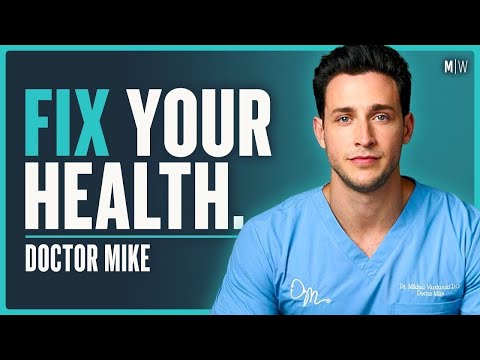
The Broken State Of The Modern Healthcare System - Doctor Mike
Chris Williamson (host), Doctor Mike (guest)
In this episode of Modern Wisdom, featuring Chris Williamson and Doctor Mike, The Broken State Of The Modern Healthcare System - Doctor Mike explores doctor Mike Exposes Profit-Driven Healthcare, Anxiety Myths, and Misinformation Doctor Mike and Chris Williamson explore the chaos of modern healthcare, from social-media-fueled misinformation to a profit-obsessed medical system that burns out clinicians and underserves patients.
Doctor Mike Exposes Profit-Driven Healthcare, Anxiety Myths, and Misinformation
Doctor Mike and Chris Williamson explore the chaos of modern healthcare, from social-media-fueled misinformation to a profit-obsessed medical system that burns out clinicians and underserves patients.
They dig into evidence-based treatment for anxiety and depression, the ADHD and SSRI debates, and how mental health, pain perception, and cognitive behavioral therapy interact.
The conversation also examines cosmetic and body-modification trends, microplastics and environmental toxins, and the transformative—yet inequitable—potential of new weight-loss drugs like GLP‑1 agonists.
Throughout, Doctor Mike argues for nuanced, transparent science communication, continuity of care over quick fixes, and resisting private equity’s habit of creating health problems and then selling the solutions.
Key Takeaways
Healthy skepticism is essential, but cynicism toward all experts is dangerous.
Social media and AI have taught people to question sources, yet blanket distrust of credentialed experts fuels conspiracy thinking and makes it harder to deliver accurate, life-saving guidance.
Get the full analysis with uListen
Best evidence for anxiety and depression favors tailored combinations of CBT and medication.
Validated scoring tools and patient conversations guide whether to use bibliotherapy, therapy alone, meds like SSRIs, or combinations—rather than reflexively prescribing or rejecting drugs.
Get the full analysis with uListen
Pain and physical symptoms are heavily influenced by mindset and mental health, not just anatomy.
Guarding movements, expecting pain, and poor emotional health can amplify pain perception; graded exposure, CBT principles, and addressing mood can reduce chronic pain without surgery.
Get the full analysis with uListen
The U.S. healthcare system’s profit and quota structure undermines quality care and clinician morale.
Private equity and productivity targets force short visits, excess paperwork, and tele/urgent-care expansion at the expense of continuity, making it harder to treat complex human problems humanely.
Get the full analysis with uListen
Cosmetic and medical tourism procedures carry serious, often under-communicated risks.
Surgeries like BBLs can cause fatal fat embolisms even in healthy people, and unregulated overseas or unlicensed practitioners increase infection, complication, and long-term harm risks.
Get the full analysis with uListen
GLP‑1 drugs may revolutionize obesity treatment but deepen inequality and stigma if access lags.
While they improve weight, cardiometabolic risk, and potentially healthcare costs, high prices and limited insurance coverage mean the same low-income groups targeted by junk food can’t get them—yet may be blamed for not using them.
Get the full analysis with uListen
Overconfident health influencers and bad messaging damage trust in science.
When experts or influencers state mechanisms as certainties, refuse to correct misinterpretations, or sensationalize findings (e. ...
Get the full analysis with uListen
Notable Quotes
“You can't say anything is all good or all bad. That's the first thing we teach in cognitive behavioral therapy.”
— Dr. Mike
“Doctors used to run hospitals. Now doctors have become laborers and the people in charge are financial folks thinking about profits.”
— Dr. Mike
“How many times is private equity gonna create a problem and then sell you the solution?”
— Dr. Mike
“Chasing perfection in health is not just an illusion that's impossible, it's a toxic illusion.”
— Dr. Mike
“When problem-solving itself begins to be owned by private equity, it becomes so weird.”
— Dr. Mike
Questions Answered in This Episode
How can an individual practically distinguish between credible medical information and seductive misinformation on social media?
Doctor Mike and Chris Williamson explore the chaos of modern healthcare, from social-media-fueled misinformation to a profit-obsessed medical system that burns out clinicians and underserves patients.
Get the full analysis with uListen AI
What concrete policy changes would most effectively reduce the influence of private equity and profit quotas in frontline healthcare delivery?
They dig into evidence-based treatment for anxiety and depression, the ADHD and SSRI debates, and how mental health, pain perception, and cognitive behavioral therapy interact.
Get the full analysis with uListen AI
How should clinicians talk to patients about the psychological component of chronic pain without making them feel dismissed or blamed?
The conversation also examines cosmetic and body-modification trends, microplastics and environmental toxins, and the transformative—yet inequitable—potential of new weight-loss drugs like GLP‑1 agonists.
Get the full analysis with uListen AI
As GLP‑1 drugs become more common, how should society rethink ideas of personal responsibility, body positivity, and what counts as a ‘choice’ in weight?
Throughout, Doctor Mike argues for nuanced, transparent science communication, continuity of care over quick fixes, and resisting private equity’s habit of creating health problems and then selling the solutions.
Get the full analysis with uListen AI
What ethical obligations do popular health influencers have to correct viral oversimplifications or misinterpretations of their content?
Get the full analysis with uListen AI
Transcript Preview
Dr. Mike, welcome to the show.
Excited to be here. Let's, uh, chat evidence-based medicine, my favorite. (laughs)
(laughs) It's having a resurgence at the moment. What's it like being on that side of the fence?
Well, you know, I feel like I was one of the early adopters doing this on social media, because when I was coming about during my residency training, it was mostly people doing it on television, and doing it quite poorly, might I add, in terms of confusing people or selling some miracle cures. So that's why I started social media medical conversations, and now it's just exploded into every different possible niche. Whatever you wanna find online, there's a confirmation bias waiting for you.
Well, that's the problem, this multiplicity and the democratization of access to health information sounds great in principle, but in practice, what it feels like to a muggle like me or everybody that's listening is just confusion and an abundance of conflicting messages.
Yeah, I think it's, uh, encouraged all of us to develop healthier skepticism, which I feel like before the age of social media, we might have been lacking. But now with the rise of AI, people don't right away see a video and assume it's real. In fact, they're more likely to say, "Is this real? Where is this from? Can I see the original video? Can I see the sources and description of where the evidence is coming from?" That stuff gets me excited.
One of the problems with that is when skepticism runs too far, and when even-
That's cynicism, my friend.
... credentialed experts, "No, no, they're part of big..." Insert your favorite evil organization of choice. Big ag, big pharma, big-
Sure.
... food, big earbuds, big whatever.
Yep. I think, uh, in that regard, there's negativity, if you wanna find it, everywhere. It's about understanding where that negativity lies and how it impacts people's messaging. So I think just broad stroking or broad brushing certain subjects in health care will always be an incorrect message. So you can't say anything is all good or all bad. You can't say humans are all good or all bad. In fact, that's the first thing we really teach when we institute cognitive behavioral therapy with patients that are struggling with anxiety and depression, because it's very easy to get into this cognitive distortion of labeling things as all good or all bad or, "This is a terrible catastrophe and it's gonna end everything for me. Just because I got this C in my class, it means I'm a failure," and labeling ourselves, when in reality, if we just have a little bit of a pause, go back and think a little bit rationally with less of our emotional mind, we can go a lot further. And that's not easier s- That's a lot easier said than done. That's why we need the help of, uh, some mental health specialists from time to time.
Install uListen to search the full transcript and get AI-powered insights
Get Full TranscriptGet more from every podcast
AI summaries, searchable transcripts, and fact-checking. Free forever.
Add to Chrome