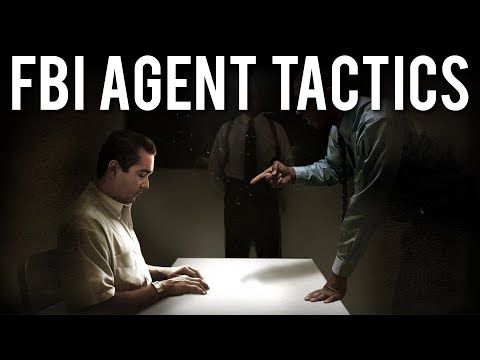
How To Read Behaviour Like An FBI Agent | Robin Dreeke
Chris Williamson (host), Robin Dreeke (guest)
In this episode of Modern Wisdom, featuring Chris Williamson and Robin Dreeke, How To Read Behaviour Like An FBI Agent | Robin Dreeke explores fBI Spy Hunter Reveals Science of Trust, Influence, and Deception Former FBI counterintelligence agent and head of the Behavioral Analysis Program, Robin Dreeke, explains how his 21-year career recruiting spies led him to develop a practical framework for building trust and reading behavior.
FBI Spy Hunter Reveals Science of Trust, Influence, and Deception
Former FBI counterintelligence agent and head of the Behavioral Analysis Program, Robin Dreeke, explains how his 21-year career recruiting spies led him to develop a practical framework for building trust and reading behavior.
He describes why traditional ‘type A’ dominance fails in high‑stakes human interactions and outlines a five‑step trust strategy grounded in understanding others’ priorities, context, and motivations.
The conversation contrasts long‑game relationship building with rapid information elicitation, emphasizes radical transparency and anti‑manipulation ethics, and shows how these skills translate directly into sales, leadership, and everyday relationships.
Dreeke also discusses limits of lie detection, the impact of technology on intelligence work, and why deep, in‑person human connection will always outperform purely digital engagement.
Key Takeaways
Make every interaction about the other person, not yourself.
Dreeke’s central rule is to focus on others’ needs, wants, dreams, and priorities; seek their thoughts and opinions; validate them non‑judgmentally; and give them choices. ...
Get the full analysis with uListen
Anchor every relationship in three end goals: relationship, transparency, and service.
Before any engagement, Dreeke orients to three non‑negotiables: build a healthy professional relationship, maintain open and honest communication, and be an available resource for others’ prosperity with no expectation of reciprocity. ...
Get the full analysis with uListen
People are predictable: they always act in what they believe is their best interest.
Instead of forcing outcomes, he profiles priorities (personal/professional, short/long term) and then aligns his resources with those priorities. ...
Get the full analysis with uListen
Don’t chase ‘tells’; use behavior to measure comfort vs. stress.
Even elite experts only hit ~50% accuracy detecting lies using nonverbals alone. ...
Get the full analysis with uListen
Ask clarifying questions and walk away from opaque agendas.
To avoid being manipulated, simply insist on clarity. ...
Get the full analysis with uListen
Inspire rather than convince by asking for their view of your ideas.
Instead of arguing or pushing opinions, he asks people what they think about his ideas. ...
Get the full analysis with uListen
Truth and transparency are operational advantages, not moral luxuries.
Dreeke avoids lying because deception destroys trust and creates cognitive load—undercover trainers even teach that you can only sustain so many lies. ...
Get the full analysis with uListen
Notable Quotes
“All I was ever doing was strategizing trust.”
— Robin Dreeke
“You don’t recruit a spy—you align with their best interests.”
— Robin Dreeke
“People will always act in their own best interests. My job is to figure out what they think those are.”
— Robin Dreeke
“I refuse to lie, because the moment you blow trust, just give up.”
— Robin Dreeke
“You don’t plant seeds with people by telling them what you think. You plant seeds by asking them what they think.”
— Robin Dreeke
Questions Answered in This Episode
How can an ordinary person practically apply Dreeke’s five‑step trust framework in everyday conversations with friends, colleagues, or partners?
Former FBI counterintelligence agent and head of the Behavioral Analysis Program, Robin Dreeke, explains how his 21-year career recruiting spies led him to develop a practical framework for building trust and reading behavior.
Get the full analysis with uListen AI
Where is the ethical line between ‘influence’ and ‘manipulation,’ and how can someone self‑monitor to avoid crossing it while still being effective?
He describes why traditional ‘type A’ dominance fails in high‑stakes human interactions and outlines a five‑step trust strategy grounded in understanding others’ priorities, context, and motivations.
Get the full analysis with uListen AI
Given the acknowledged limits of lie detection, how should we realistically use body language and behavioral cues in high‑stakes decisions (hiring, partnerships, security)?
The conversation contrasts long‑game relationship building with rapid information elicitation, emphasizes radical transparency and anti‑manipulation ethics, and shows how these skills translate directly into sales, leadership, and everyday relationships.
Get the full analysis with uListen AI
How might social media and virtual interactions be redesigned to better support the kind of deep validation and affiliation Dreeke says humans are wired for?
Dreeke also discusses limits of lie detection, the impact of technology on intelligence work, and why deep, in‑person human connection will always outperform purely digital engagement.
Get the full analysis with uListen AI
As AI, deepfakes, and VR ramp up, what new behavioral skills will people need to distinguish genuine human trust from manufactured or synthetic rapport?
Get the full analysis with uListen AI
Transcript Preview
(wind blowing) Hi, friends. Today my guest is Robin Dreek, and he is the ex-head of the FBI's Behavioral Science Division. Now that sounds like an incredibly secretive and exciting job to have, and it really is. Today's discussion takes us through Robin's 21-year in-field career, including when he was in Manhattan on 9/11. He was out for coffee with his friend as the first plane struck the North Tower, and then back on the 25th floor of his department when the second plane hit. Apart from that, we're also going to learn the verbal and non-verbal cues that both you can use to help encourage trust and make your communication with others more effective, and also to be able to detect deception in other people. Robin really is the real deal. Uh, i- it's evident that he has a very terrifying and wide-ranging skill set of personal and interpersonal communication. Um, I- I'm super happy to have him on. I- I'm not going to pontificate anymore. Please welcome Robin Dreek. Oh, yeah, P.S., uh, we did have some connection issues during this episode. Uh, I promise that any of the cuts I made weren't due to Robin giving away national secrets. (laughs) And also the irony of a podcast about communication being beset with communication problems is not lost. But there may be a couple of jumps here and there, so just bear that in mind. (upbeat music) So Robin, is this the moment where the FBI burst in through the door of my bedroom and tell me that we need to stop this interview?
(laughs)
Is that when this happens?
No, 'cause I duck and weave really well. (laughs)
(laughs) Yeah. And you're on the other side of the screen, so you're gonna be fine. Well, anyway, thank you very much for coming on. Welcome to Modern Wisdom. It's a pleasure to have you here.
Thanks, uh, thanks for having me. I'm excited about it as well.
It's gonna be a great, great conversation. So can you tell the listeners at home what your job roles were please?
Sure. Uh, so I'll kinda give you a chronology, um, from the beginning to the end without taking a million, uh, million, million, uh, minutes to do this-
Yeah.
... uh, just 'cause it's not boring. But i- it's good to frame the background of where I came from to where I arrived and where I'm still going to, and that is, so, uh, my background is I graduated from the United States Naval Academy here in Annapolis, Maryland, and from there went on to become a Marine Corps officer, and from there I joined the FBI. And I joined the FBI in 1997 and worked counterintelligence for my entire career. So I was assigned to the New York field office in Manhattan. From there I went to Norfolk, Virginia. From Norfolk, Virginia, I went into management, so I went up to, to the J. Edgar Hoover Building here in Washington, DC. Um, also during out my entire career I worked Russian, so that's kind of the, the nouveau thing these days, although for 21 years no one was listening to me. Um-
Install uListen to search the full transcript and get AI-powered insights
Get Full TranscriptGet more from every podcast
AI summaries, searchable transcripts, and fact-checking. Free forever.
Add to Chrome