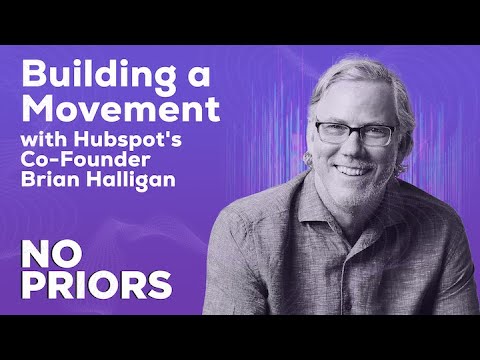
No Priors Ep. 36 | With Hubspot's Co-Founder Brian Halligan
Sarah Guo (host), Brian Halligan (guest)
In this episode of No Priors, featuring Sarah Guo and Brian Halligan, No Priors Ep. 36 | With Hubspot's Co-Founder Brian Halligan explores hubSpot’s Brian Halligan on Inbound, AI, Culture, and Climate Reinvention Brian Halligan recounts HubSpot’s evolution from a risky SMB marketing startup into a leading CRM platform that successfully challenged Salesforce by inventing and evangelizing inbound marketing. He explains key strategic “zigs” against conventional wisdom: focusing on SMBs, building a community-driven Inbound conference, launching a freemium CRM, and transforming from a single app into a multi-product platform.
HubSpot’s Brian Halligan on Inbound, AI, Culture, and Climate Reinvention
Brian Halligan recounts HubSpot’s evolution from a risky SMB marketing startup into a leading CRM platform that successfully challenged Salesforce by inventing and evangelizing inbound marketing. He explains key strategic “zigs” against conventional wisdom: focusing on SMBs, building a community-driven Inbound conference, launching a freemium CRM, and transforming from a single app into a multi-product platform.
Halligan details how HubSpot approached freemium and product-led growth, why thoughtful culture design became a core “second product,” and how leadership decisions like hiring a COO, getting coaching, and eventually transitioning to executive chairman enabled post-IPO growth. He also breaks down how AI is reshaping CRM and go-to-market workflows, and why incumbents may hold a rare advantage in this technological shift.
In the final chapter, he shares how a serious accident led him to step back from day-to-day operations and co-found Propeller Ventures, a climate-tech fund focused on ocean-based solutions, drawing a line from his mission-driven mindset at HubSpot to his new work in climate innovation.
Key Takeaways
Category creation around a clear enemy can be a powerful growth lever.
HubSpot successfully branded ‘inbound marketing’ in direct contrast to ‘outbound,’ rallying a community, anchoring its positioning, and reinforcing it through content, a book, and the Inbound conference—though Halligan emphasizes it was a ton of sustained work and hard to replicate.
Get the full analysis with uListen
Zig where others zag: contrarian bets on SMBs and freemium can pay off.
Despite investor skepticism, HubSpot focused on SMB/scale-ups and later launched an easy-to-use, freemium CRM instead of chasing enterprise buyers; these decisions differentiated the company and opened a larger long-term opportunity against entrenched players.
Get the full analysis with uListen
Freemium and PLG pivots require structural separation and long patience.
To build its sales product and PLG motion eight years in, HubSpot isolated a team, leadership, and even systems, accepted a multi-year runway to viability, and only later reintegrated it—treating it as a distinct startup rather than a small feature.
Get the full analysis with uListen
Deliberate culture design functions like a second product for talent.
Initially dismissive of culture, Halligan and Shah eventually treated it as a ‘product’—articulated in a living culture deck, measured with employee NPS, and managed transparently—making it a magnet for hiring and retention and a way to scale decision-making.
Get the full analysis with uListen
Post-IPO success depends on mindset and information design, not the ticker.
HubSpot intentionally framed the IPO as a starting line, made every employee an “officer” with equal information access and trading windows, and kept strategic focus on becoming a CRM platform—minimizing the cultural shock that often stunts public tech companies.
Get the full analysis with uListen
AI will reward depth, quality, and proprietary data over sheer content volume.
Halligan argues AI systems will mirror Google in valuing authority signals, so low-quality auto-generated content will underperform; companies must create truly high-quality material and distinct experiences (including gated or product experiences) that justify a direct visit.
Get the full analysis with uListen
Founders benefit from self-awareness: augment yourself, then consider stepping aside.
Prompted by missed quarters and later a life-threatening accident, Halligan hired a COO, worked with an executive coach, and ultimately moved to the chairman role—arguing many CEOs should more honestly assess their strengths across stages and not cling to the top job.
Get the full analysis with uListen
Notable Quotes
“Culture is how you scale your company. Culture is how people make decisions when you’re not in the room.”
— Brian Halligan (quoting Colin Angle of iRobot, then adopting it)
“We wanted to build a West Coast company on the East Coast.”
— Brian Halligan
“We have two products. One is what we sell to customers, and the second is our culture.”
— Brian Halligan
“I’m a big believer in zigging when everyone else is zagging.”
— Brian Halligan
“This is a big shift that’s incredibly relevant to CRM... this wasn’t something we could half-measure in.”
— Brian Halligan, on AI
Questions Answered in This Episode
If you were starting HubSpot today in an AI-native world, what would you build first and what would you avoid?
Brian Halligan recounts HubSpot’s evolution from a risky SMB marketing startup into a leading CRM platform that successfully challenged Salesforce by inventing and evangelizing inbound marketing. ...
Get the full analysis with uListen AI
Where do you think the limits of product-led growth are in complex B2B sales, and when do you still need heavy human sales motions?
Halligan details how HubSpot approached freemium and product-led growth, why thoughtful culture design became a core “second product,” and how leadership decisions like hiring a COO, getting coaching, and eventually transitioning to executive chairman enabled post-IPO growth. ...
Get the full analysis with uListen AI
How should a startup today decide whether to try to create a new category versus piggybacking on an existing one?
In the final chapter, he shares how a serious accident led him to step back from day-to-day operations and co-found Propeller Ventures, a climate-tech fund focused on ocean-based solutions, drawing a line from his mission-driven mindset at HubSpot to his new work in climate innovation.
Get the full analysis with uListen AI
What concrete metrics and behaviors should founders track to know if their ‘culture as product’ is actually working?
Get the full analysis with uListen AI
In climate tech, what parallels and differences do you see compared to early SaaS markets in terms of risk, funding, and the type of founders who will prevail?
Get the full analysis with uListen AI
Transcript Preview
Customer relationships are the lifeblood of every business, and CRM, a key system of record for every business is facing a sea change. Riding those waves is Hubspot, one of my hero companies. A unlikely SMB marketing software startup founded in 2006 in Boston has over almost two decades become the primary contender to Salesforce through brilliant strategy and consistent execution and is as much a community and a movement as a business. They've recently made big bets on AI. Today, I'm sitting down with Brian Halligan, founder, long-time CEO, and now executive chairman of Hubspot to discuss learnings from the founder journey, staying innovative as an incumbent, the impact of AI on workflow software, and his new mission in climate tech with Propeller. Brian, thanks for doing this. Welcome to No Priors.
Thanks. I have two questions for you.
Shoot.
Why were we an unlikely success?
Oh, uh, I hope that is not offensive.
(laughs)
I guess-
'Cause of Boston?
Uh, I think 'cause of Boston, because in 2006 time period, the companies ... You must have heard this from VCs. The markets that people thought were go- worth going after were, like, high-end enterprise in a small number of categories.
Yeah. Things like that, yeah.
Right? And so the, um, the idea that you'd sell software for SMBs to manage an online presence and do social, like that, that felt unclear that you'd become a, you know, $25 billion plus business.
Interesting. It was clear to us. (laughs)
That's what makes you the founder.
Okay, I have another question for you. You, you referred to us as a hero company. By the way, I'm honored. Like, what's number one on your hero list?
Oh, man. Um, I feel like I'm gonna offend friends if I choose one. Uh, I don't know.
(laughs) What's your criteria?
If I think the product has changed the world, if I think, like, the, the people just made really interesting decisions.
Okay.
I'd probably say, like ... But this is just 'cause it's the one I'm closest to, Figma.
Yep.
I have a lot of admiration for Dylan and Evan, and, like, I think they changed how a lot of people worked, and it was also, like, not obvious at the beginning.
No, no. I am with you on that.
Yeah. But yeah, good questions. I'm supposed to be asking the questions.
(laughs)
It's supposed to be easy for me, Brian.
(laughs) All right, fire away.
Okay, so, uh, Brian, you, you actually started, I think, as a sales leader for PTC, like, famous enterprise sales organization in Asia. How did you go from that to the founder of Hubspot?
I actually started as PTC's first BDR in its headquarters in, uh, Boston and moved in sales and channels, and then they s- they were ... The company was going incredibly well, and they moved me over to Asia to start it, so I moved to Japan, and I lived in Hong Kong for a while, and, um, yeah, I worked there for 10 years. It was a really good run. Um, but I just think of my ... I have three chapters in my story. Chapter one was PTC, enterprise sales, eat your young, really a hard-charging culture, sales-driven culture, um, terrific company in some ways, uh, unusual culture, tough place to work. I left there, and I had a second chapter that couldn't be more different. Started the sales organization for a company no one's heard of anymore called Groove Networks, and Groove's famous for its founder, a guy named Ray Ozzie, who's the father of Lotus Notes, and it did okay. Like, we got to 20 million in revenue when Microsoft bought it, and it's, like, a little part of SharePoint now, but it really didn't tip, and it ... And what was, was interesting about that company and learnings for me was Ray was a product person, and the company was very much a product company, and he referred to himself as a social anthropologist, which I thought was really interesting. He'd sort of watched where technology was going, and he thought about how human behavior would change, and then he tried to create something kind of in the future to, to match it, and he did that with L- Notes, sort of hit the nail on the head. He did it with Groove. It was a little early. Groove was, like, a little bit of Dropbox, a little bit of Slack, a little bit of Notion. It was peer, on a peer-to-peer platform. It was just a little early. Microsoft bought it, but I learned a lot, how to envision and build compelling products. He was very early on product-led growth, freemium model, and, uh, I don't know anybody else in B2B who was really doing that at the time, and so I get to ... We didn't figure it out, by the way, but we got to learn a lot along there, and then I went back to business school. In those three sort of, you know, this sort of right-wingish PTC, this sort of left-wingish Groove, and this sort of back-to-basics MIT came into my head and really influenced me personally, and I think still influence Hubspot in a lot of ways.
Install uListen to search the full transcript and get AI-powered insights
Get Full TranscriptGet more from every podcast
AI summaries, searchable transcripts, and fact-checking. Free forever.
Add to Chrome