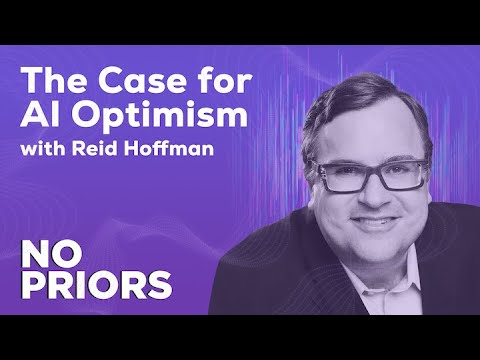
No Priors Ep. 45 | With Reid Hoffman
Sarah Guo (host), Reid Hoffman (guest), Elad Gil (host), Narrator
In this episode of No Priors, featuring Sarah Guo and Reid Hoffman, No Priors Ep. 45 | With Reid Hoffman explores reid Hoffman champions optimistic, human-centric AI amid doomer backlash Reid Hoffman frames modern AI as a “steam engine of the mind,” a transformation on par with or exceeding past industrial revolutions, and argues it will unlock massive gains in health, education, equity, and creativity. He criticizes AI ‘doomerism’ and miscalibrated regulation that foreground hypothetical x‑risk while ignoring near-term, concrete benefits such as tutors and medical assistants for billions. The discussion covers human–AI symbiosis, job transitions—especially for white‑collar workers—and why society must focus on using AI to solve the very problems it disrupts. Hoffman also explains the vision behind Inflection’s Pi: a personal, empathetic AI “personal intelligence” that reflects clear values, supports individuals’ real-life decisions, and embodies a constructive, opinionated worldview.
Reid Hoffman champions optimistic, human-centric AI amid doomer backlash
Reid Hoffman frames modern AI as a “steam engine of the mind,” a transformation on par with or exceeding past industrial revolutions, and argues it will unlock massive gains in health, education, equity, and creativity. He criticizes AI ‘doomerism’ and miscalibrated regulation that foreground hypothetical x‑risk while ignoring near-term, concrete benefits such as tutors and medical assistants for billions. The discussion covers human–AI symbiosis, job transitions—especially for white‑collar workers—and why society must focus on using AI to solve the very problems it disrupts. Hoffman also explains the vision behind Inflection’s Pi: a personal, empathetic AI “personal intelligence” that reflects clear values, supports individuals’ real-life decisions, and embodies a constructive, opinionated worldview.
Key Takeaways
Treat AI as a symbiotic amplifier, not just an autonomous replacement.
Hoffman stresses that many of the highest-value use cases will be “people plus AI,” where tools augment human cognition—like tutoring, research summarization, and creative assistance—rather than fully replacing humans.
Get the full analysis with uListen
Balance risk awareness with a clear vision of AI’s positive trajectory.
He argues critics often trumpet worst‑case scenarios without articulating desired futures or concrete paths to them, which can delay beneficial deployments like global medical and educational support.
Get the full analysis with uListen
Use AI to mitigate the disruptions it creates in the labor market.
The same systems that may displace roles (e. ...
Get the full analysis with uListen
White-collar workers should actively experiment with AI to stay relevant.
Hoffman advises professionals to treat AI like learning Excel in a previous era: start using tools on real problems that matter to you, discover where they’re strong or weak, and build competence now rather than resisting change.
Get the full analysis with uListen
AI systems inevitably embed values, so builders must be explicit and transparent.
He rejects the idea of value-neutral technology, arguing AI products should clearly state their normative stance—e. ...
Get the full analysis with uListen
Effective AI governance requires dialogue with builders, not top-down fantasy control.
Because small, focused teams actually create technology, Hoffman says attempts to ‘regulate before innovation’ or control AI via large committees misunderstand how tech is built and risk enshrining the past while sacrificing the future.
Get the full analysis with uListen
Personal AI companions like Pi could become a foundational user interface.
Inflection’s Pi is designed as a persistent, empathetic “personal intelligence” that helps users navigate everything from daily hassles to complex life decisions, modeling a future where everyone has a tailored cognitive partner.
Get the full analysis with uListen
Notable Quotes
“It’s somewhere between the largest tech transformation of our lifetime and perhaps the largest tech transformation of human history.”
— Reid Hoffman
“AI is the steam engine of the mind.”
— Reid Hoffman
“Anything that AI creates as a challenge, AI can also be part of the solution.”
— Reid Hoffman
“The critics think they’re virtuous because they trumpet danger, but by only trumpeting the negativity, you may be doing more harm than good.”
— Reid Hoffman
“Technology is built by small groups of people doing things. You just can’t have AI built by UN committee.”
— Reid Hoffman
Questions Answered in This Episode
How can policymakers encourage rapid deployment of beneficial AI (like tutors and medical assistants) while still addressing legitimate safety and misuse concerns?
Reid Hoffman frames modern AI as a “steam engine of the mind,” a transformation on par with or exceeding past industrial revolutions, and argues it will unlock massive gains in health, education, equity, and creativity. ...
Get the full analysis with uListen AI
What concrete steps should individual white-collar workers take in the next 12 months to future-proof their careers with AI?
Get the full analysis with uListen AI
How should AI companies decide which moral and political values to encode into their systems, and who gets a say when global cultures conflict?
Get the full analysis with uListen AI
What would an effective, innovation-friendly regulatory framework for AI actually look like in practice, given the pace of model development and deployment?
Get the full analysis with uListen AI
In what ways might personal intelligences like Pi reshape our notions of friendship, therapy, and decision-making over the next decade?
Get the full analysis with uListen AI
Transcript Preview
(music plays) Hi listeners, and welcome to another episode of No Priors. This week we're joined by my longtime friend and partner Reid Hoffman. He needs no introduction as co-founder of PayPal, LinkedIn, and now Inflection AI, as well as Microsoft board member and former OpenAI founding board member. He's a prolific author, podcaster, and political activist, and he's also one of my favorite technology optimists, big picture thinkers, and supporter of people and founders. Welcome Reid. Thanks for doing this.
Great to be here and love what you guys are doing and, you know, uh, longtime, uh, friends and partners with both of you. So this is awesome.
We will start with a small question, which is what is your view on the state of AI today? What do we need more of and less of?
Well, um, I mean the obvious thing about AI that everyone probably listening to this podcast already agrees with is that it's somewhere between the largest, you know, tech transformation of our lifetime and perhaps the largest tech transformation of, of, of human history. And one of the things I use to describe it is like steam engine of the mind. So just like the steam engine gave us physical powers, you know, kind of superpowers of, you know, construction and transport and manufacturing and a bunch of other things, this will give us a whole bunch of mental superpowers. It's both the implication of humanity, um, which is part of what the Impromptu book was gesturing towards. And also there will be some places where we will create, you know, kind of, um, uh, substitution, uh, replacement of work in various ways. And obviously we'll get into some depth on that. But I think that's the, the macro picture. And then with that of course there's tons of things that are current status and current needs, and you know, I think everyone tends to be a little bit over-predict like how quickly things like everything will change next year, and that's not gonna happen. Um, but then they tend to under-predict, you know, 10, 20 years, um, in some ways in terms of how the transitions. Although, you know, obviously because just like all technologies, the doomsayers come out first. Um, whether it's the printing press, electricity, everything else is like, "This is the end of the world." You can go back and you can find that this is the end of the world in each of these things. You know, the printing press was described as, as degrading human capabilities through cognition and spreading misinformation, um, as, as an example. And, um, but you know what I'd say that probably as an arc the thing that I would want to see more of in the... And that's part of the reason why I did Impromptu the way I did, in the creation, theorization, and the design of what we're doing in artificial intelligence is more in the kind of symbiotic, uh, amplification loop. We tend to as technologists say, "Well, I'm going to have autonomous vehicles and they're going to drive separately," which I think is a good thing in that case, uh, because I think, you know, you don't need an amplification loop. You just need, uh, effective logistics, you know, safety, uh, you know, save the 40,000 deaths that we currently have in, in human-driv- driven vehicles and so forth. You can go in depth in that if that's useful. But like, like the fact is there's gonna be a whole bunch of things that are actually going to be better with people plus, um, AI. That "plus" is a thing to focus on. And I think we haven't nearly as much, and that's of course part of the reason I wrote Impromptu.
Install uListen to search the full transcript and get AI-powered insights
Get Full TranscriptGet more from every podcast
AI summaries, searchable transcripts, and fact-checking. Free forever.
Add to Chrome