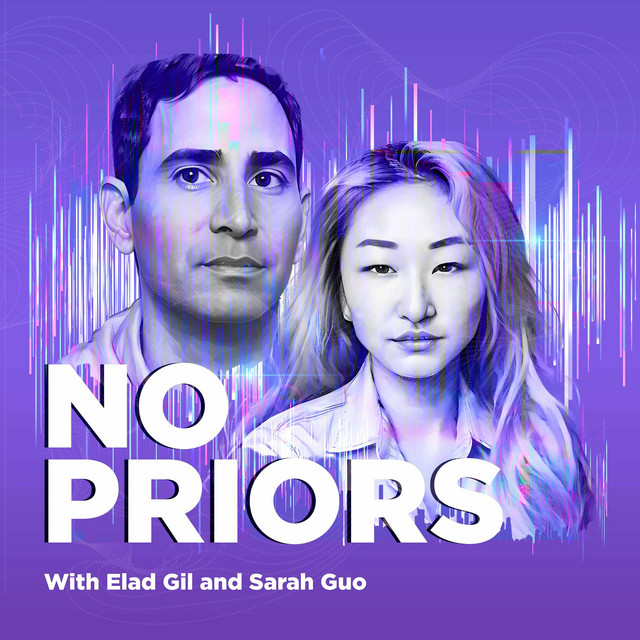
 No Priors
No Priors Ep. 20 | With Sarah Guo and Elad Gil
Sarah Guo on aI’s New Era: Misconceptions, Regulation Risks, And Startup Openings Explored.
In this episode of No Priors, featuring Sarah Guo and Elad Gil, No Priors Ep. 20 | With Sarah Guo and Elad Gil explores aI’s New Era: Misconceptions, Regulation Risks, And Startup Openings Explored Sarah Guo and Elad Gil discuss how current AI systems represent a fundamental architectural break from the last decade of machine learning, and why the market still largely misunderstands how early this wave is. They argue that calls for heavy-handed regulation, especially framed like nuclear oversight, risk stalling massive potential gains in global equity, healthcare, and education. The conversation explores enterprise adoption timelines, code generation as a leading beachhead, infrastructure bottlenecks like context windows and GPUs, and the geopolitical dynamics of China’s AI push under hardware sanctions. They close by mapping where incumbents will likely dominate and where new startups can still build defensible, AI-native products in core enterprise workflows.
AI’s New Era: Misconceptions, Regulation Risks, And Startup Openings Explored
Sarah Guo and Elad Gil discuss how current AI systems represent a fundamental architectural break from the last decade of machine learning, and why the market still largely misunderstands how early this wave is. They argue that calls for heavy-handed regulation, especially framed like nuclear oversight, risk stalling massive potential gains in global equity, healthcare, and education. The conversation explores enterprise adoption timelines, code generation as a leading beachhead, infrastructure bottlenecks like context windows and GPUs, and the geopolitical dynamics of China’s AI push under hardware sanctions. They close by mapping where incumbents will likely dominate and where new startups can still build defensible, AI-native products in core enterprise workflows.
Key Takeaways
Treat current AI as a new platform, not incremental ML.
Diffusion models and large language models enable chain-of-thought reasoning and synthesis capabilities that old convolutional/RNN-based systems never had, so assumptions and playbooks from the last ML decade no longer fully apply.
Enterprise adoption is early; don’t misread the six‑month timeline.
ChatGPT and GPT‑4 only became widely visible months ago, so large organizations are still in their first planning cycles; slow visible rollout does not imply lack of substance or that AI is ‘just hype.’
Overzealous regulation could cripple beneficial AI progress.
Drawing analogies to nuclear oversight, they warn that rigid regulatory regimes can freeze innovation for decades, undermining AI’s potential to dramatically improve global equity in healthcare, education, and access to knowledge.
Code generation is a leading, but still early, AI success story.
Tools like GitHub Copilot show real productivity and revenue impact, yet future systems will go far beyond autocomplete—handling repo-wide context, issue-to-PR flows, and richer, context-aware development workflows.
Context window size won’t magically solve product problems.
Even as token windows grow to hundreds of thousands or more, naive ‘just dump everything into context’ strategies fail; product advantage will come from how efficiently teams structure, prioritize, and feed information into models.
China will likely build its own AI and hardware stack.
Sanctions on NVIDIA GPUs are spurring domestic investment in accelerators and AI platforms (e. ...
Incumbent AI features narrow some spaces but open others.
Big Tech will embed AI into core suites over 12–24 months, squeezing undifferentiated startups, yet AI also lowers integration and customization costs—creating rare opportunities to challenge entrenched systems like CRM, ERP, and other dense enterprise platforms.
Notable Quotes
“People are prematurely assuming this is just a continuum from before, and therefore there's nothing new here, and I just think that's wrong.”
— Elad Gil
“Once the Nuclear Regulatory Agency existed, we had no new nuclear designs approved for the last 50 years.”
— Elad Gil
“The idea that you don't want to give this to as broad an audience as possible, when it is so cheap to offer some flawed representation of knowledge, to me is ridiculous.”
— Sarah Guo
“Context will expand to fit the window.”
— Sarah Guo
“You could almost measure the rapidity with which somebody adopts this technology as a metric of management competence.”
— Elad Gil
Questions Answered in This Episode
If current AI is fundamentally different from past ML, what core assumptions from older data science and ML practices should enterprises explicitly discard?
Sarah Guo and Elad Gil discuss how current AI systems represent a fundamental architectural break from the last decade of machine learning, and why the market still largely misunderstands how early this wave is. ...
Where is the line between necessary safety regulation and the kind of misregulation that could stall AI’s positive impact for decades?
How might product design and engineering workflows change once code-generation agents can reliably handle full repositories and issue-to-PR pipelines?
What strategic choices should U.S. and European policymakers make, knowing that China is likely to build a parallel AI and hardware stack regardless of sanctions?
For startups building on top of AI, how can they design products and moats that remain defensible once incumbents fully roll out their own AI-infused suites?
EVERY SPOKEN WORD
Install uListen for AI-powered chat & search across the full episode — Get Full Transcript
Get more out of YouTube videos.
High quality summaries for YouTube videos. Accurate transcripts to search & find moments. Powered by ChatGPT & Claude AI.
Add to Chrome